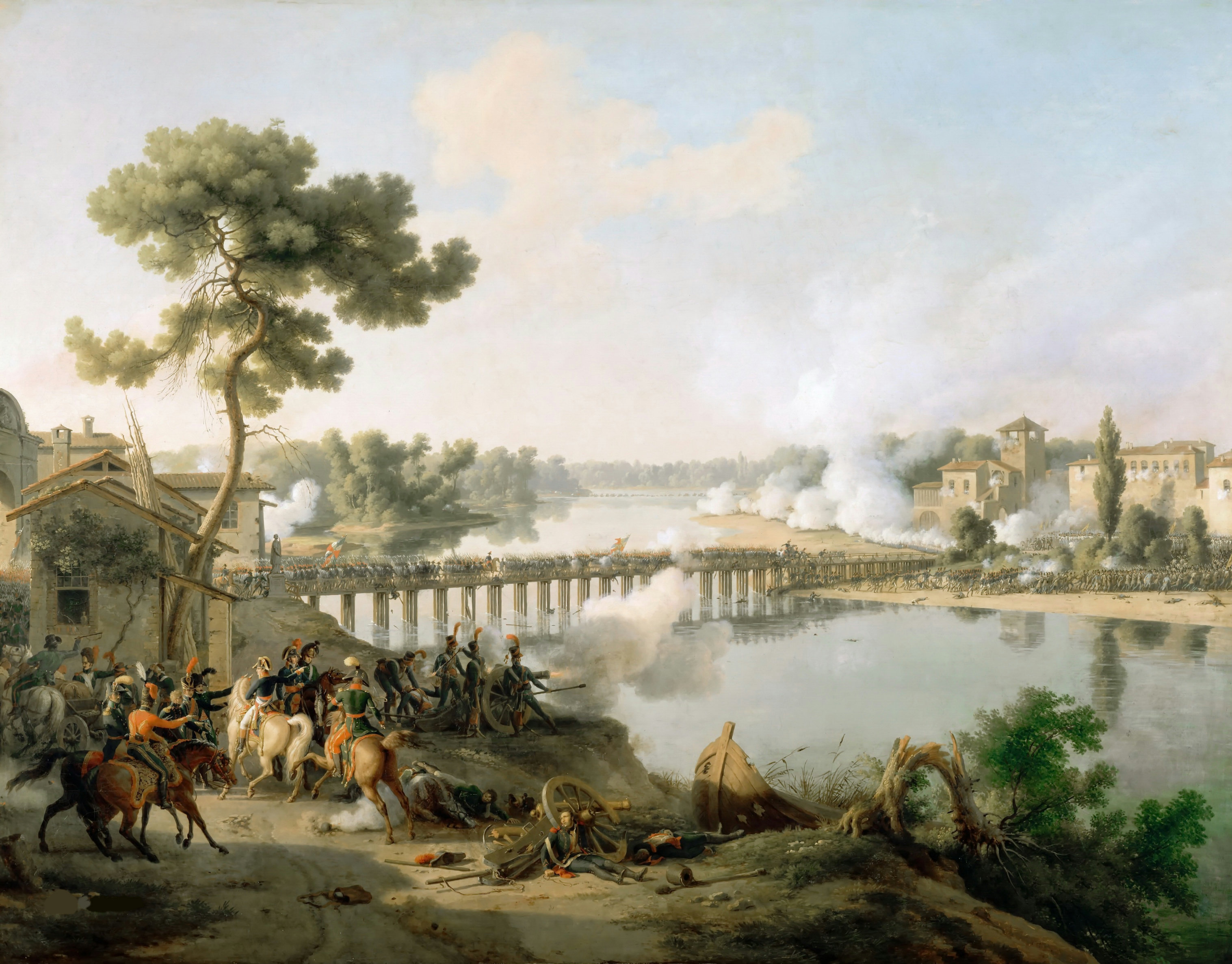
From the noon arrival to the evening decision, the whole affair lasted six and a half hours; the decisive storming of the bridgehead took barely thirty minutes—the kind of skirmish military textbooks dispose of in a single page. Against the 9,500 men of the Austrian rearguard holding the bridgehead, the French assault column that actually charged the bridge numbered just 3,500–6,000: the attacker was locally outnumbered. Why, then, is this one fight the engagement that Napoleon himself named when he said "it was here that I realized my own destiny"[6]?
What Napoleon discovered in this battle was a method for designing the battlefield victory and its narrative at the same time. That prototype runs through everything in the empire that followed.
1. The essentials
- Date
- 10 May 1796noon to dusk
- Place
- LodiRiver Adda, present-day northern Italy
- Belligerents
- France vs AustriaWar of the First Coalition
- Result
- French tactical victory→ on to Milan
Strength (total reaching the field)
Fr about 1.6×
Local strength in the bridge assault
Au about 2× (local edge)
Guns
Fr 1.5–2×
Casualties
Fr lost about 3× fewer
| Role | France | Austria |
|---|---|---|
| Supreme command | 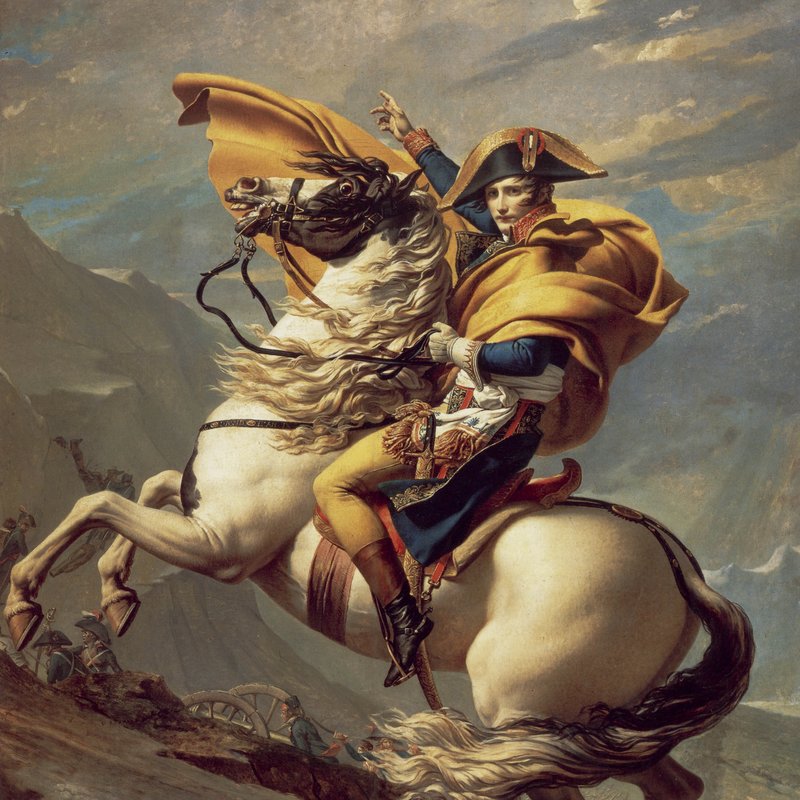 NapoleonGeneral, 26 NapoleonGeneral, 26 |
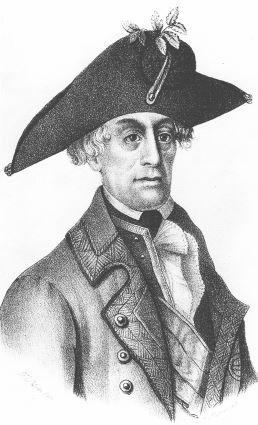 J.P. Beaulieu70, not present J.P. Beaulieu70, not present |
Note: for staff and field commanders, see §3 Terrain and dispositions.
2. Strategic background: Lodi within the First Italian Campaign
For the French Directory in 1796, Italy was a secondary front. The main theater lay along the Rhine in Germany, where the best troops were entrusted to Generals Jourdan and Moreau, while Italy was handed to a young, unknown general—Napoleon (still called "Bonaparte" in France at this period)—and thirty thousand men so ill-equipped they lacked shoes, posted there "for budgetary reasons."
Yet the Po plain was strategically exceptional. The Milan–Venice corridor was the financial and material artery of northern Italy, the only direct overland route to the Austrian heartland, and a hub of influence over the Papal States and Tuscany. Napoleon understood this geometry and, from the outset, harboured the ambition of turning a secondary front into the main line of strategy.
In April, in just three weeks, he knocked the Kingdom of Piedmont out of the war; the Armistice of Cherasco narrowed the campaign down to Austria alone. What remained was the Austrian Army of Italy under Beaulieu.
Beaulieu chose to avoid a decisive engagement and instead conduct a staged withdrawal to preserve his main body. He used the Po, and then the Adda, as defensive lines, leaving Sebottendorf's rearguard to buy time while he pulled the main force back into north-eastern Lombardy.
The action at Lodi was, in origin, no more than a delaying fight within that retreat[5]. There was no need to force the bridge head-on: a few days spent finding a ford upstream would have closed the gap. As several historians point out, Napoleon deliberately chose to storm it. That choice defines the character of the battle.
3. Terrain and dispositions
The Adda flows north–south along the eastern edge of the town of Lodi, and the only crossing was a narrow timber-pile bridge about 200 m long linking the town with the far bank. At the bridgehead—the bridge's exit on the far bank—14 to 20 Austrian guns (sources vary) were massed, covering the entire length of the bridge with a line of direct fire.
The west bank (the Lodi side) carried a slight rise of ground, and this became the firing position for the French artillery. The east bank was open farmland, easy for deploying infantry but fully visible to the French guns.
And on this firing position on the western heights stood the 26-year-old Napoleon himself[2]. A commander placing himself with the gun line on the front edge—when the "correct" image of a general of the day was to issue orders from a safe headquarters in the rear—was something the rank and file witnessed; within days they began to call him the "Little Corporal" (le petit caporal) (detailed in §7). That the decision about the battlefield's layout was at the same time a decision about where the general's own body would stand is what defines Lodi.
French army (vanguard, Army of Italy)
-
Supreme command
Napoleon Bonaparte (General, 26)
-
Head of the second wave
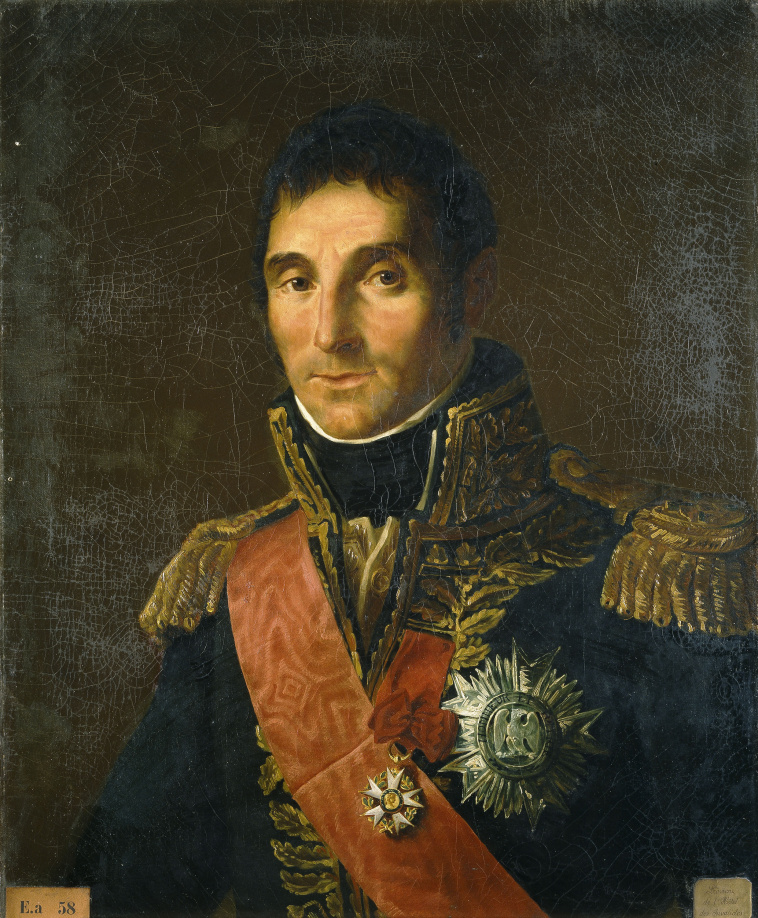 André Masséna (Divisional general, 38)
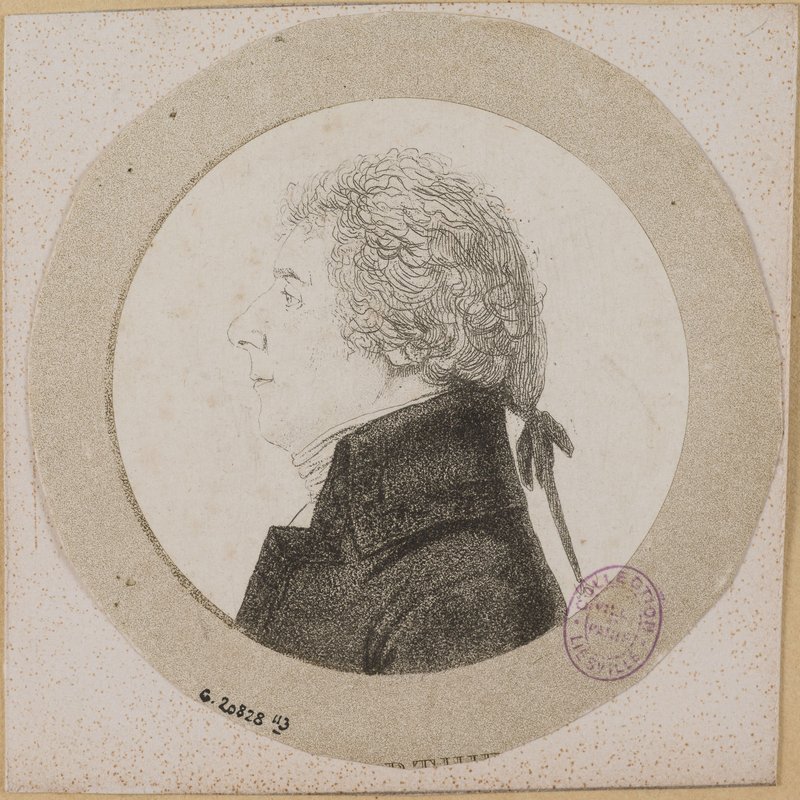 Louis-Alexandre Berthier (Chief of staff, 42)
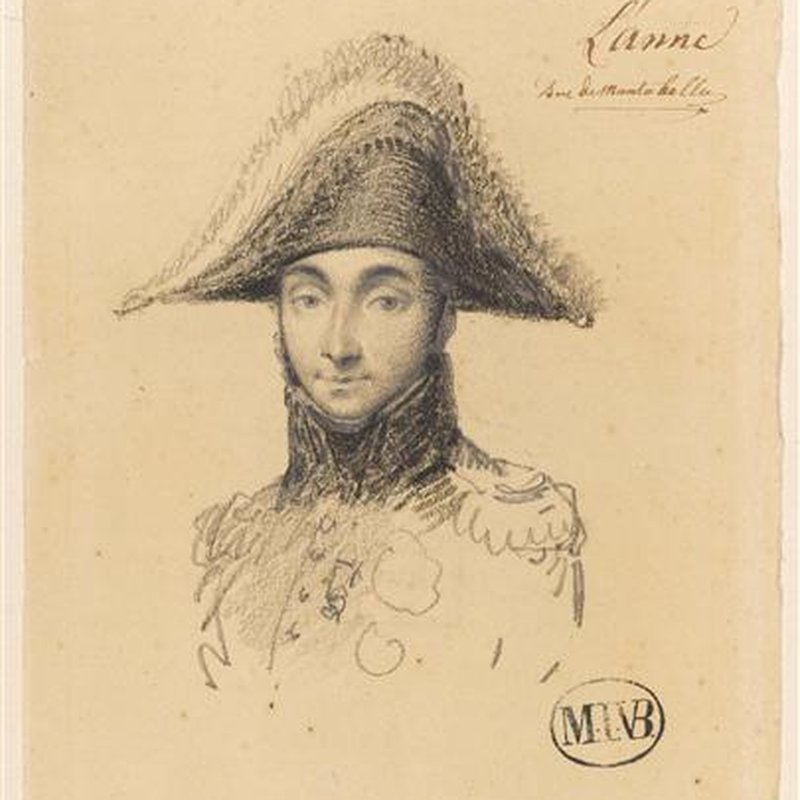 Jean Lannes (Led the second wave, 27)
-
Cavalry detachment (upstream crossing attempt)
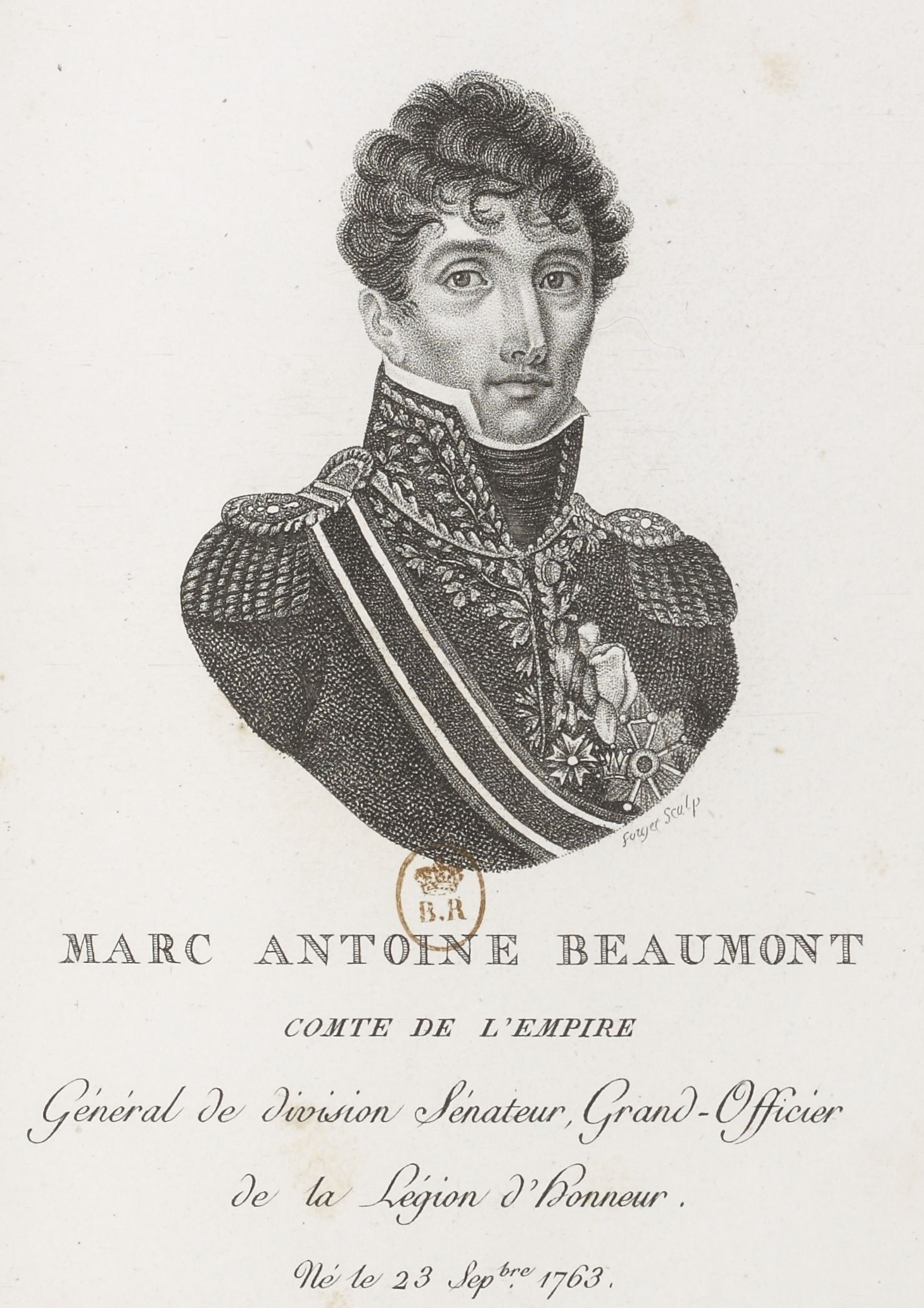 Marc-Antoine de Beaumont (Cavalry divisional general, 32)
Austrian army (rearguard)
-
Commander-in-chief (absent)
 J.P. Beaulieu (withdrawing eastward with the main force)
-
Field command
K.P. Sebottendorf (rearguard of 9,500, 14–20 guns)
4. Course of the battle (four phases — click through the map)
By 9 a.m. the advance guard had made contact with the Austrian rearguard in the town of Lodi. By the time Napoleon reached the field with the main body at noon, the rearguard was already deployed on the east bank, with 14–20 guns massed at the bridgehead and the whole length of the bridge within range.
At 3 p.m. 24 guns were concentrated on the western heights, shutting down the Austrian attempt to demolish the bridge (the 6 added at the bridge entrance appear in only some sources). Inside Lodi, an assault column of 3,500–6,000, mostly grenadiers, was formed up.
At 6 p.m. the grenadier column rushed the bridge. The leading ranks reached about the middle but, caught in concentrated canister from the east-bank guns, were driven back. The order then went out for senior officers themselves—Masséna, Berthier, Lannes—to lead the second wave from the front.
At 6:30 p.m. the second wave, led in person by the officers, crossed the bridge and established a bridgehead on the east bank. The Austrian cavalry tried to counter-attack, but the French troops following over the bridge pushed them back. With the bridgehead secured, Sebottendorf, to avoid a rout, ordered an orderly withdrawal. Beaumont's cavalry, held up by the difficult upstream crossing, arrived too late for the fight or the pursuit (the major sources agree).
Note: click the map to enlarge it.
5. Analysing the tactical structure: why the bridge assault worked
Storming a 200-meter timber bridge head-on is, as a rule, a reckless operation. The bridgehead guns can fire directly down the entire length of the bridge, while the attacker, hemmed in by its narrowness, cannot concentrate his fire (he can only press forward in column). In a straight contest of strength, it could never succeed.
The reason it worked at Lodi is that four structural elements came together at the same time.
Asymmetric concentration of artillery
The French massed 24 guns right alongside the bridge (the western heights). Some sources add a further 6 at the bridge entrance. Either way, the arrangement met two needs at once: the suppressing fire that prevented any attempt to demolish the bridge, and the counter-battery fire that traded shots with the Austrian guns at the bridgehead.
The choice of timing
The assault went in at 6 p.m. (with about two hours to sunset in Lombardy), an arrangement that put pressure on the French themselves to force a quick decision. As it happened, this coincided with the moment when the defenders, in the midst of preparing their withdrawal, were beginning to relax the cohesion of their formation, which amplified the effect (whether by deliberate calculation or by chance cannot be settled from the sources).
Breakthrough momentum from commanders at the front
After the first wave was repulsed, Masséna, Berthier and Lannes took the head of the second wave in person. A means of using the commanders' own bodies as collateral for the cost of the breakthrough, forcing the men's resolve back to life.
The "pressure" of the upstream bypass
Beaumont's crossing attempt was delayed and never reached the field, so it made no direct contribution to the day's outcome. But the very framework of forcing the enemy to worry about front and flank at once very probably weighed on the Austrian rearguard as a psychological burden in its handling of the formation (whether it actually blunted the concentration of fire cannot be settled from the sources).
To put it another way, at Lodi Napoleon did not "cross the bridge"; he "created the conditions under which the bridge could be crossed." This is the most primitive prototype of the "situation-design" thinking that reaches completion at Austerlitz.
And what matters is how contingent it was that these four elements lined up at once. Take away any one of them and the assault fails—and it is precisely that fragility that the counterfactual simulation (§8) examines. Lodi keeps its place in the casebooks of tactical history not because it was a perfect victory. It is because it is a rare battle in which one can see, laid out as a set of four simultaneous conditions, just how unlikely it is that the conditions a victory needs will all coincide.
6. The "limits" of the strategic result
A fact many historians point out: Lodi did not destroy Beaulieu's main force[1][3]. The rearguard's losses of about 2,000 were a blow, but the Austrian main body of some 30,000 withdrew eastward intact and went on resisting for a year and a half from the line of the Mincio and the fortress of Mantua. Over that period Vienna entrusted relief armies to a succession of generals—Wurmser, Alvinczi and others—committing a cumulative total of nearly 100,000 men to the Italian front.
And, more cuttingly still, Napoleon could have won without choosing to storm it[1]. Beaulieu had already issued his orders to withdraw, and a few days' wait would have left the Lodi bridge undefended. Finding a ford upstream and going round it would, in all likelihood, have delivered the same strategic result (the surrender of Milan) without paying the price in blood.
The reason Lodi is nevertheless treated as important lies not in its military result but in its political and psychological effect.
In the days after the battle, 11–14 May, the Austrians abandoned Cremona and Pavia in quick succession. On 15 May the French army entered Milan, and the whole of Lombardy passed under French control. On the surface it looks as though "Lodi opened the door," but as noted at the head of §6, this was a sequence that followed the withdrawal plan Beaulieu had already issued—an outcome that would have come about even without Lodi. The main theater of the campaign then shifted to the Mincio and Mantua, and the siege of Mantua (June 1796 – February 1797) became the true focus. The series of battles against the relief armies of Wurmser, Alvinczi and others ran on for a year and a half after Lodi.
In other words, Lodi is closer to a case in which a strategic chain reaction happened to attach itself to a limited tactical result than one in which a tactical victory set off a strategic chain. And it is here that Napoleon's own stagecraft is laid over the top.
7. The other victory: the birth of the "Little Corporal"
After Lodi, it is said, a habit grew up among the soldiers of calling Napoleon le petit caporal (the Little Corporal). Accounts of the origin differ, but the version widely in circulation holds that it was a mark of respect from the rank and file for the fact that Napoleon had taken the aim of a gun himself and stood in the danger zone alongside the men.
Researchers such as Chandler, however, point out that contemporary evidence for the name being coined on the field that day is thin[2]. The myth has, rather, a strong element of having been deliberately constructed by Napoleon himself in his reports back to Paris. In the memoirs he dictated later on St Helena, too, the gist that "at Lodi I first realized I could become something more than an ordinary general" is repeated[6].
Here is the structure worth noticing. A victory that was, in military terms, limited, Napoleon turned thoroughly into narrative and converted into political capital:
- In his report to the Directory in Paris, he dramatised the boldness of his own command and his numerical inferiority
- He circulated a heroic account for the newspapers
- He spread episodes that stressed his closeness to his soldiers (taking a gun's aim, appearing in the danger zone)
The painted propaganda of the later Battle of Arcole (1796)—"Napoleon crossing the bridge with the flag in hand"—is likewise an extension of the pattern learned at Lodi.
Seen from this angle, the essence of Lodi can be restated as follows: Lodi was the first battle in which Napoleon learned to run the battlefield action and the design of the narrative in parallel. It is not a tactical masterpiece. But as the birthplace of a method for producing two victories at once, it shaped everything in the empire that followed.
7-1. How the "Little Corporal" myth spread
Word of mouth begins on the field
Within the units that crossed the bridge, the story spreads that "the general too came up to the gun line"
The official report is dispatched to Paris
Written to stress the boldness of command, the numerical inferiority, and the closeness to the men
It reaches Paris and the press
The report is carried in the official gazette Le Moniteur Universel and other papers, and the image of the young general begins to circulate
Set down in writing in the memoirs on St Helena
He dictates: "On the night of Lodi, I realized I bore a special destiny"[6]
Fixed as the origin point of the Napoleon legend
The later imperial biographies, paintings and songs all take "the general from Lodi onward" as their premise
8. Counterfactual simulation
Of the four elements named in §5 (concentrated artillery, timing, commanders at the front, the upstream bypass), we examine the three changes that produce the most "qualitatively different" results. A reverses the decision itself (the upper premise of all four elements); B removes element ③; C removes element ①. Elements ② and ④ have no decisive effect on their own (see §5 in the body), so no separate branch is set up for them.
| Branch | Tactical result | Long-term effect on the empire |
|---|---|---|
| A: Do not storm; wait to go round | A ford is found upstream a few days later. The 1,000 casualties never occur. The entry into Milan is delayed by one or two weeks, but the tactical result is the same. | He is regarded as a cautious general, and the bond with his soldiers is formed in some other battle. But with the first mythic victory delayed, the tempo of his heroising slows. After the failure of the Egyptian expedition in 1799, he is likely to hesitate over the coup of 18 Brumaire. Even if he carries it out, his pull is weaker and he is politically frozen not as First Consul but as one consul in a collegial body. The accession to emperor either never happens or happens at someone else's hand. |
| B: The officers do not lead the second wave forward | The second charge, too, is most likely repulsed. With morale broken, the assault fails. From the next day on, the bypass still brings him to Milan itself. | In the eyes of his soldiers the general is "the reckless one." At the negotiation of the Treaty of Campo Formio in 1797 his political weight as a general declines, and the verdict of "able but dangerous" sets hard. The Directory does not regard Napoleon as a threat, and he, in turn, loses the motive to rush at seizing power. The Egyptian expedition still goes ahead, but he is unlikely to make the political gamble after his return. |
| C: The Austrian guns (14–20) are spread out | With the density of fire at the bridgehead reduced, the first wave may get across the bridge. He wins, but without drama, and the battle drags out. | However flamboyantly the report is written, the material is thin, and the raw material for myth-making falls decisively short. Without the dramatic reversal at Arcole, the propaganda machine itself never starts up in 1796. His standing as a "military populist" against the Directory is not established, and the road to empire is fundamentally altered. Several years' delay before he can build the myth afresh in some other campaign. |
What can be seen across all three: without Lodi, the rise of Napoleon the emperor would, in all likelihood, have been greatly delayed, or taken a different shape in a different context. The narrow bridge, the concentrated enemy fire, the advancing commanders, the numerical disadvantage—unless these coincide, there is not enough raw material for myth-making. It is even possible that Napoleon himself sensed this structure (whether consciously or by instinct is another matter) and chose to storm the bridge accordingly (though the outcomes of a counterfactual cannot be proven, and this section is no more than a thought experiment that makes the dependencies among the elements visible).
9. Lessons for today
The lesson Lodi offers the reader today lies less in the military sphere than in a leadership structure that designs action and narrative at the same time.
- Choosing the symbolic act: the judgement to deliberately choose an act that—while not the shortest rational route—rewrites the cognitive map of those around you.
- The commander's physical involvement: the effect of a leader standing physically at the hardest point of the organization.
- Assigning meaning after the fact: designing not only the result but also the way the result is told.
Long-term result: set down in the St Helena memoirs as a "realization of destiny" → fixed as the origin point of the imperial legend
9-1. Mapping it onto modern cases
Steve Jobs's launch of the first iPhone (January 2007, Macworld) is the structure of Lodi itself. A flamboyant challenge chosen (a latecomer's entry into the mobile-phone industry) + the commander's physical involvement (Jobs demonstrating it himself in a 90-minute presentation) + meaning assigned after the fact (the repeated keyword "reinvent"). Technically it was a mobile version of OS X, but the design of the presentation lifted it into a symbol of generational change.
SpaceX's successful landing of the Falcon 9 first stage (December 2015) fits the same pattern. Recovering the rocket was not a technical necessity but a "choice to show"; Musk shared the emotion on the live stream and thereafter placed the narrative of the "reusable rocket" at the core of the company's brand. More than the engineering significance of the landing itself, the fact of showing it rewrote the cognitive map of NASA and of Elon's fans.
And the precedent from outside tech whose structure overlaps most closely is Mahatma Gandhi's "Salt March" (March 1930). In defiance of the salt monopoly of British India, the 60-year-old Gandhi undertook a 24-day, 385-km march on foot, and at the Dandi coast picked up a handful of salt. What matters is that he designed the narrative in parallel with the act itself—ten days before the march he sent an open letter to the Viceroy, Lord Irwin; he invited the world's press (American correspondents especially); and he published the march route, village by village, in advance. The government of British India, faced with a "story it could not win however it cracked down," was slow to respond, and that very slowness eroded, over the long term, the story of the legitimacy of imperial rule. In war, in a corporate launch, in a political movement, the structure is identical.
There is no evidence that the three cases consciously referred to Lodi. Yet the structure matches completely—the judgement to make a flamboyant choice, the choice to stand in the front rank oneself, and the design that puts it into circulation as a narrative. 1796 (Lodi), 1930 (the Salt March), 2007 (the iPhone), 2015 (Falcon 9)—across 230 years, across fields and cultures, the same method is reproduced.
Conclusion: Lodi is the origin not of tactical history but of the history of a method
As a finished piece of tactics, the action at Lodi is small. But seen as the birthplace of the very idea of running the battlefield action and the design of the narrative in parallel, it becomes the far-reaching starting point of the whole Napoleon empire—and of modern leadership after it.
It is not a battle in which the enemy was annihilated. Nor one in which his own side was annihilated. It is the battle in which he constructed his own sense of destiny—and we should read it this way: from the moment, on the evening of 10 May 1796, that the 26-year-old general got his men all the way across that 200-meter bridge, the modern "grammar of leadership" began to move.
FAQ
It took place on 10 May 1796 at the timber bridge over the River Adda in Lodi, in present-day Lombardy, Italy. The French Republic's Army of Italy, under Napoleon Bonaparte, faced an Austrian rearguard under Sebottendorf in a crossing battle.
In purely military terms it was a small engagement of limited significance. The major sources (Britannica, Chandler, napoleon.org and others) agree that the Austrian main force withdrew eastward intact, and that the French could probably have gained the same strategic result — the entry into Milan — without bloodshed by going round upstream.
A widely circulated account holds that it was an affectionate name given by the rank and file to Napoleon, who took the aim of a gun himself. But researchers such as Chandler note that contemporary evidence for it arising on the battlefield that day is thin, and the legend owes much to Napoleon's own deliberate construction in his reports back to Paris.
Lodi (May 1796) was a tactical victory won by storming a bridgehead, while Arcole (November 1796) was a three-day battle of maneuver over a marsh causeway. Arcole was turned into a grand painting by Gros showing Napoleon racing across the bridge with the flag, whereas Lodi, though it has a documentary picture, never became a symbolic propaganda canvas. Through both, Napoleon established a method of running the battlefield victory and the design of its narrative at once.
No. Napoleon ordered Beaumont to cross a ford upstream, but the crossing was in poor condition and his arrival on the field was badly delayed. The major sources (napoleon-series.org and others) agree that Beaumont was too late for both the fight and the pursuit. The framing of a flank threat may have weighed psychologically on the Austrian rearguard, but any direct effect on the concentration of fire cannot be settled from the sources.
The timber bridge of 1796 was later replaced after floods and decay and no longer exists. The bridge over the Adda on the east side of Lodi today is a stone-and-iron one rebuilt in the 19th century or later, a different structure from the roughly 200 m timber-pile bridge shown on the map. The city of Lodi keeps a monument and museum displays commemorating the battle, and a small ceremony is held on the anniversary (10 May).
In purely military terms, the casualties of this battle were a sacrifice that going round could have avoided. The reason Napoleon nonetheless chose to storm lies in the need for narrative analyzed in the article: a vivid story of pushing back a numerically superior enemy could be spent as political capital in Paris, whereas a bloodless victory by detour gives a report or a newspaper nothing to write about. The coldness of converting soldiers' lives into raw material for a symbolic victory became the template for the war management repeated across the later empire.
He says so plainly in his St Helena memoirs (recorded by Las Cases in 1823), but no contemporary evidence exists. The reports and letters of 1796 contain no such self-reference, and it is most likely a later self-narration produced after a string of defeats (Russia 1812, Waterloo 1815). The major sources (Chandler and others) treat the self-discovery at Lodi not as fact but as a construction in hindsight. The quotation at the head of the article should therefore be read not as what he really thought that night but as how he later positioned it.
Claims and Sources
- Encyclopædia Britannica. Battle of Lodi | Napoleon Bonaparte, Austria, Lombardy, Encyclopædia Britannica. [link]
- David G. Chandler(1966). The Campaigns of Napoleon, Macmillan.
- J. Rickard(2009). Battle of Lodi, 10 May 1796, historyofwar.org. [link]
- The Napoleon Series. The Campaign in Italy, 1796-97: Lodi. [link]
- Harrison W. Mark(2023). Battle of Lodi, World History Encyclopedia. [link]
- Emmanuel de Las Cases(1823). Mémorial de Sainte-Hélène. [link]