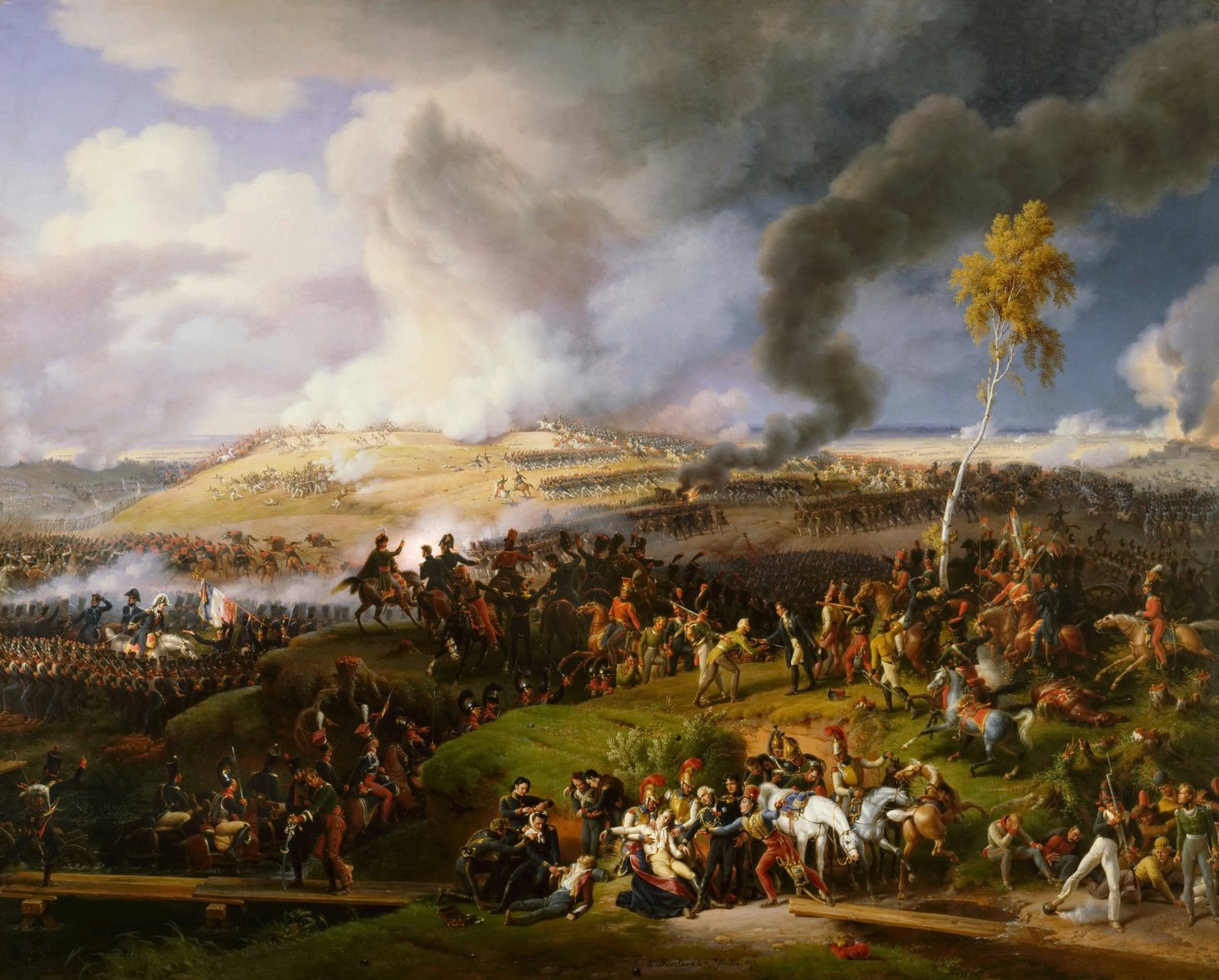
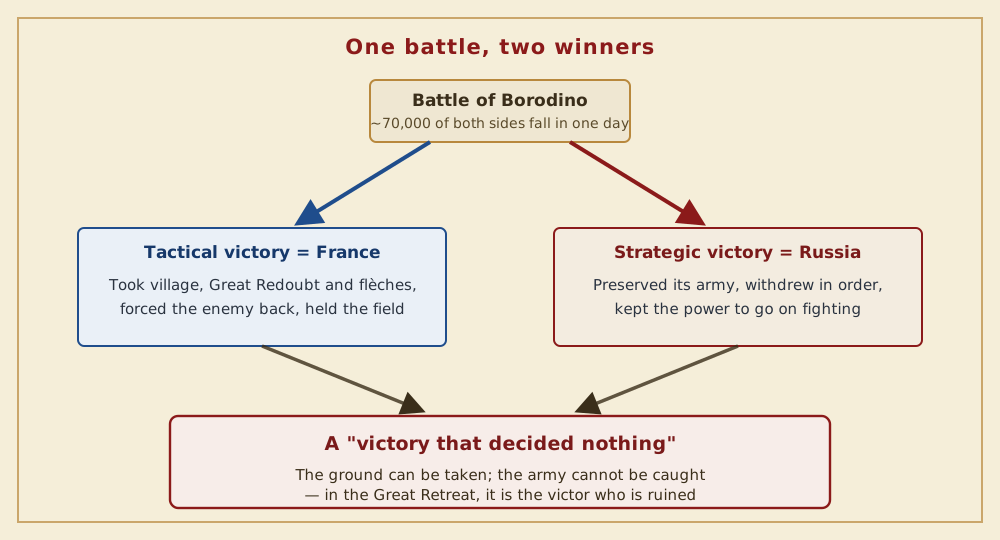
On 7 September 1812, at Borodino just short of Moscow, Napoleon finally caught the Russian army that had eluded him for months. In a single day some 70,000 men of both sides fell — the bloodiest single day of the Napoleonic Wars. The French seized the positions and won the battle on tactical terms. Yet the Russian army escaped destruction and withdrew in good order. Neither the lure of Austerlitz nor the mass of Wagram produced a decisive victory here. Borodino is the battle in which the winner was ruined. To take the ground and lose the war — tactical victory and strategic catastrophe split cleanly apart on this one day.
1. Key Facts
- Date
- 7 September 181226 August, Russian calendar
- Location
- Village of Borodino~120 km west of Moscow
- Combatants
- France vs. RussiaRussian campaign
- Result
- French tactical victory (no strategic payoff)→ occupation of Moscow, the Great Retreat
Note: in this article the French army is shown in blue and the Russian army in red.
Strength (regular field army)
roughly even
Artillery
Ru slight edge
Casualties (one day / killed and wounded)
~70,000 combined — the worst single day in history
| Role | France | Russia |
|---|---|---|
| Supreme command | 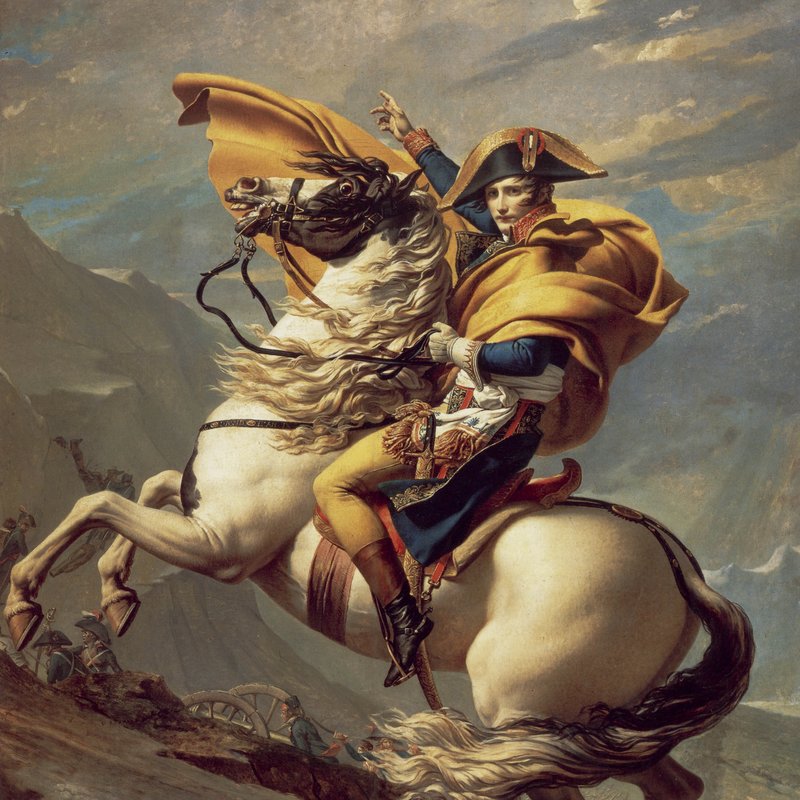 NapoleonEmperor, age 43 NapoleonEmperor, age 43 |
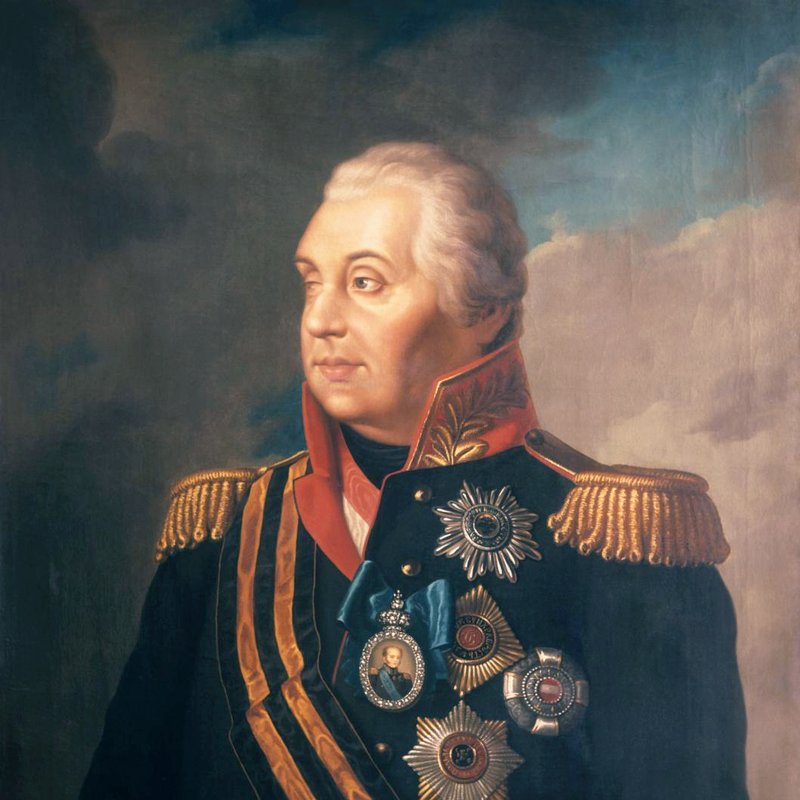 KutuzovRussian C-in-C, age 66 KutuzovRussian C-in-C, age 66 |
Note: for the corps-level command structure, see §3, The Two Armies. Kutuzov's birth year is given as either 1745 (age 66) or 1747 (age 64).
2. Strategic Background: A Fleeing Enemy and an Emperor Who Wanted a Decision
In June 1812, Napoleon invaded Russia with the largest army ever assembled. The Russians, however, refused to give battle: under Barclay de Tolly they kept up a strategy of withdrawal and scorched earth. They burned villages, cut supply, and drew the French ever deeper inland. It was the correct strategy, but a retreat that let the enemy trample more and more of Russia's own soil enraged public opinion and the nobility. Tsar Alexander I dismissed Barclay — of Scottish descent and sneered at as "the German" — and handed supreme command to the thoroughly Russian Kutuzov[3].
Here lay an asymmetry in the two sides' aims. What Napoleon wanted was "a decisive victory that would destroy the enemy army and force a peace." Kutuzov, for his part, privately understood that Barclay's policy of attrition was sound. His real aim was not to hold ground but to keep his army alive. Public opinion made one battle unavoidable — but the army must not be destroyed. Kutuzov took up a position at Borodino, astride the road to Moscow.
Two days before the battle, on 5 September, the French stormed the Shevardino redoubt in front of the Russian left after a hard fight. With it gone, the Russian left lost its anchor and fell back to the line of arrowhead-shaped earthworks thrown up around the village of Semyonovskoye behind it — Bagration's flèches. But those two days of resistance had also bought the Russians time to entrench[5].
3. The Two Armies and the "Line of Earthworks"
French and Allied Army
-
Supreme command
Napoleon (Emperor, age 43 / unwell)
-
Center & right (main effort)
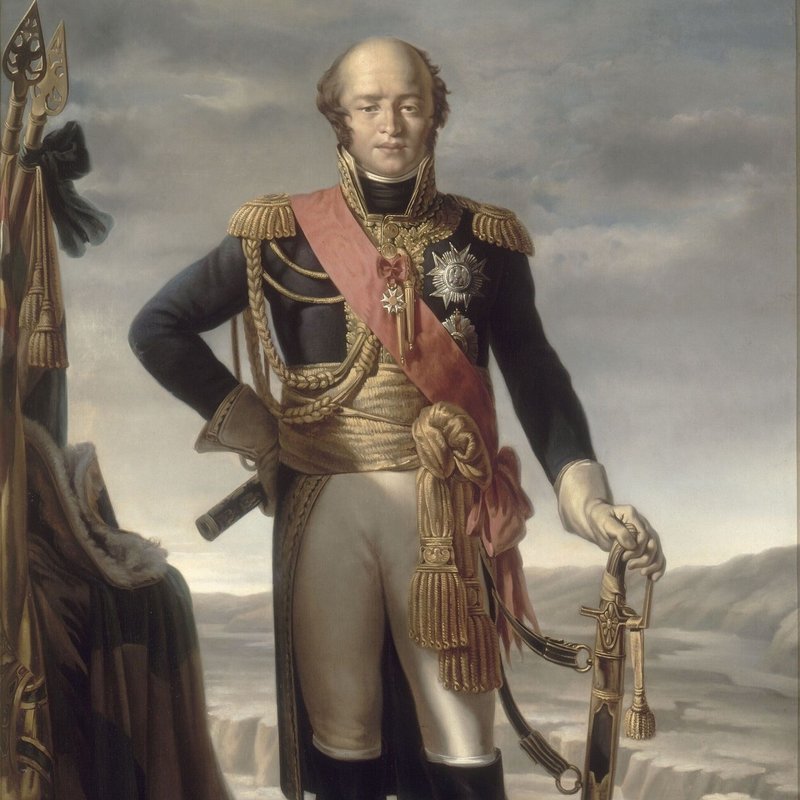 Davout (I Corps, age 42 / flèches / unhorsed, knocked out)
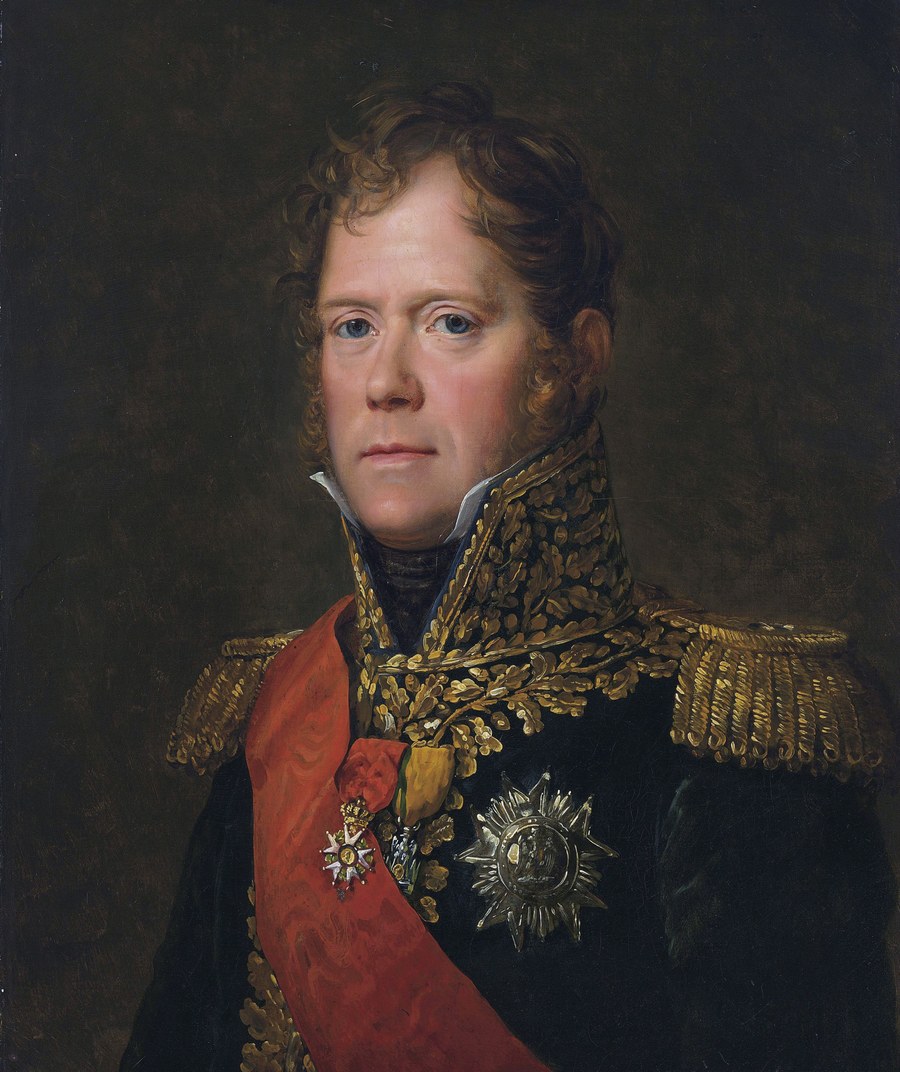 Ney (III Corps, age 43 / flèches)
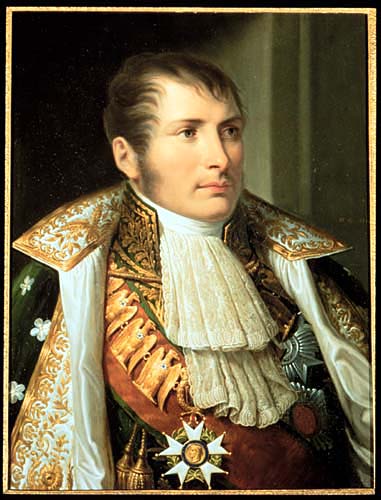 Eugène (IV Corps, age 31 / Borodino village, Great Redoubt)
-
Cavalry & south wing
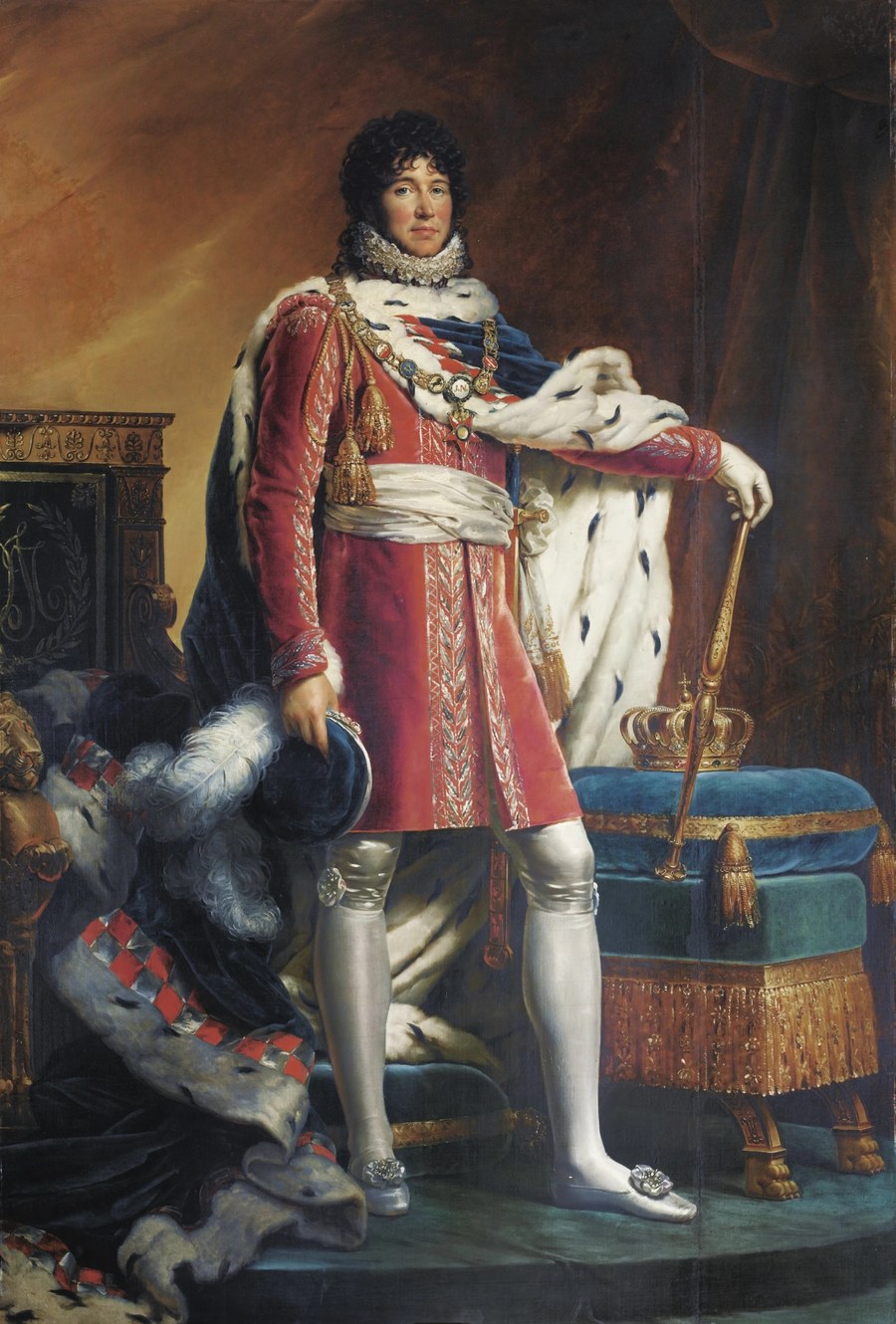 Murat (Cavalry Reserve, age 45 / urged committing the Guard)
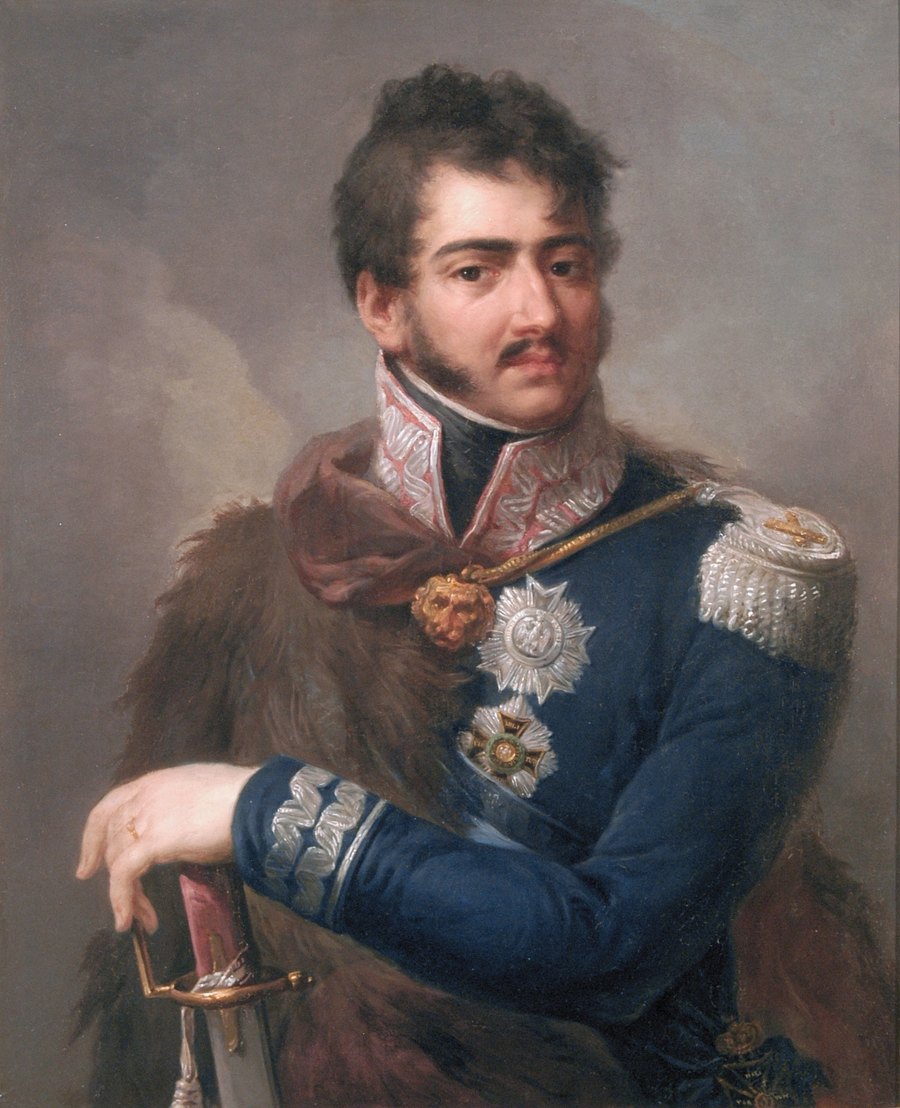 Poniatowski (V Corps, age 49 / south wing at Utitsa)
Russian Army
-
Supreme command
Kutuzov (C-in-C, age 66 / directed from Gorki in the rear)
-
Right & center (First Army)
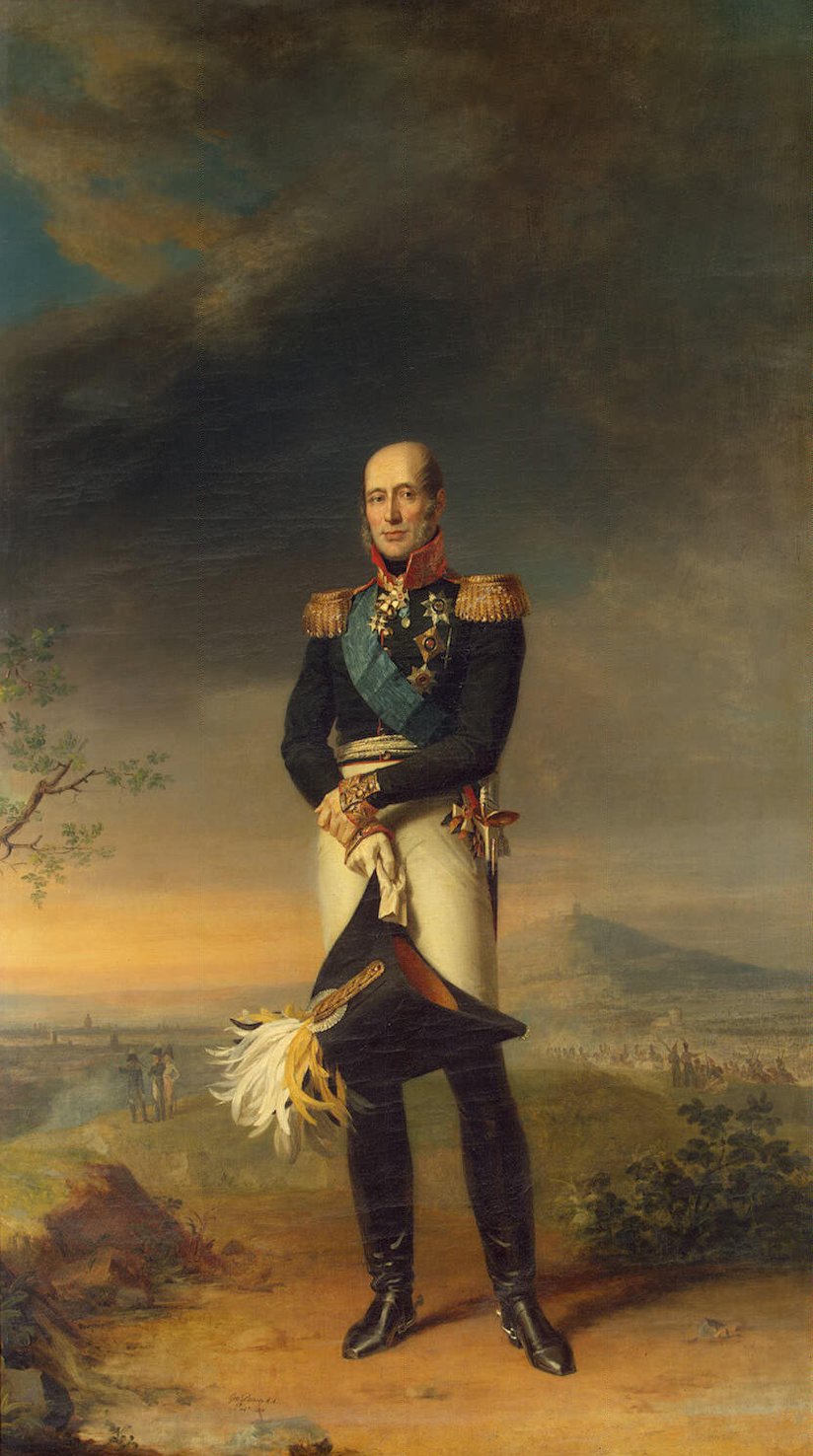 Barclay de Tolly (First Army, age 50 / former C-in-C)
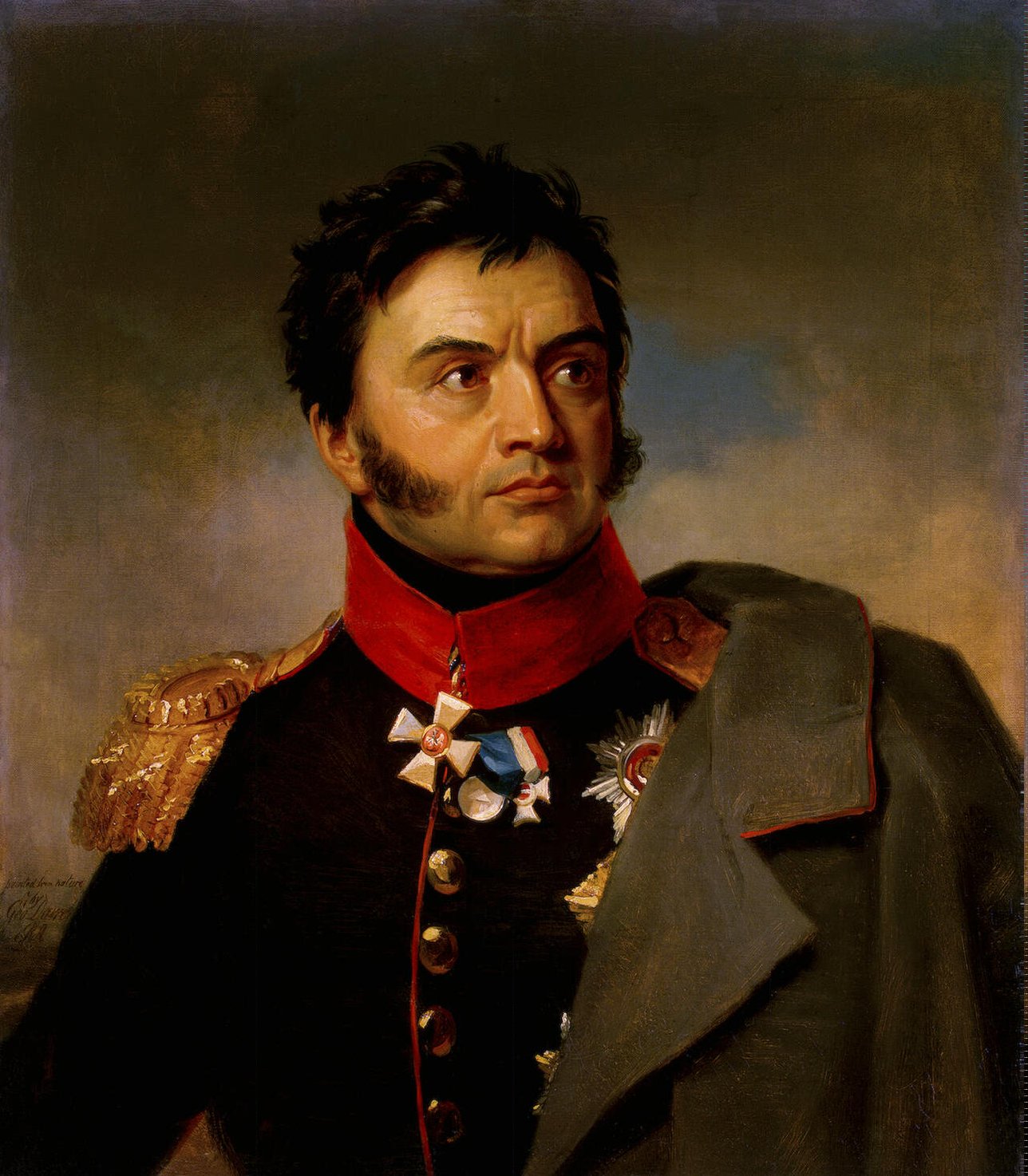 Raevsky (center, age 40 / held the Great Redoubt to the last)
-
Left (Second Army)
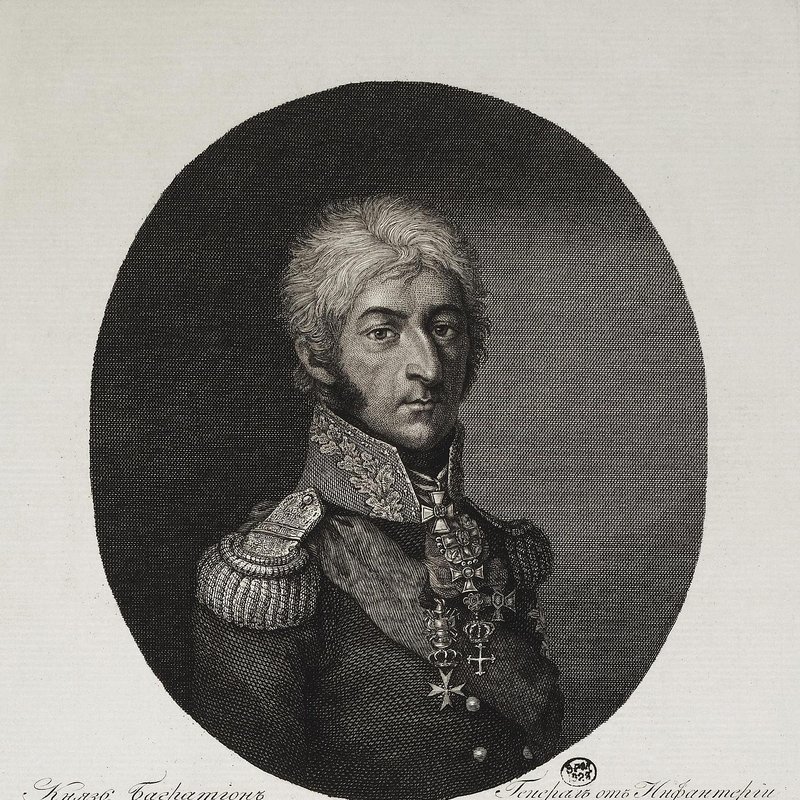 Bagration (Second Army, age 47 / gravely wounded at the flèches)
The battlefield was a line of earthworks and gun positions running roughly 8 km north to south. At the north stood Borodino village (on the Kolocha River and the New Smolensk Road); in the center the fortress of the Great Redoubt (Raevsky Redoubt), mounting about 20 guns; south of it three arrowhead-shaped earthworks, Bagration's flèches; and further south, along the Old Smolensk Road, Utitsa. The Russians defended along this line, and the French attacked from the west[6].
Here Davout proposed taking his own corps and Poniatowski's — about 40,000 men together — on a wide sweep around the outside of the Russian left to strike its rear. But Napoleon rejected the idea and chose a frontal assault[1]. A turning movement would take time, he judged, and risk letting the decisive battle slip away. To hammer the line of earthworks head-on — that choice would turn the day into a "meat grinder."
4. The Course of Battle: A Meat Grinder and a Killing Blow Never Struck
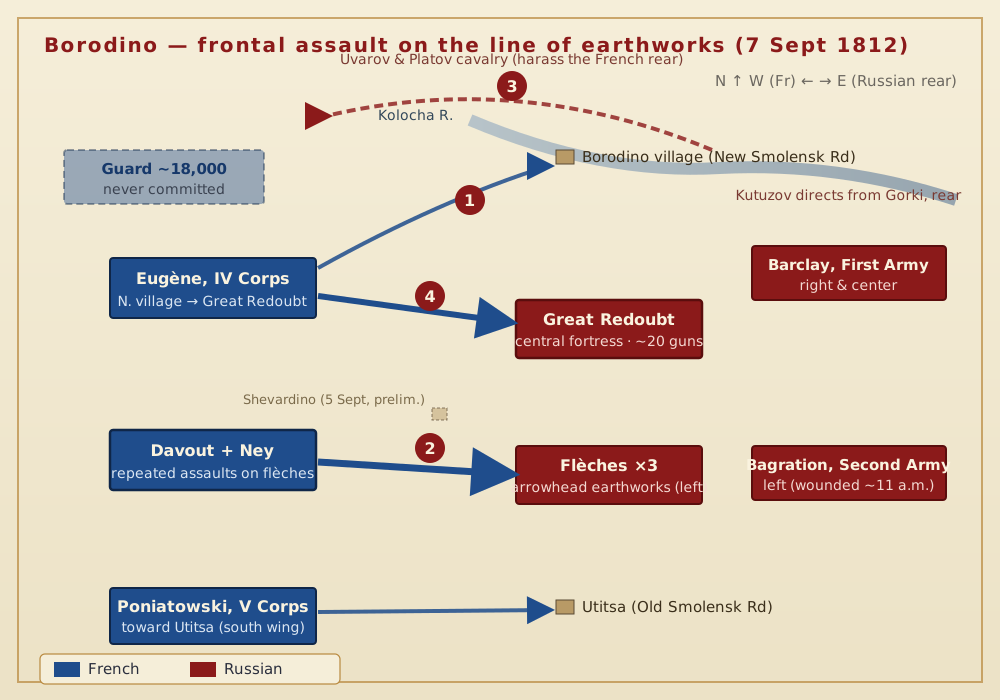
Dawn (around 6 a.m.): bombardment and the northern village. The battle opened with a salvo from more than 100 guns. In the north, Eugène's IV Corps took Borodino village early, but its advance halted at the line of the Kolocha River[6].
Morning (the meat grinder): the struggle for the flèches. The main battle was at the flèches in the south. Davout and Ney charged again and again; the earthworks changed hands repeatedly. Over roughly five hours, by some accounts seven assaults were traded back and forth[6]. Davout had his horse shot from under him and was briefly knocked unconscious. Around 11 a.m. Bagration had his left leg shattered by a shell fragment and was carried off on a stretcher. Robbed of their commander, the Russian left wavered but did not break, falling back to the line of the Semyonovka stream behind it to re-form. It was not a quick seizure but hours of bloodletting before the flèches finally fell into French hands.
Midday (a thrust at the rear): time is bought. At this point Uvarov's cavalry and Platov's Cossacks, some 8,000 strong, swung around to the French left rear. Unsupported by infantry, the raid achieved little to speak of, and the Russians themselves judged it a failure. Yet Eugène, wary of it, broke off and pulled back his attack on the center — and as a result the decisive assault on the center, the Great Redoubt, was delayed by about two hours[6]. The Russians used the interval to reinforce their center.
Afternoon (the central fortress): the Great Redoubt falls — but… Between roughly 2 and 3:30 p.m., after the Great Redoubt had been ground down by hundreds of guns, Eugène's infantry and cavalry stormed in. Montbrun, leading the cavalry, was struck down by a shell, and Auguste de Caulaincourt, who took over the charge in his place, was killed inside the redoubt[2]. The fortress fell at last. But the Russian center only fell back a few hundred meters; it did not rout. It held on in fresh squares along a new line, and though French troops braced themselves in the captured redoubt, the counterattack that should have come never did — both armies had spent what little strength remained to move.
5. The Day the Guard Was Held Back
By the afternoon the Russians were battered. Their central redoubt and their left-wing earthworks were both gone, and their line was falling back. To deliver the killing blow now might have realized the very thing Napoleon had sought from the start of the campaign: the destruction of the enemy army. Ney, Murat and Davout all urged him to commit the intact final reserve — the roughly 18,000 men of the Imperial Guard[6].
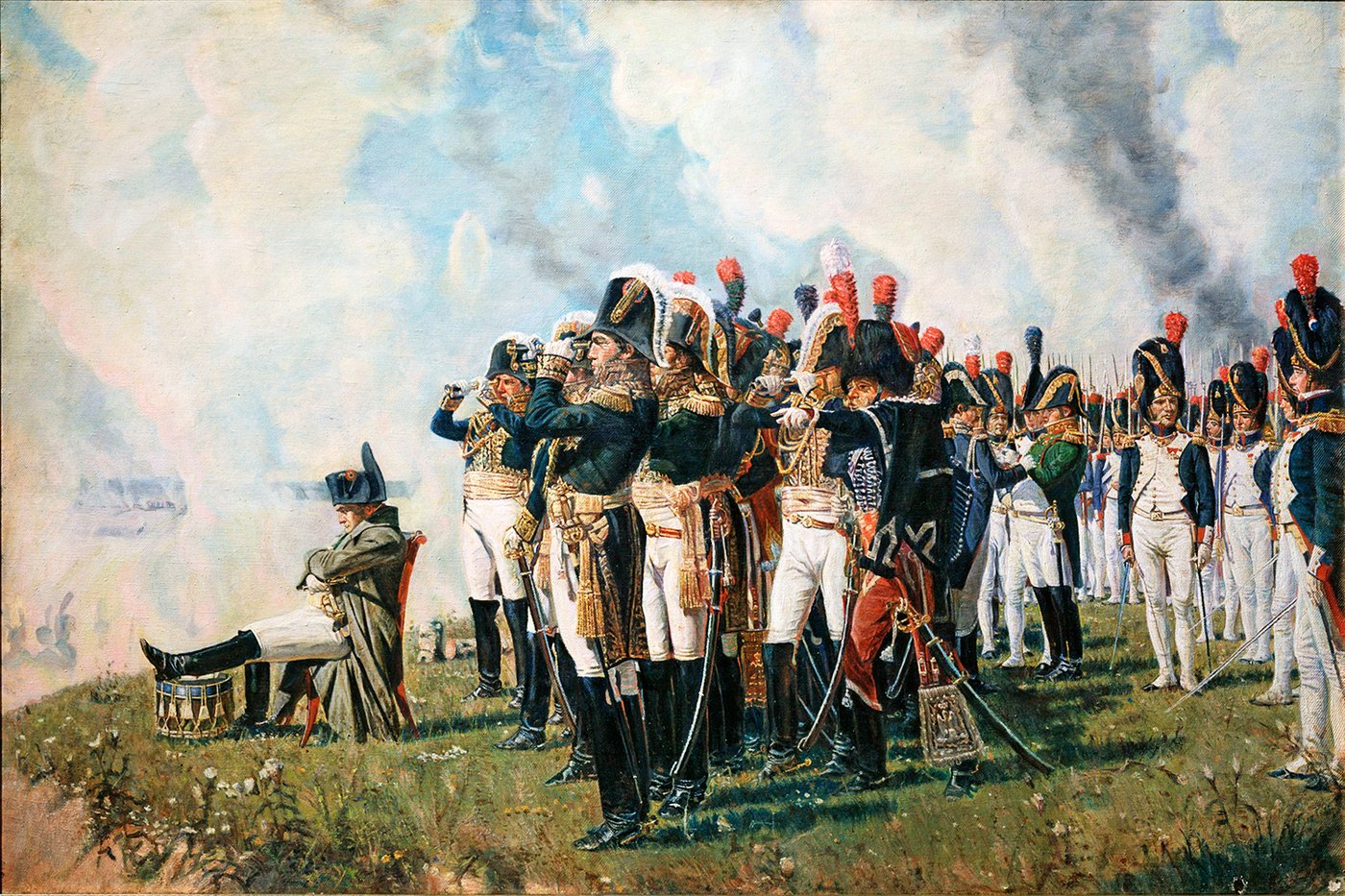
The Emperor seated on a campstool on the heights, gazing over the battlefield. That day he was lackluster.
But Napoleon refused. "Eight hundred leagues from Paris, I will not risk my last reserve" — whatever the exact wording attributed to him, the decision was to husband his one intact elite force deep in enemy country[4]. Many accounts record that the Emperor was unusually passive that day, suffering from a cold and from difficulty urinating. Still, to declare flatly that ill health clouded his judgment goes beyond what the sources support. For a commander who had marched more than 1,000 km into the Russian interior, the decision to guard his last reserve had a rationale of its own.
In the end, no killing blow was struck. There was no pursuit, and the Russian army quit the battlefield in good order during the night. That single move — the Guard left unmoved — has been recounted for two centuries as the turning point at which a decisive victory slipped away.
6. Winning Without Winning: Tactical Victory, Strategic Ruin
The essence of Borodino comes into view when set beside Austerlitz and Wagram.
At Austerlitz, Napoleon lured the enemy into moving, split his line at a single point, and brought it crashing down. The victory was brilliant, and it destroyed the enemy army. At Wagram, mass replaced maneuver and he simply ground the foe down. The victory came dear, but he still won the battle.
Borodino has no such sequel. Napoleon seized the positions and held the field — on tactical terms, he was the victor. But Kutuzov guarded not ground but his army. The Russian main force withdrew in order and was preserved. As long as the enemy army survives, the war does not end. The historian Mikaberidze argues that the very survival of the Russian army after Borodino was the decisive factor that would ultimately destroy the empire[5]. Sokolov called it a "Pyrrhic victory." If Austerlitz was "the art of winning by making the enemy move" and Wagram "a battle of attrition won by sheer mass," then Borodino was a "victory that decided nothing" — winning yet settling nothing.
7. Four Reasons No Decision Was Reached
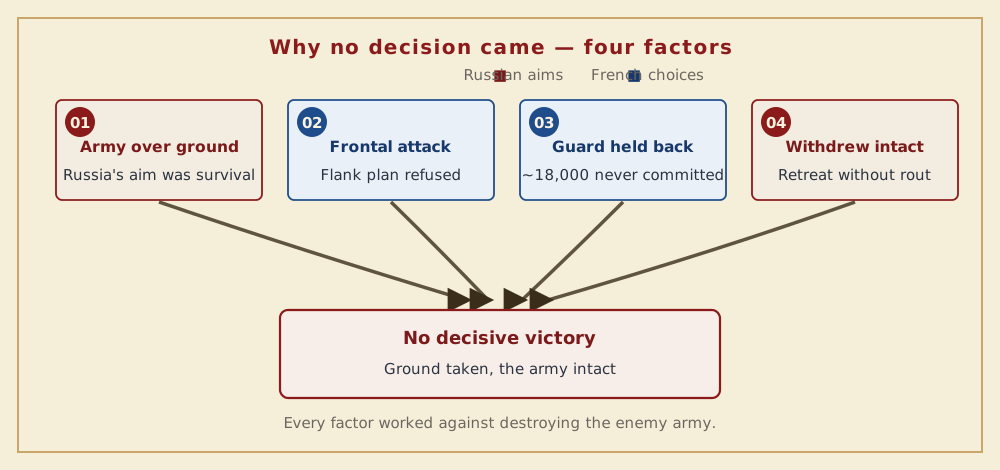
Why did the bloodiest battle in history decide nothing? The causes break down into four.
Russia made "preserving the army" its goal
Kutuzov's aim was not to hold ground but to keep his army alive. Withdraw before being broken — and so it could never be decisively pinned down. An enemy whose object of defense is "the army," not "the land," cannot be destroyed by taking the land.
He chose a frontal assault (rejecting Davout's plan)
Turning down Davout's plan for a wide sweep around the left, Napoleon chose a frontal assault on the line of earthworks. Not an envelopment that cut off the line of retreat, but a frontal fight that merely pushed the enemy back. The shape was one that "forced the enemy back" rather than "destroyed" him.
He husbanded the last reserve
At the moment the killing blow could have been struck, the roughly 18,000 men of the Guard stayed put. It was a rational caution 1,000 km deep in enemy country, but a decisive victory requires the decisive final push — and that push was never delivered.
The center fell back but did not break
Even with the Great Redoubt lost, the Russian center held on in squares and did not rout. An orderly withdrawal without rout offers no opening for pursuit. The moment when the line "cracks open" never came.
All four worked to prevent the "destruction" of the Russian army. The ground could be taken; the army could not be caught. Borodino's vast bloodletting was spilled not for a decision, but for the absence of one.
8. Counterfactual Simulation
What follows is a thought experiment grounded in the sources; its outcomes cannot be proven. It is offered to make visible the dependencies among the factors.
| Branch | Tactical outcome | Long-term effect |
|---|---|---|
| A: Davout's wide left sweep is adopted | By threatening the rear and line of retreat of the Russian left, the result might have become "capture" rather than "withdrawal." Yet the sweep would take time, and there was a risk the Russians would pull back sooner and leave the French striking at empty air. | Had the line of retreat been cut, the battle of annihilation Napoleon craved might have come off, and the war might have ended before Moscow. A branch that shows the difference between "forcing back" and "enveloping." |
| B: The Guard is committed in the afternoon | Hurling the intact 18,000-strong elite into the retreating Russian center might have cracked the line and turned the withdrawal into a rout. On the other hand, the Russians had reserves of their own, and there was a danger of having to retreat saddled with a spent Guard. | Had the killing blow succeeded, the Russian field army would have been destroyed and the campaign's outcome transformed. But had it failed, an army stripped of its last reserve would be left stranded deep in enemy country. A branch that shows the trade-off between caution and the decisive blow. |
| C: Kutuzov gives battle again before Moscow | Had he refused to husband his army and clung to defending the capital in a renewed battle, the Russian field army could have been worn down further and destroyed. The position (Moscow) might be held, but at the cost of the army. | Lose the army and you "lose both Moscow and Russia." It was precisely because Kutuzov chose to preserve his army that the occupation was rendered meaningless and France perished in the retreat. A branch that shows the weight of choosing the army over the land. |
What the three branches show is that Borodino's "lack of a decision" was no accident, but arose structurally from the asymmetry of aims (France sought destruction, Russia sought preservation). A battle to seize land and a battle to keep an army alive — two victory conditions that never meshed, running side by side on the same field.
9. Strategic Consequences: The Ashes of Moscow and the Great Retreat
Taking the ground did not end the war.
- 13 September: at the council of war at Fili, Kutuzov decides to abandon Moscow. The sense of it: "Lose Moscow and Russia is not lost; lose the army and we lose both."[3]
- 14 September: Napoleon enters an all but empty Moscow. But no one came to negotiate.
- 14–18 September: the city is engulfed in a great fire (whether Russian arson or accident is disputed; the involvement of Governor Rostopchin is debated). Tsar Alexander I rejected all overtures of peace.
- 19 October: Napoleon begins the retreat. Cut off from the southern route at Maloyaroslavets (24 October), he is forced back along the ravaged road he had himself burned.
- 26–29 November: catastrophic losses at the crossing of the Berezina. Amid winter, hunger and pursuit, of the roughly 450,000–600,000 who had invaded, only a few tens of thousands made it home[4].
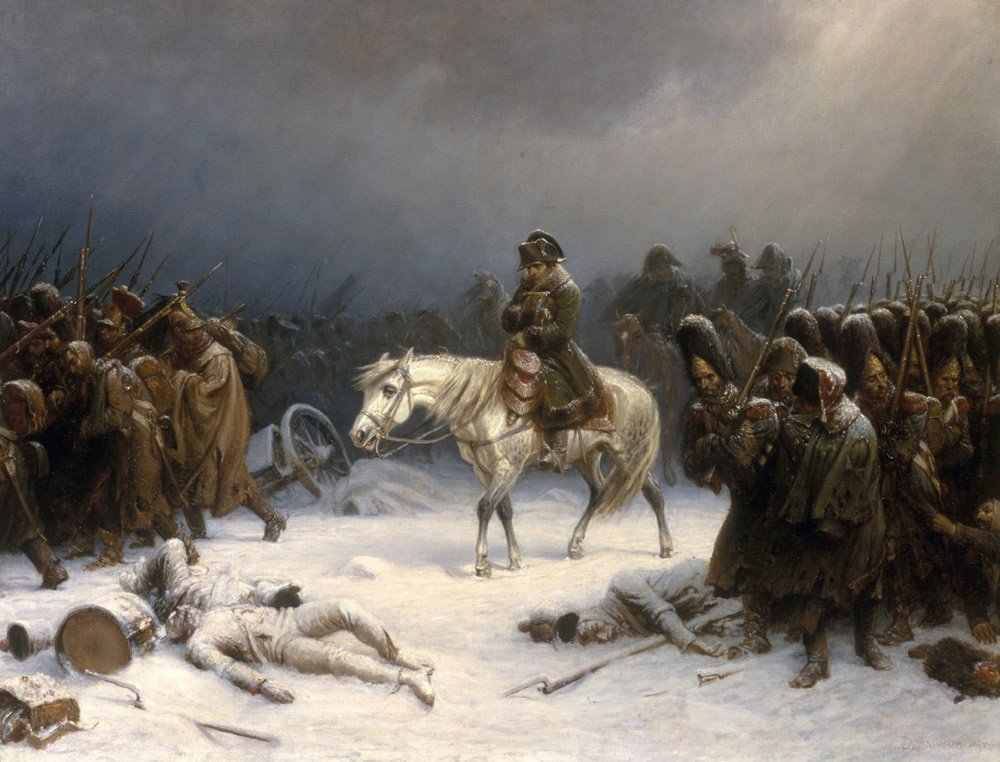
The Russian army preserved at Borodino was still intact. The price of a victory that settled nothing showed itself in this retreat.
Kutuzov was promoted to field marshal immediately after Borodino, and for his exploits at Krasnoi in December earned the title "Prince of Smolensk." Napoleon himself is said to have remarked later that "the French showed themselves worthy of victory, and the Russians worthy of being called invincible." In War and Peace, Tolstoy portrayed Borodino as a Russian moral victory. The side that took the ground was ruined, and the side that lost it survived — that paradox was the outcome of 1812.
10. Lessons for Today
What Borodino poses is the view that "taking the visible win — the position, the metric — can actually hasten your ruin if you fail to achieve the real objective."
- Do not confuse the win in the metric with the win in the objective. France won the visible prizes — "holding the field," "taking the capital" — but failed at the real objective: breaking the enemy's will to keep fighting. In business too, a victory chasing visible metrics like market share or revenue can damage the real objective of a sustainable earnings base. The AOL–Time Warner merger (announced January 2000, valued at roughly $350 billion at the time) was a victory that "acquired" a giant on the strength of dot-com stock prices, but after the bubble burst it booked a loss of about $99 billion in 2002 and was split apart in 2009. The win of acquisition brought the destruction of value.
- A "win" bought too dear eats away at the body itself. A costly victory drains the very strength of the victor. Quaker Oats bought the beverage brand "Snapple" for $1.7 billion in 1994, but a mismatch in distribution model damaged the brand's value, and about 27 months later, in 1997, it sold the brand for roughly $300 million (a loss of about $1.4 billion). If you cannot make use of what you win, the victory of acquisition turns into self-destruction.
- If the enemy defends "survival" rather than "land," taking the land will not win. An opponent who can retreat, who preserves his core, will give up the position and still survive. What must be defeated is not the position but the opponent's "capacity to keep going."
Austerlitz's cheap victory, Wagram's expensive one, and Borodino's victory that decided nothing. Set the three side by side and you can watch the process by which Napoleon's method lost its "power to produce a decisive victory."
Conclusion: The Victory That Ruined the Victor
Borodino is the battle in which Napoleon won and yet could not win. He hammered the line of earthworks head-on, seized the positions, and stood on the field. But the frontal assault only forced the enemy back without enveloping him; the last reserve was husbanded; and the Russian center fell back without breaking. The roughly 70,000 who fell in a single day were spilled not for a decision, but for the absence of one.
An enemy whose object of defense is "the army" rather than "the land" cannot be defeated by taking the land. Kutuzov kept his army alive even at the cost of giving up Moscow, and that army would in time swallow the retreating French. The method that came to fruition at Austerlitz and grew heavy at Wagram could, at Borodino, no longer produce "decisive victory" itself. When the bloodiest single day decided nothing, the wheel of the empire's fate had begun to slide down a long descent into the snow.
FAQ
Fought on 7 September 1812, it was the bloodiest single day of the Napoleonic Wars, with about 70,000 of both sides killed or wounded in one day. France took the positions and won tactically, but the Russian army escaped destruction and withdrew in good order. Lacking a decisive victory, Napoleon could not end the war even after occupying Moscow, and in the great retreat that followed he lost the cream of his empire. It is a turning-point battle in which victory became the doorway to ruin.
What he needed was a decisive victory that would destroy the enemy army and force a peace. But at Borodino he only took the positions; the Russian main force withdrew in order and was preserved. As long as the enemy army survives, the war does not end. A week later Kutuzov abandoned Moscow, Napoleon entered an empty, burning city, but Tsar Alexander I rejected peace. The absence of a decisive victory rendered the occupation meaningless and led to the retreat and catastrophe.
In the closing stage, with the Russian center pressed back, Ney, Murat and Davout urged Napoleon to commit the intact final reserve, the roughly 18,000-strong Imperial Guard. But he refused, reportedly because he would not risk losing his only reserve eight hundred leagues from Paris, deep in enemy country. He was unwell and lacklustre that day, but whether that was the cause of the refusal cannot be stated with certainty from the sources. This single move is often discussed as the turning point at which a decisive victory slipped away.
In a single day's fighting, about 70,000 to 73,000 of both sides were killed or wounded (France ~30,000–35,000, Russia ~40,000–50,000, figures varying by source) — roughly a third of each army. On the French side alone some 48–50 generals were killed or wounded, earning it the name the battle of the generals. In casualties for a single day it was a record unbroken until the First World War in 1914.
Kutuzov's aim was not to hold ground but to preserve his army. He lost the positions, but his army was not destroyed and could keep fighting — and that was a strategic success. At the council of war at Fili after the battle he decided to abandon Moscow, in the sense that to lose Moscow is not to lose Russia, but to lose the army is to lose both. Keeping his army alive is what ultimately destroyed Napoleon. Tolstoy's War and Peace portrayed this as a Russian moral victory.
He stayed off the front line, taking in the broad picture from near Gorki in the rear and delegating much of the tactical command to subordinates such as Barclay, Bagration and Raevsky — a passive style. Rather than flashy generalship, his was a patient command of attrition: keep the army intact, inflict the wear and tear on the enemy, and wait for the right moment. He was promoted field marshal immediately after Borodino, and after Krasnoi in December earned the title Prince of Smolensk.
Bagration, who led the Russian left, was wounded around 11 a.m. by a shell fragment in his left leg while defending the arrowhead earthworks (the flèches) he had had built. His wounding briefly threw the left-wing command into disorder, but the Russians fell back to the line of the Semyonovka stream and re-formed. As the wound worsened into gangrene, Bagration died about two weeks later, on 24 September.
At the council of war at Fili on 13 September, Kutuzov decided to abandon Moscow. The next day, 14 September, Napoleon entered an all but empty Moscow, but the city was soon engulfed in a great fire (arson or accident is disputed). Alexander I rejected all peace overtures, and on 19 October Napoleon began the retreat. Cut off from the southern route at Maloyaroslavets, he was forced back along the ravaged road and suffered catastrophic losses at the Berezina crossing in late November. Of the roughly 450,000–600,000 who had invaded, only a few tens of thousands made it home.
Claims and Sources
- David G. Chandler(1966). The Campaigns of Napoleon, Macmillan.
- Encyclopædia Britannica. Battle of Borodino, Encyclopædia Britannica. [link]
- Harrison W. Mark(2024). Battle of Borodino, World History Encyclopedia. [link]
- Adam Zamoyski(2004). 1812: Napoleon's Fatal March on Moscow, HarperCollins.
- Alexander Mikaberidze(2007). The Battle of Borodino: Napoleon Against Kutuzov, Pen & Sword Military.
- Wikipedia contributors. Battle of Borodino, Wikipedia. [link]