France · III Corps Commander
Louis-Nicolas Davout
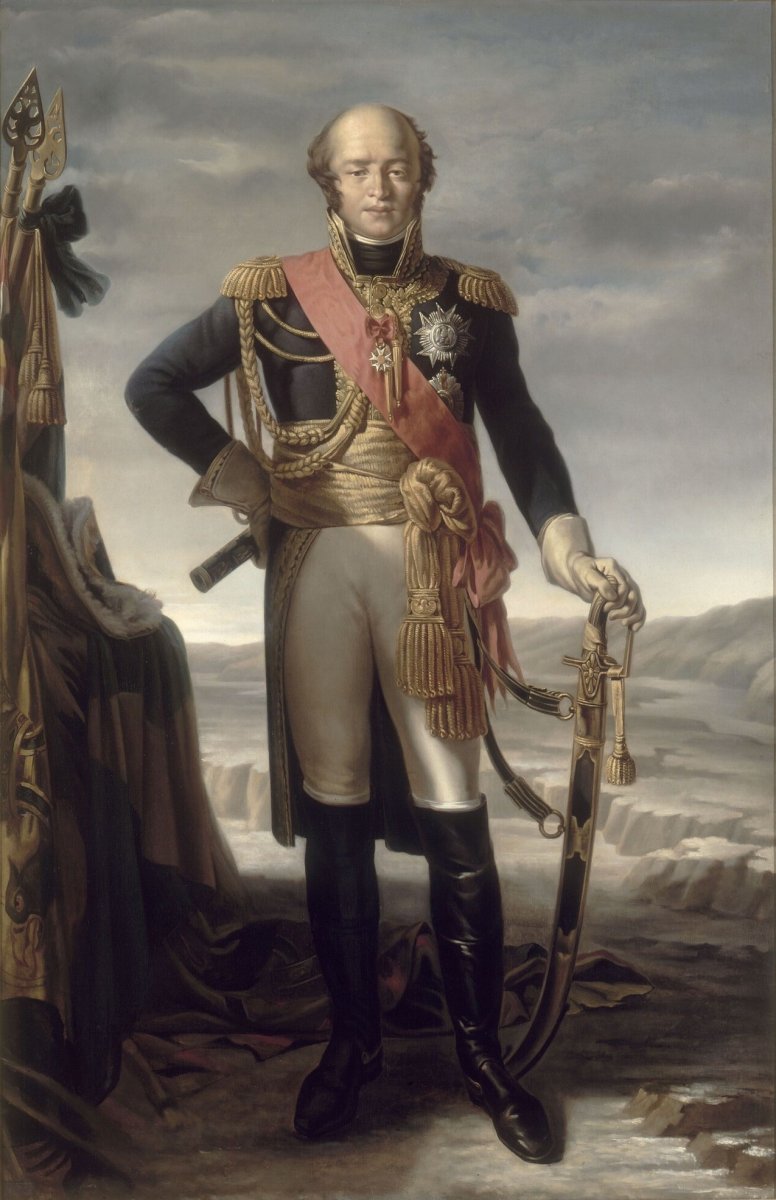
The Iron Marshal, the most trusted executant in Napoleon's army. Outstanding in discipline and in practical competence, he was one of the very few generals who could win on his own with the Emperor elsewhere. That single point separates him from the other marshals.
What he actually did: redundancy
Napoleon's method was built on the assumption that one man would be present at the decisive point. The corps system exists to relax that assumption: each corps is organised to fight alone for several days. But a structure alone is not enough - without commanders able to use it, no redundancy appears. In practice most marshals given independent command did not produce the expected results.
Davout was the exception. Strict discipline kept his corps trained and supplied, and he filled the hours when no orders arrived with his own judgement. There was nothing showy about it, but his was the one sector the Emperor did not have to worry about. That in the War of the Sixth Coalition the allies could adopt a rule of never fighting the army he led in person and always fighting the marshals' armies is, read the other way round, a statement that executants like Davout remained exceptions.
Discipline was a means, not an end. In December 1805 his III Corps covered about 110 km in 48 hours from the direction of Vienna to reach the southern end of the field at Austerlitz (sources vary: 110-130 km in 48-50 hours)[1]. The speed a force can move at is peacetime discipline made visible.
The decisive moment: Auerstedt
On 14 October 1806, at Jena-Auerstedt, the Emperor mistook which was the main battle. What was fighting at Jena was only part of the Prussian army; the real main body was to the north at Auerstedt. Facing it was Davout's III Corps, alone.
The numbers were about 26,000 to 27,000 against some 50,000 to 64,000. He repulsed an enemy more than twice his strength without reinforcement[2]. His corps lost about 7,100 men, but the Prussian main body broke after losing the Duke of Brunswick, its commander-in-chief[3]. The Emperor is said not to have believed the first report. It was a day on which the design worked as designed, at a level its designer had not anticipated.
His role at Austerlitz was the same in essence. He absorbed the attack of the enemy main effort on the southern wing and bought the time in which the trap of inducement could form. Not the role of attacking but the role of not breaking, so that another man's operation can exist. At Eckmuhl in 1809 too, the Emperor could assemble a decisive battle on arrival because the corps had held until then.
Limits, or how it ended
From late 1813 to May 1814 Davout held Hamburg. He beat off four attacks and gave up the place only after the new government in Paris had confirmed the abdication and ordered him directly to do so[1]. He was one of the very few marshals never defeated in his career.
Then in 1815, during the Hundred Days, he was kept in Paris as minister of war and never reached the field. If what was missing at Waterloo had to be said in one word, the word is Davout. The redundancy was never inherited as an institution; it passed as a period during which the right people happened to exist - and his career is the proof of it.
Sources
- Fondation Napoleon, Davout, Louis Nicolas.
- Encyclopaedia Britannica, Louis-Nicolas Davout, duke of Auerstedt.
- J. Rickard, Battle of Auerstadt, 14 October 1806, History of War.
Appears in battles
-
1805-12-02
Battle of Austerlitz (1805) — Napoleon's Masterpiece of Situation DesignRole: III Corps (the iron shield on the right)
-
1806-10-14
The Twin Battle of Jena–Auerstedt (1806) — The Decisive Battle Was the One Napoleon Wasn't AtRole: III Corps (won Auerstedt unaided)
-
1807-02-08
Battle of Eylau (1807) — The Day Napoleon's Method Failed to Deliver a DecisionRole: III Corps (pressed the Russian left)
-
1809-07-06
Battle of Wagram (1809) — The Day Napoleon's Method Turned from Art to AttritionRole: III Corps (the decisive blow at Markgrafneusiedl on the Austrian left)
-
1812-09-07
Battle of Borodino (1812) — Why the Bloodiest Day Produced No DecisionRole: I Corps (proposed a flanking move on the left; rejected)