On 12 July 1813 the allies agreed at Trachenberg on a policy that fits in one line. Never fight the army Napoleon commands in person. Fight the armies his marshals command. This is not a tactical device. It is a rule about whether to meet at all. They did not copy how he won; they broke the conditions that let him win.
1. What this war was played for
What the Russian campaign destroyed was not only men. About 175,000 horses were lost, and a large share of them were trained cavalry mounts[4]. Conscription can replace numbers. It cannot replace horses and the years of riding that go with them.
A new army was raised in the spring of 1813. On paper it could fight. What it lacked were the eyes that scout and the legs that pursue. That absence quietly settled the year.
What was at stake was not territory but whether the method still worked under the conditions of 1813. The answer was: half of it did.
2. An army that could win but not decide
Lutzen on 2 May, Bautzen on 20-21 May. Both were won. Neither broke the enemy army. The reason lies not in the handling but in the cavalry. Without the legs to run down a retreating enemy, a victory amounts to nothing more than the other side having stepped back[4].
In earlier campaigns the pursuit was what turned a victory into a decision. Ulm and Austerlitz ended the War of the Third Coalition outright because they removed the enemy army as an army. In 1813 the same thing could no longer be done.
An army whose victories do not become decisions cannot improve its position, however often it wins. That suited the other side. If you keep your army after losing, you can go on losing and wait.
3. The one-line rule
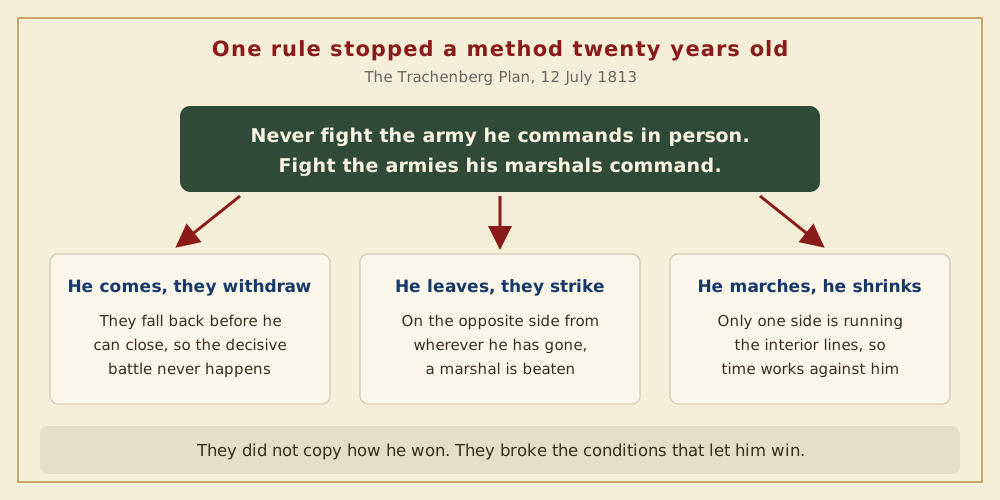
Between 9 and 12 July the Tsar, the King of Prussia and Bernadotte - once a marshal of France - met at Trachenberg. The plan that came out of it was drafted mainly by Bernadotte and revised by Radetzky, the Austrian chief of staff[1].
Its content was a prescription for attrition. Three armies would move independently; withdraw when he comes, fight when a marshal comes; threaten the lines of communication and tighten the ring[1].
The rule bites because it attacks the premise of operating on interior lines. Interior lines are a technique for beating separated enemies in turn and making a local majority. But once the enemy decides not to stay where he can be beaten, interior lines become a device for marching back and forth. Only one side is running, and only one side is shrinking.
4. Four defeats in the same fortnight as the victory
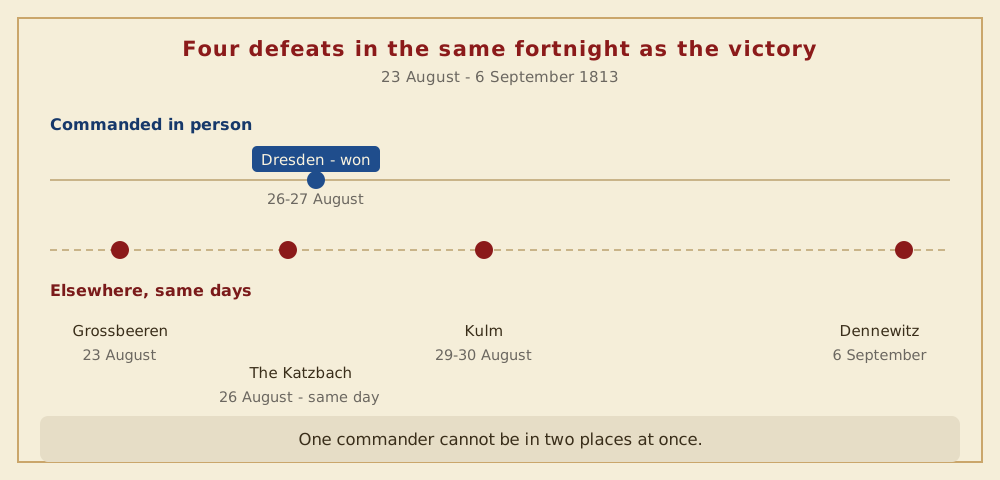
Grossbeeren on 23 August (Oudinot), the Katzbach on the 26th (Macdonald), Kulm on the 29th-30th (Vandamme), Dennewitz on 6 September (Ney). Four defeats in fifteen days. In the same fifteen days Napoleon won at Dresden on 26-27 August[1].
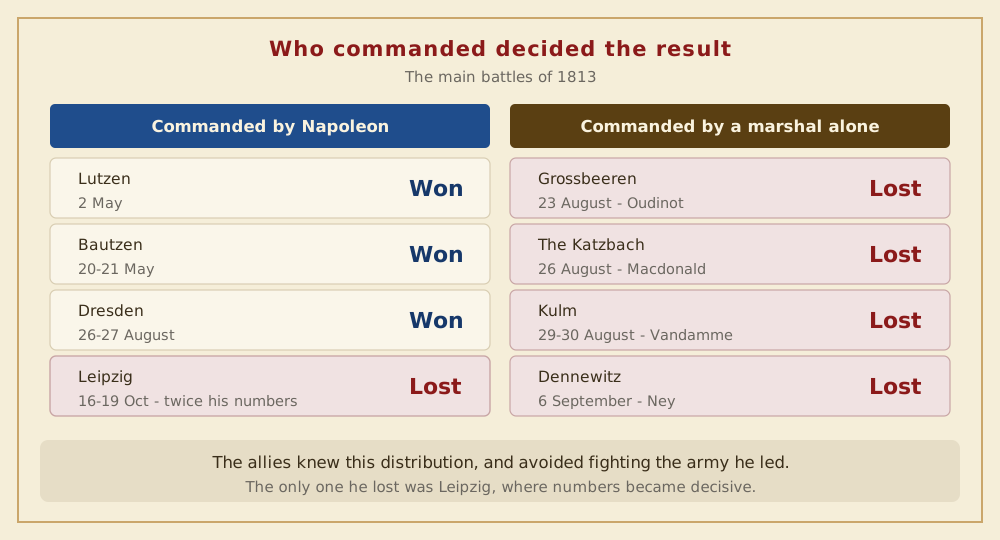
The distribution is not chance. The method lived in one head and had never been moved into the organisation. The corps system could be handed over; the judgement of when to concentrate and where to accept a decisive battle could not. Twenty years of work had produced an army with exactly one commander.
The French side (ages in 1813)
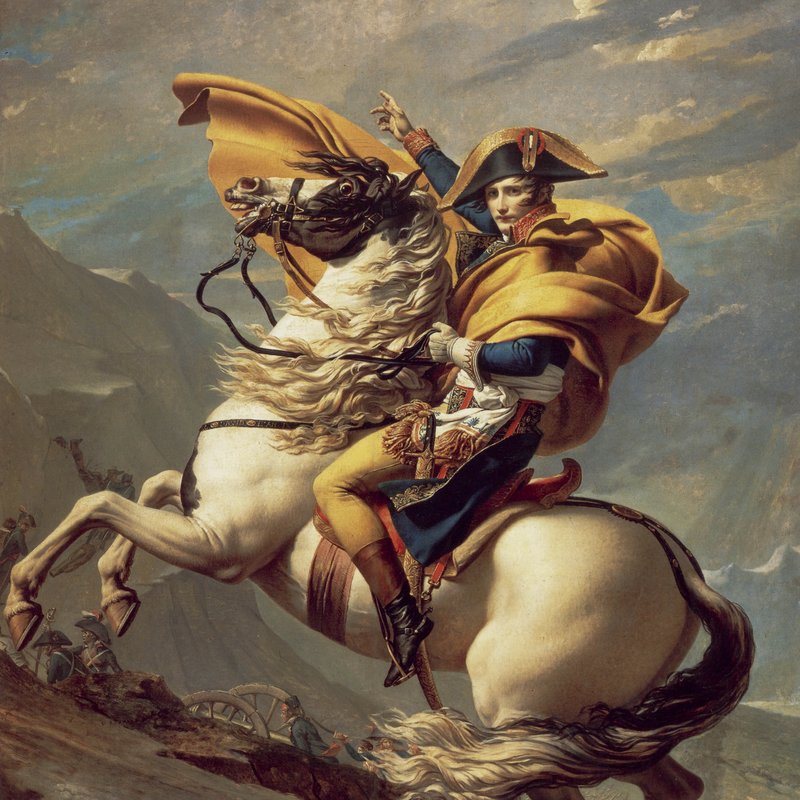
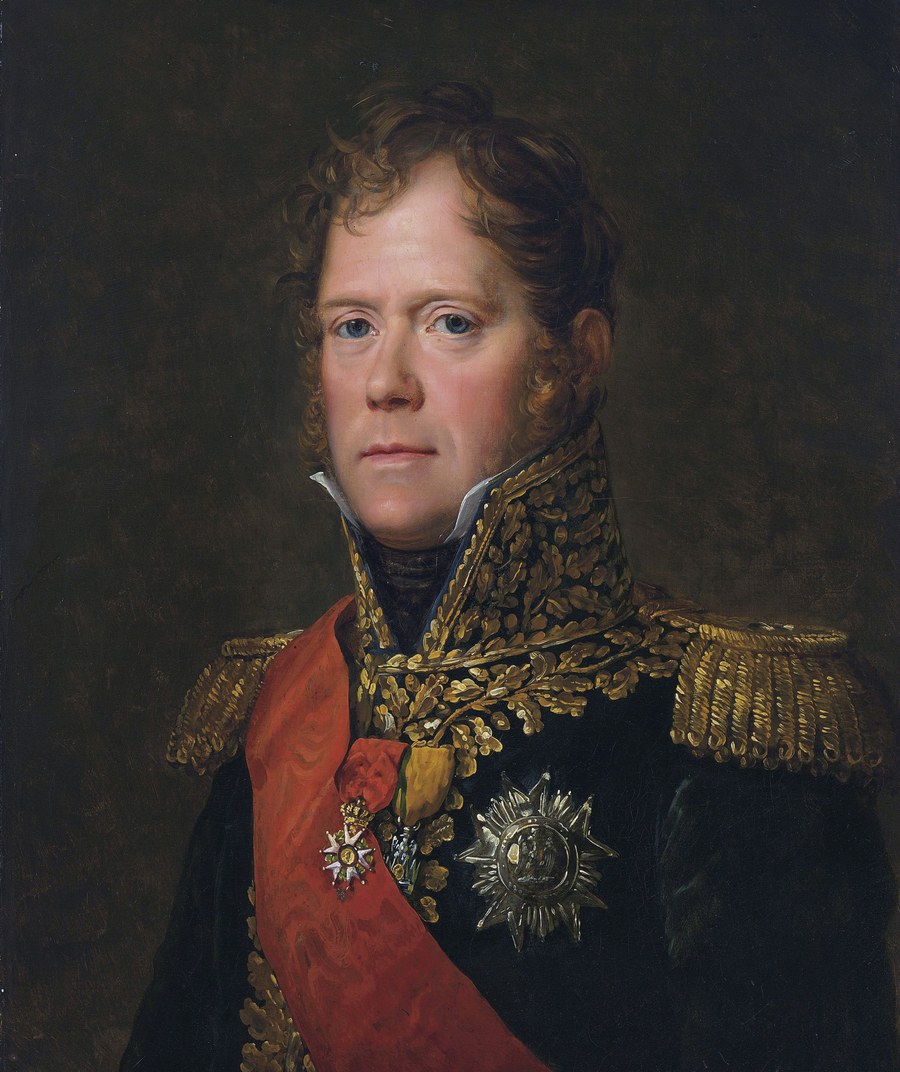
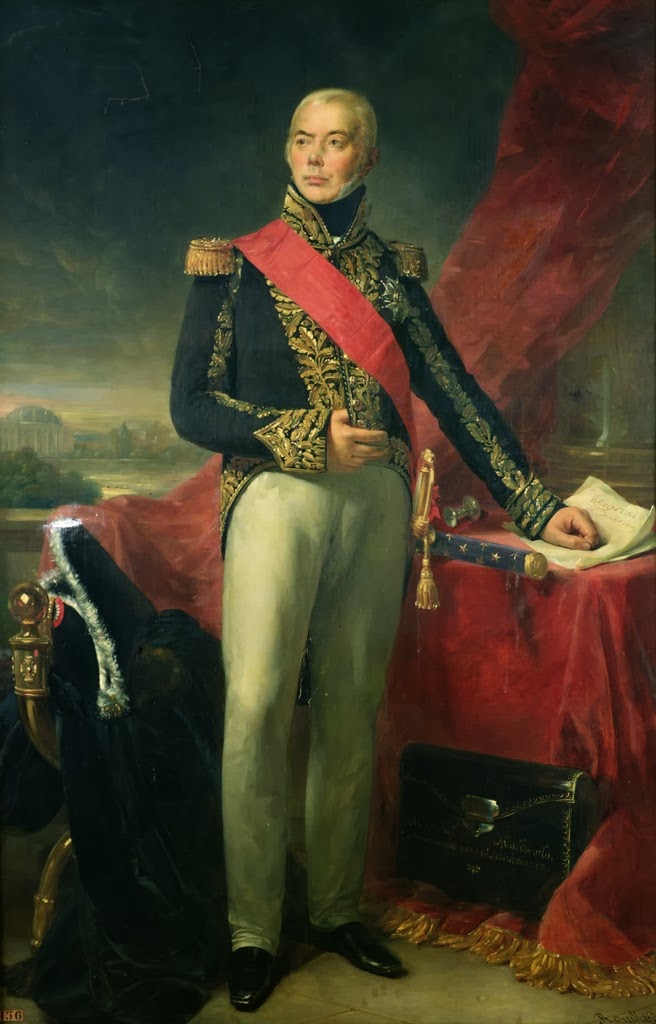
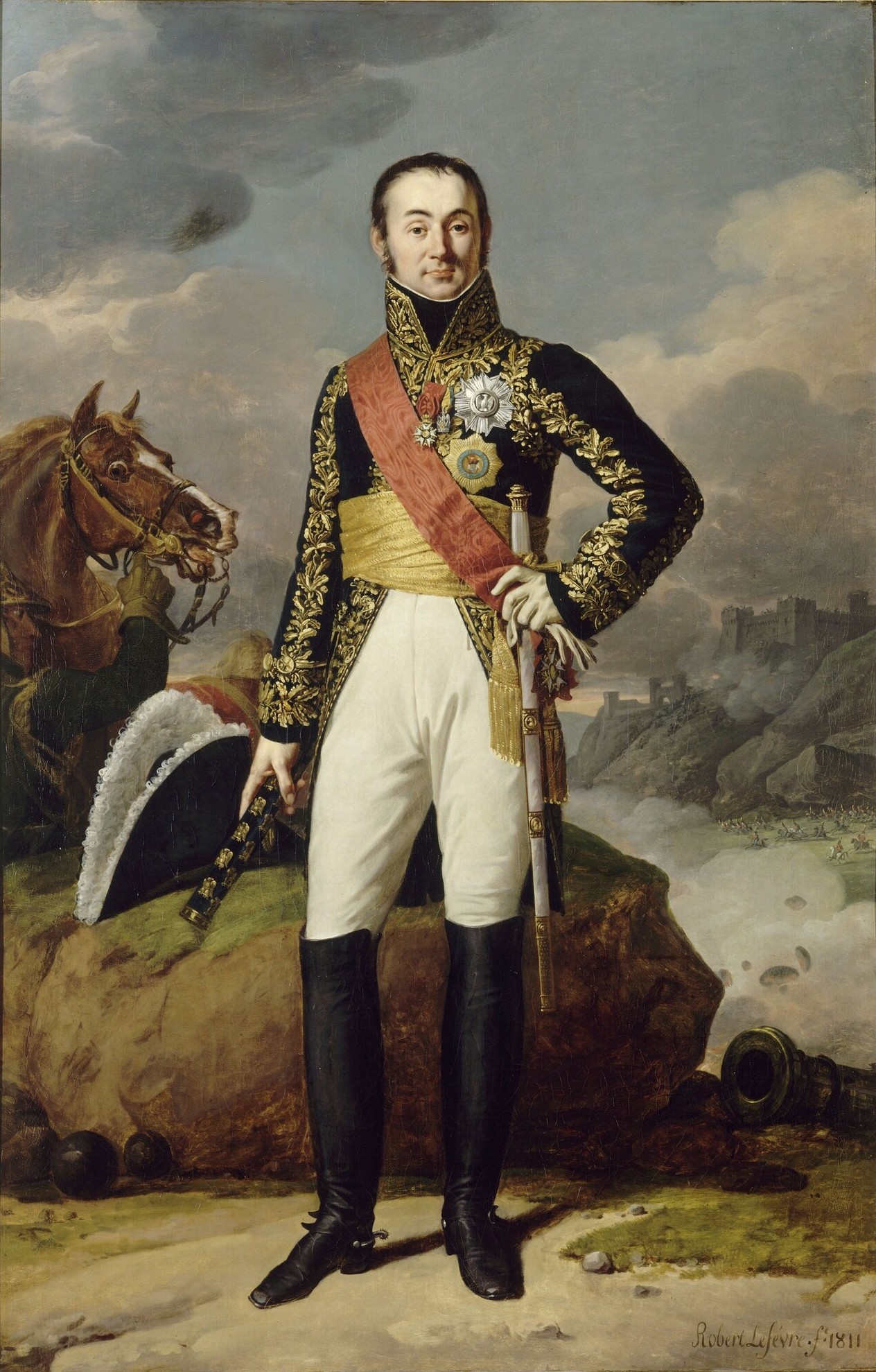
The allied side (three armies)
-
Commander-in-chief
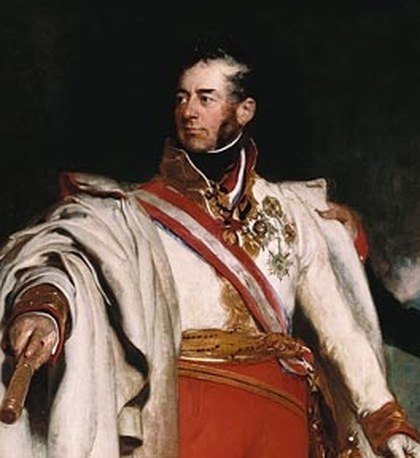 Schwarzenberg (Army of Bohemia; 42)
-
Army of Silesia
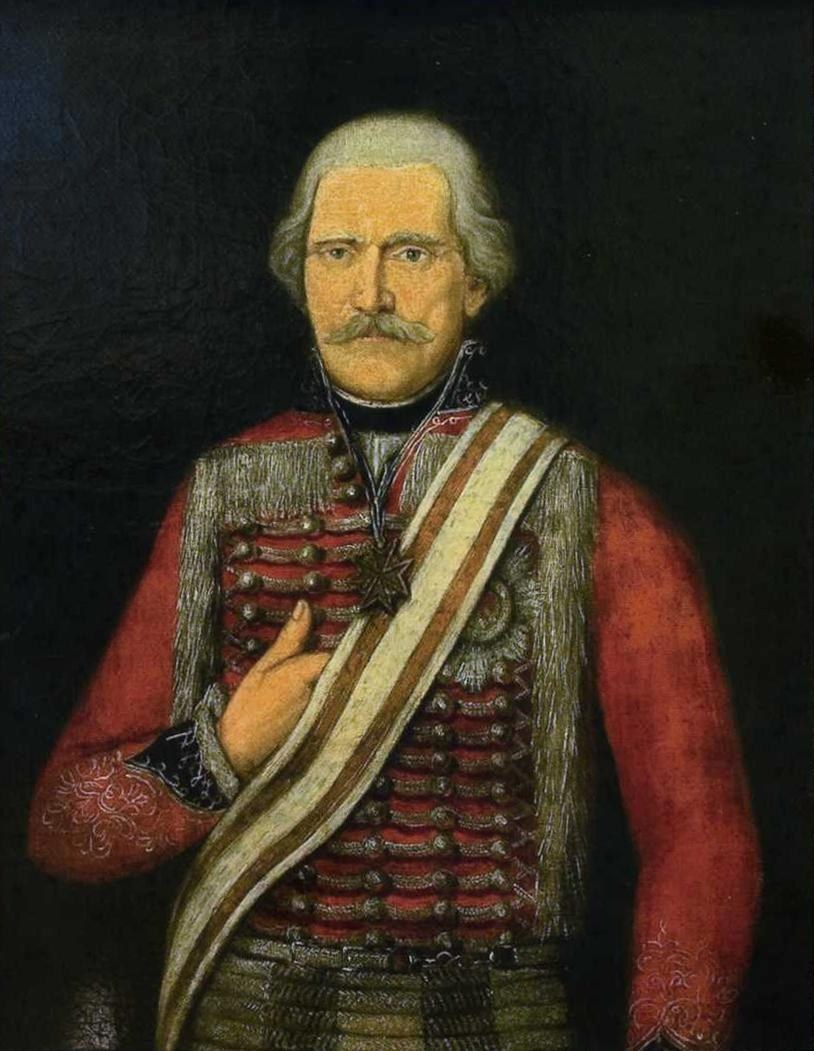 Blucher (won on the Katzbach; 70)
-
Army of the North
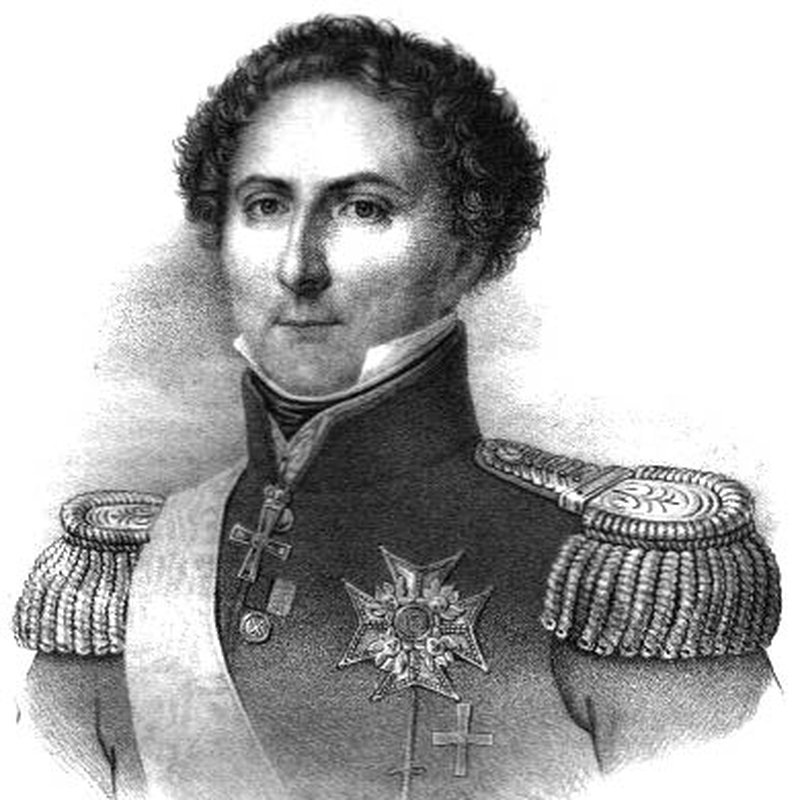 Bernadotte (drafted the plan; former marshal of France; 50)
The prescription was written by a man who had been inside
Bernadotte, who drafted most of the Trachenberg Plan, had been made a marshal of France in 1804 and served at Austerlitz and at Jena. He became Crown Prince of Sweden in 1810 and commanded one of the three allied armies in 1813[1]. The man who knew the weakness of the method best was the one who had fought with it. Inducement works only against an enemy who moves; the place and hour of a decisive battle can be chosen only by the side holding the initiative. Someone who had watched that from within wrote the rule from without.
5. Leipzig: the day numbers beat method
Strength (rising through the third day)
Allies about 1.8x
Losses (four days; killed, wounded, prisoners)
Both sides about 130,000
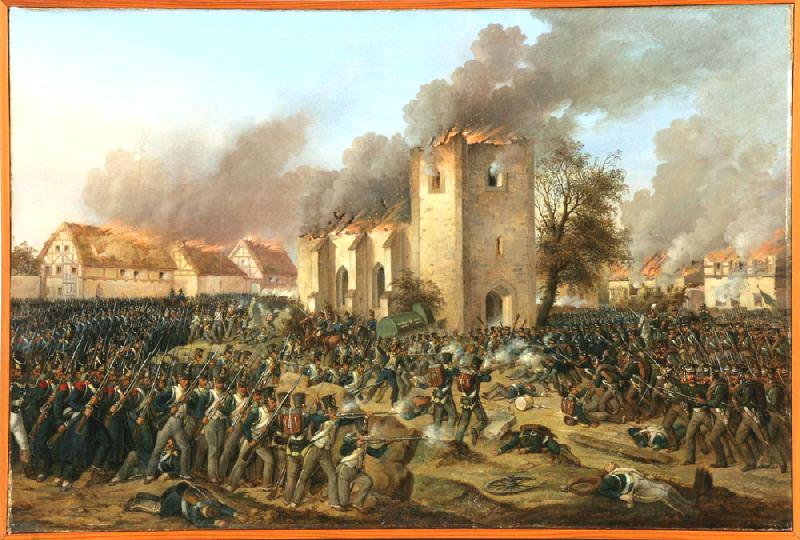
At the Battle of Leipzig (16-19 October) the rule reached its final form. Once the three armies arrived together there was no longer any need to avoid him. A ring is complete when the other side no longer has to run.
In 1814, back on French soil, he won at Champaubert, Montmirail and Vauchamps in succession. Paris fell all the same on 31 March, and he abdicated on 6 April. However many tactical victories were added up, the balance across the theatre no longer moved.
6. Four things that decided this war
An army that could not pursue
About 175,000 horses were lost in Russia, and neither Lutzen nor Bautzen became a decisive blow[4]. The means of turning a victory into a decision was gone.
The enemy decided not to meet
The Trachenberg Plan was not a tactic but a rule about whether to fight at all[1]. Inducement and concentration both assume an enemy who stays on the board.
The method was never delegated
Battles he commanded were won; battles a marshal commanded alone were lost one after another[2]. Personal skill does not travel with the structure that carries it.
Losses could not be replaced
At Leipzig the allies grew daily while French reinforcements barely came[3]. An even battle of attrition is won by whoever can replace.
7. If the conditions had been different
What follows is a thought experiment based on the sources. The outcomes cannot be demonstrated; the point is to make the dependencies between the elements visible.
| Condition changed | Immediate consequence | Effect on the war |
|---|---|---|
| A: enough cavalry in 1813 | The pursuit after Lutzen and Bautzen comes off | If one allied army broke as an army, the ring would not close. But the other two would simply withdraw as the rule required, and the reckoning would most likely be postponed rather than avoided |
| B: no independent commands for the marshals | One man has to watch a dispersed theatre | Physically impossible. With the allies coming in three armies, the more delegation is avoided, the fewer hands there are |
| C: the August peace terms accepted | The war halts and the ring never closes | Territory shrinks but the regime survives. Yet for a power justified by victory, shrinking was the same thing as defeat |
None of the three disables the rule itself. What stopped working that year was not the hand but the conditions under which the hand worked.
8. What it suggests today
(1) Against a stronger opponent, change the conditions of the contest rather than the way you compete. Where a head-on comparison is lost in advance, refining your play on the same ground does not close the gap. What the allies adopted was a policy of preventing the situations the opponent is good at from arising, which is one of the few ways to neutralise a difference in ability. Avoiding is not fleeing; it is designing the choice.
(2) Personal excellence does not transfer with the structure. The corps system could be handed over, but the judgement of when to concentrate and where to fight could not. The assumption that people grow if given structures and authority holds only where the criteria for judgement have themselves been put into words. While the master is still on the floor, the gap is invisible.
9. Closing
1813 was not a year of continuous defeat. Almost every battle he commanded in person was won. The war was lost all the same. The result of a battle and the balance across a theatre are two separate ledgers.
One line of rule stopped a method twenty years in the making. And the man who wrote that line had been inside it. A method is most exposed to someone who knows it well.
Before this came the Russian campaign; next comes the Hundred Days. In the last campaign what runs out is something more basic than any rule: the supply of people able to carry the method out.
Sources
- J. Rickard, Trachenberg Plan, 12 July 1813, History of War, 2009.
- Wikipedia contributors, German campaign of 1813.
- Michael V. Leggiere, The Fall of Napoleon: The Allied Invasion of France 1813-1814, Cambridge University Press, 2007.
- The Napoleon Series, Napoleon's Equine Strategy in 1813.
- Encyclopaedia Britannica, Battle of Leipzig.
- David G. Chandler, The Campaigns of Napoleon, Macmillan, 1966.