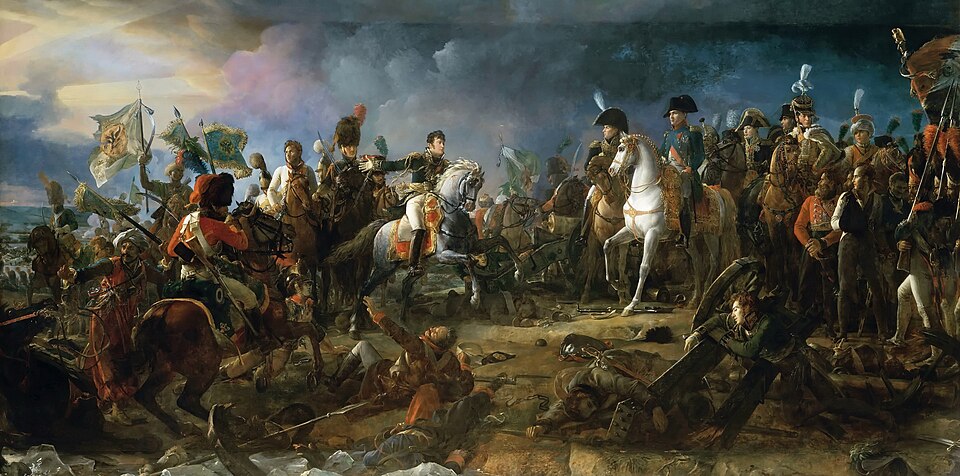
Napoleonic tactics were a way of assembling movement, organisation and firepower so that your side was the stronger one at the moment of contact. Not inspiration, not force of will. The method breaks into parts, and the conditions it needed can be written down. Which is why the same skill stopped winning once those conditions were gone. This guide opens the parts and the conditions in turn.
1. What "Napoleonic tactics" actually means
First, three words worth separating. Strategy is which war to fight, where, and how to end it. Operations is how you move armies. Tactics is how you fight once you are there. Most of what gets called "Napoleonic tactics" is in fact operational — the preparation that makes contact happen on favourable terms.
Two misconceptions are worth clearing away. The first is that he invented new weapons or new tactics. He did not: the corps system, mixed order and skirmishing were all in the French army of the Revolution already. The second is that he simply overwhelmed people with numbers. Also wrong — northern Italy in 1796 is one of several campaigns won while outnumbered throughout.
What actually happened was that existing pieces were rebuilt around a single purpose. That purpose never changes: be outnumbered on the ledger, and be the stronger side where and when you actually meet. All four parts below serve that one end.
2. Part 1: the corps system
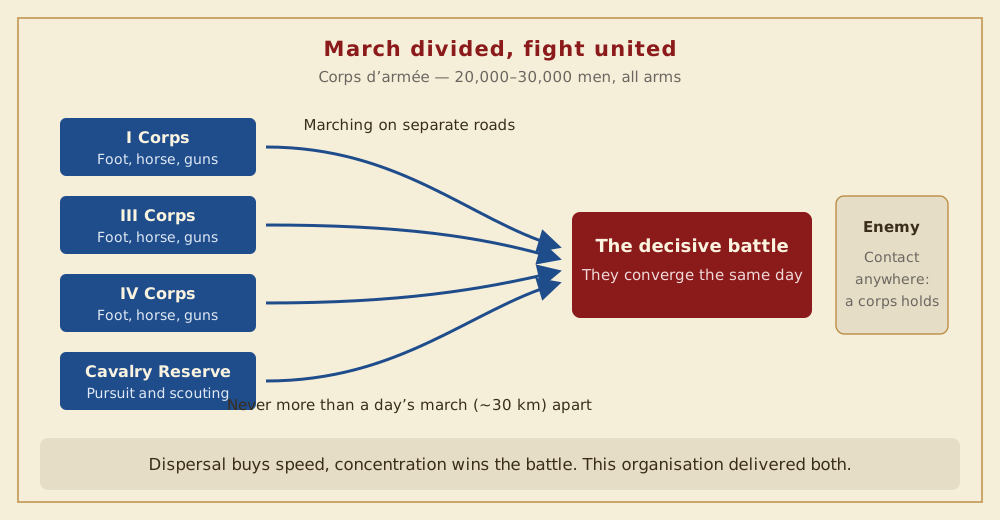
A corps (corps d'armée) was an infantry force with cavalry, artillery, engineers and its own staff attached: a self-contained body of 20,000 to 30,000 men[2]. It was built to fight alone for a day, and that is the whole point of the design.
Put a large army on one road and the column stretches for tens of kilometres, loses speed, and cannot feed itself from one district. Split it up and you go faster but risk being destroyed piecemeal. The corps system resolved that by marching divided and arriving together: separate roads, never more than one day's march (about 30 km) from each other[2].
The consequence is easy to miss. Wherever contact happens, the corps that makes it only has to hold for a day before the others arrive. That means the plan does not break when you are wrong about where the enemy is. It is why 1806 at Jena–Auerstedt could still be won while the Emperor was fighting the wrong battle.
3. Part 2: the two manoeuvres
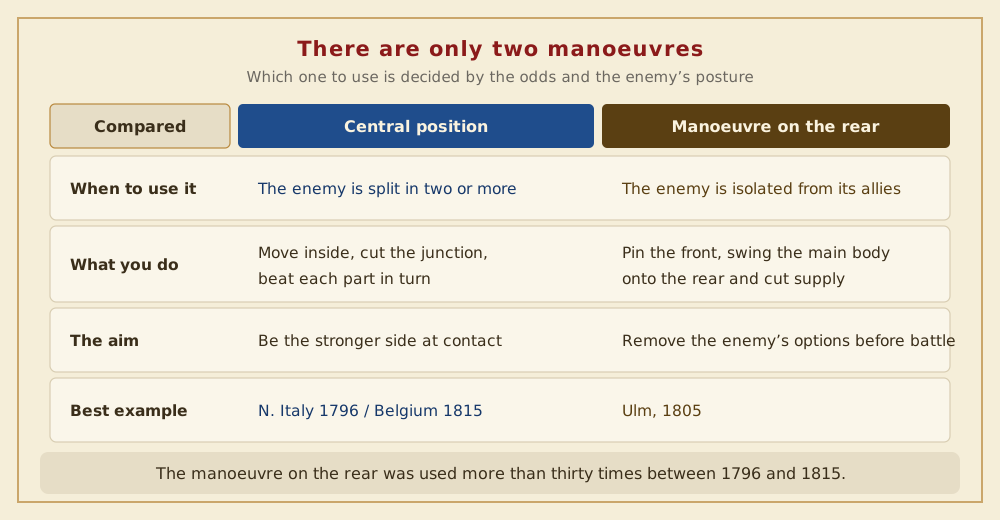
Operationally there are only two.
(1) The central position, or interior lines — used when you are outnumbered and the enemy is in two or more parts. You move inside them, cut the junction, and beat each part in turn. You lose on the total and win at every point of contact.
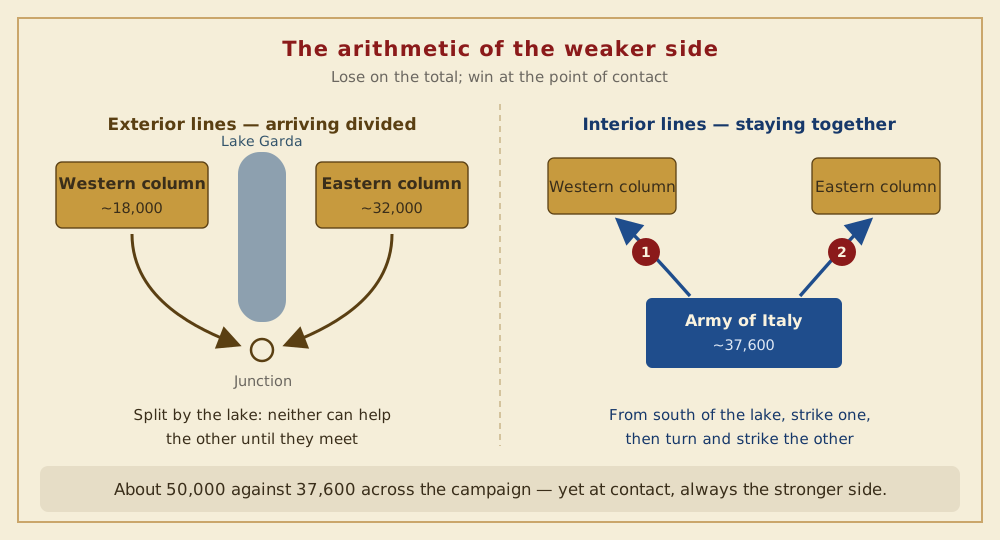
(2) The manoeuvre on the rear — used when you are the stronger side and the enemy is isolated from his allies. A small force pins him frontally while the main body, screened by cavalry, swings round onto his flank and rear to cut the line of retreat and supply. He then has to fight with his back to nothing, unsupplied. This manoeuvre was used more than thirty times between 1796 and 1815[3].
Ulm in 1805 is the classic case. Expected to come straight through the Black Forest, the army instead swung far to the north, reached the Danube and cut communications with Vienna. On 20 October about 25,000 men surrendered in Ulm itself; across the campaign some 50,000 to 60,000 were taken out of the war. Those are two different numbers and should not be merged[3]. An army had been removed with barely a battle.
4. Part 3: speed, and what living off the land bought
A manoeuvre is worthless if it is slow: the point is to finish the deployment before the enemy can react. The source of that speed was less the marching than the supply method.
Convention at the time was the magazine system: an army drew on depots behind it as it advanced. Safe, but the distance from the depot limits how far you can go. The French loosened that, relying heavily on requisition from the districts they passed through. The shorter the chain to the depot, the further and faster you can move.
The effect shows in the numbers. In 1805 roughly 210,000 men left the camps at Boulogne, crossed the Rhine on 26 September and stood on the Danube by 6 October. Some units covered 32 km a day, and up to 40 km on forced marches[4].
There was a price. Requisition exhausts the districts it crosses and manufactures hostility. In thinly populated country — Russia in 1812 — there is simply nothing to take. The method that bought the speed became the deepest weakness: in Spain and in Russia alike, that is where failure begins.
5. Part 4: massed fire and changing formation
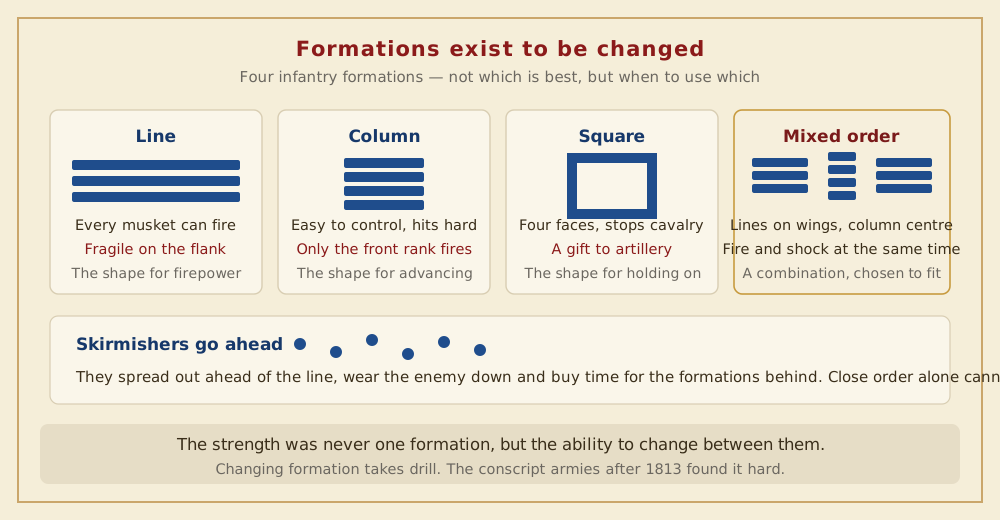
What happens once you arrive is tactics in the narrow sense. Infantry had four formations. The line lets every musket fire but is fragile on the flank and against cavalry. The column is easy to control and hits hard, but only its front ranks can shoot. The square stops cavalry and is a gift to artillery. Mixed order puts lines on the wings and a column in the centre so fire and shock arrive together. Ahead of all of them, skirmishers spread out to wear the enemy line down while the formations close.
None of these is best. The strength was being able to change between them to suit the arm you faced and the ground you stood on. Changing takes drill — and that flexibility declined in the conscript armies after 1813.
On the fire side, the use of artillery shifted. Instead of dispersing guns to support infantry, they were massed against one decisive point and used to break it. The extreme case is Friedland in 1807. Sénarmont gathered about 30 guns and advanced the batteries themselves in stages, finishing at roughly 55 to 110 metres — inside musket range — and firing canister into massed infantry[1]. About half his own gunners were hit.
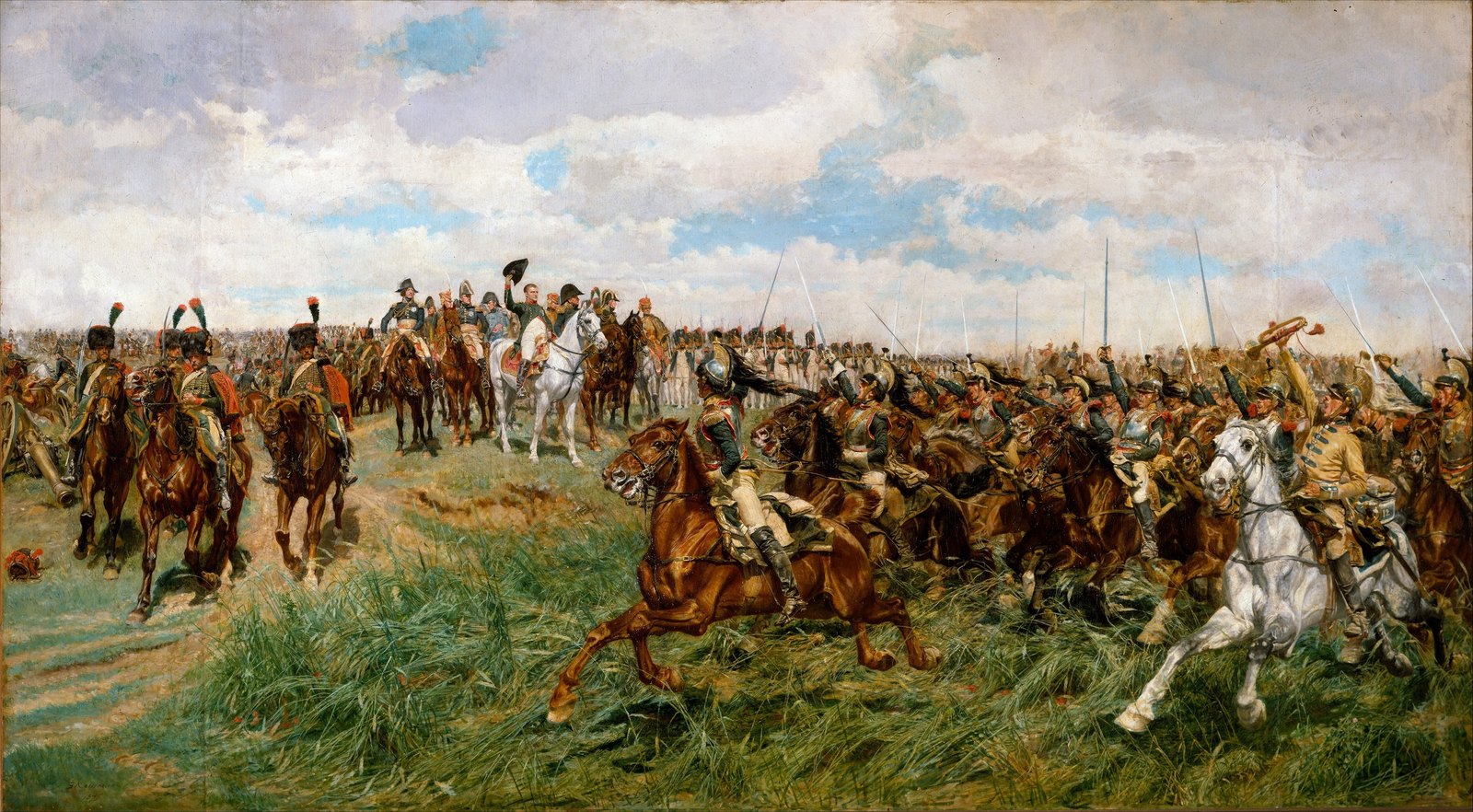
That line runs on to the roughly 112 guns massed in the centre at Wagram and to the frontal grinding of Borodino. From fire finishing what manoeuvre had set up, to fire as the main act — this part carries the record of that shift.
6. The day it all worked together
Strength (2 December 1805)
Allies about 1.2×
Losses
FR about one third
Austerlitz is where all four parts worked at once. The French were outnumbered. The right was deliberately left thin to draw the enemy onto it, and when the central heights emptied, a concentrated force went up them. The split enemy was then processed in turn, and the loss ratio came out at roughly one to three and a half.
What did the work was inducement — arranging the situation so that the enemy's correct decision was itself the opening. That is treated at length in the Austerlitz article. The point to hold onto is one line: this technique assumes an enemy who acts.
7. The four preconditions
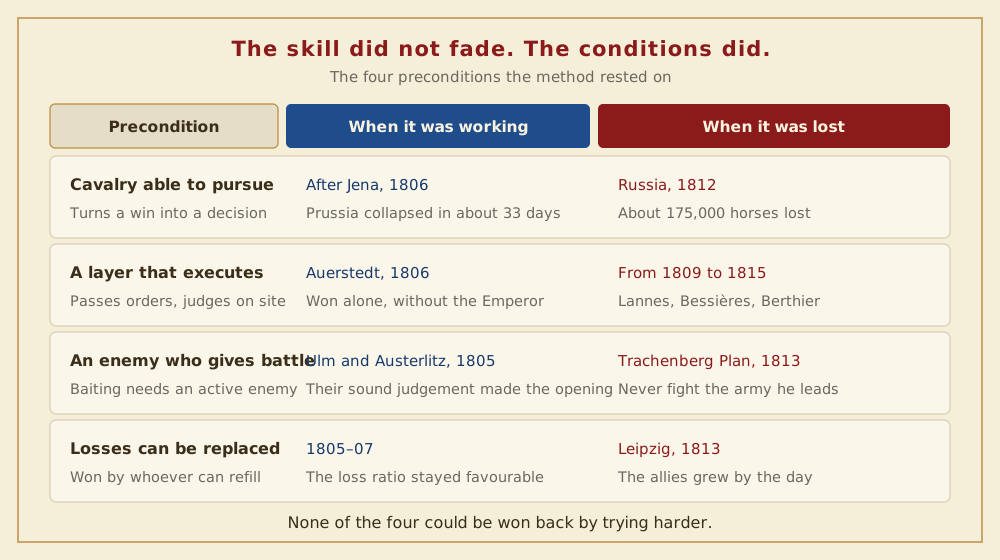
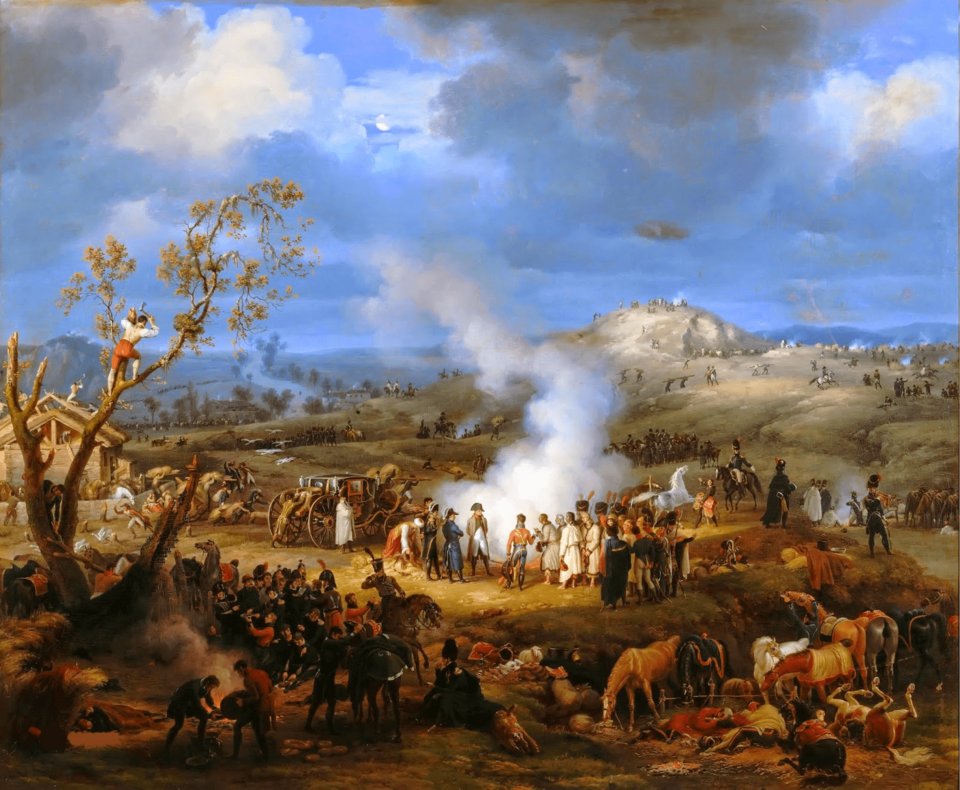
The preconditions matter more than the parts. The method worked while these four held.
(1) Cavalry able to pursue. What turns a win into a decision is the pursuit. Prussia collapsed in about 33 days after Jena in 1806. But after 1812, with roughly 175,000 horses lost, victories stopped breaking enemy armies[5].
(2) A layer of men who execute. The people who turn an intention into orders and who judge for themselves in the field. Lannes died in 1809, Bessières in 1813, and the chief of staff Berthier on 1 June 1815. By the Hundred Days, that layer was all but empty.
(3) An enemy who gives battle. Both inducement and concentration assume the enemy will act. The Trachenberg Plan of July 1813 removed that assumption in a single line: never fight the army he commands in person, fight his marshals[6].
(4) Losses that can be replaced. At Leipzig the allies grew by the day while French reinforcements trickled. Attrition is won by whoever can refill.
None of these can be recovered by getting better at the job. "He declined in his later years" is a weak explanation precisely because it converts a change in conditions into a change in a man.
8. What it suggests today
(1) Don't try to win overall; win where contact happens. The weaker side that tries to match the stronger side in total loses continuously until it catches up. This method points somewhere else: if you can choose where and when contact occurs, local superiority is always available. In a market or an organisation, the number that matters is not the total but the number at the point of collision.
(2) Strengths rest on conditions, and some conditions are not yours to protect. The better a method works, the more invisible its supports become. Cavalry that could pursue, subordinates who could judge, an opponent who would engage, resources that could be replaced — all of them looked like features of the world rather than assumptions. Explaining failure as a loss of ability hides the change in conditions. The question to ask on a schedule is not "what have we got worse at" but "what does our way of winning assume, and does it still hold".
9. Closing
Told as genius, Napoleonic warfare leaves nothing to learn. Broken into parts and conditions it reads differently. The corps system was a way of getting dispersal and concentration at once; the two manoeuvres were a choice made by the odds; the speed was bought by a supply method; massed fire finished what movement had arranged.
And over twenty years, the four preconditions came away one at a time. The same drawing does not build the same thing in different ground. Read this way, each battle stops being a scoreline and becomes an observation point: was the condition alive that day, or already gone.
Each war is read as a whole on the campaign pages, and every battle discussed here is on the chronology, where the same structural reading is applied one day at a time.
Sources
- David G. Chandler, The Campaigns of Napoleon, Macmillan, 1966.
- The Napoleon Series, The Development of the Corps d'Armée.
- Wikipedia contributors, Ulm campaign.
- Harrison W. Mark, Ulm Campaign, World History Encyclopedia, 2023.
- The Napoleon Series, Napoleon's Equine Strategy in 1813.
- J. Rickard, Trachenberg Plan, 12 July 1813, History of War.
- Andrew Roberts, Napoleon: A Life, Allen Lane / Penguin, 2014.