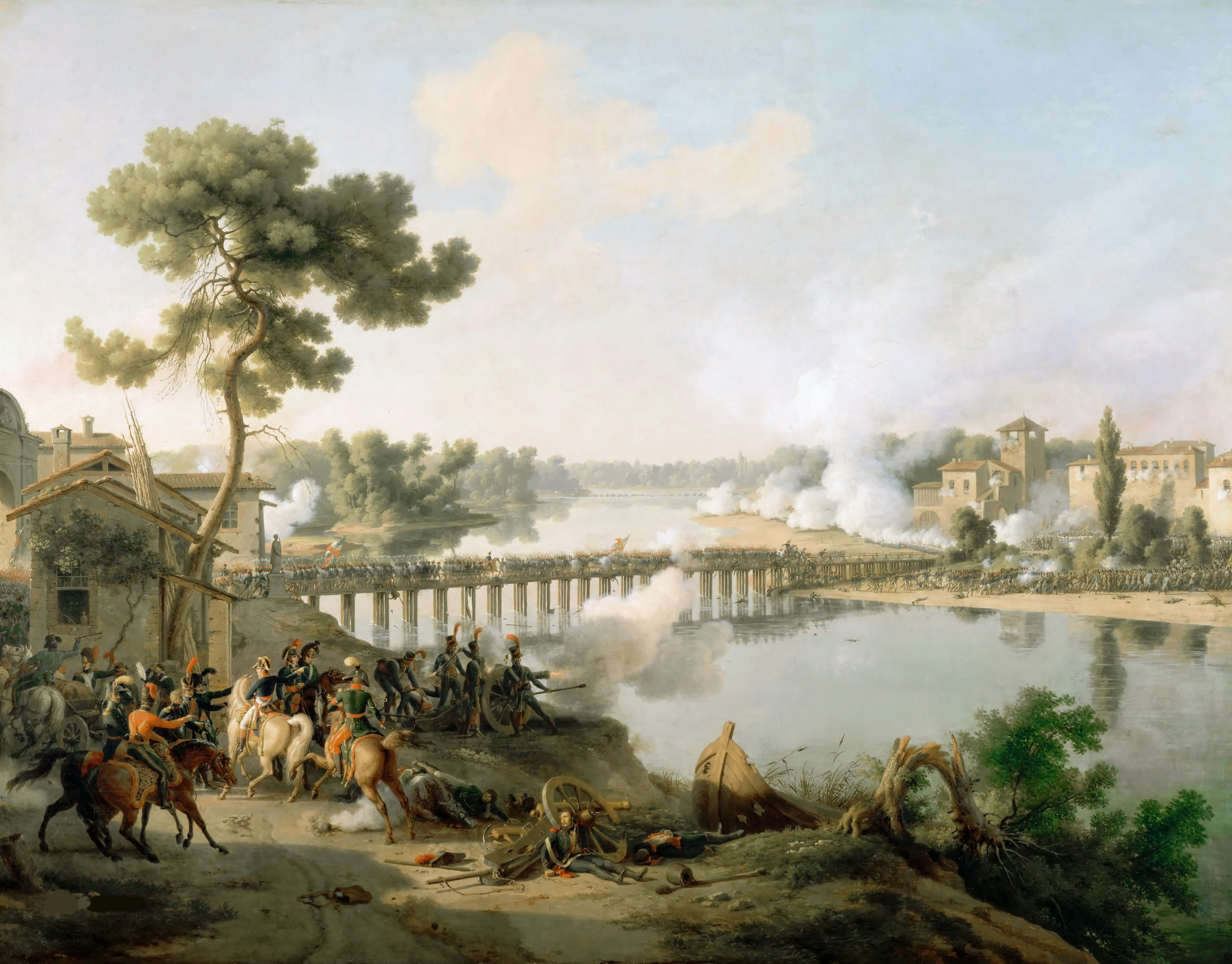
In March 1796 a 26-year-old general took over the Army of Italy: unpaid, unshod, the least regarded force France had. Nineteen months later he had brought Austria to the negotiating table and broken the First Coalition. What was invented in this campaign was not a tactic. It was a circuit that turned victory into capital the home government could not afford to lose.
1. What was actually at stake
For the Directory in Paris, Italy was a secondary theatre. The main effort was in Germany; the Army of Italy existed to draw enemy troops south. Money and reinforcements went elsewhere.
In March 1796 that army amounted to roughly 37,600 men and 60 guns[5]. Pay was months in arrears and, when it came, arrived as mandats territoriaux — paper worth almost nothing[2]. The government had nothing left to give.
So what was really being played for was not territory in northern Italy. It was which of the two — the capital or the front — would end up needing the other. A government that gives nothing can demand nothing. The 26-year-old commander understood that asymmetry from the day he arrived.
2. The arithmetic of the weaker side
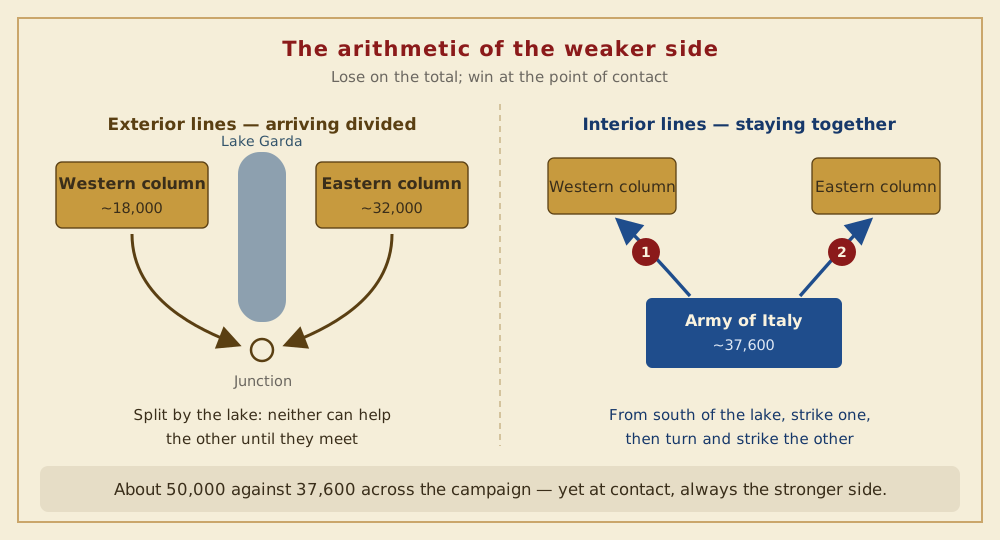
The method itself was simple. While the enemy is divided, do not divide. Move inside before his two wings can join, deal with one, then turn and deal with the other. You lose on the total and win at every meeting.
Within three weeks it produced its first result. On 12 April at Montenotte the seam between the Austrian and Piedmontese armies was split; Millesimo, Dego and Mondovì followed; and on 28 April the Armistice of Cherasco took the Kingdom of Sardinia out of the war[8]. Five engagements removed a country from the enemy coalition.
Lodi, on 10 May, was one episode in that sequence. From arrival at noon to the decision at dusk it lasted six and a half hours, and the assault on the bridgehead that settled it took about thirty minutes[3]. That he later said "here I realised I was a superior being" has nothing to do with the scale of the action and everything to do with the name the army gave him afterwards.
First relief, July–August 1796
AT about 1.3×
Rivoli, 14–15 January 1797
AT about 1.2×
All four relief attempts were made with superior numbers, and all four failed. Total strength explains nothing about this campaign.
3. Mantua as a magnet
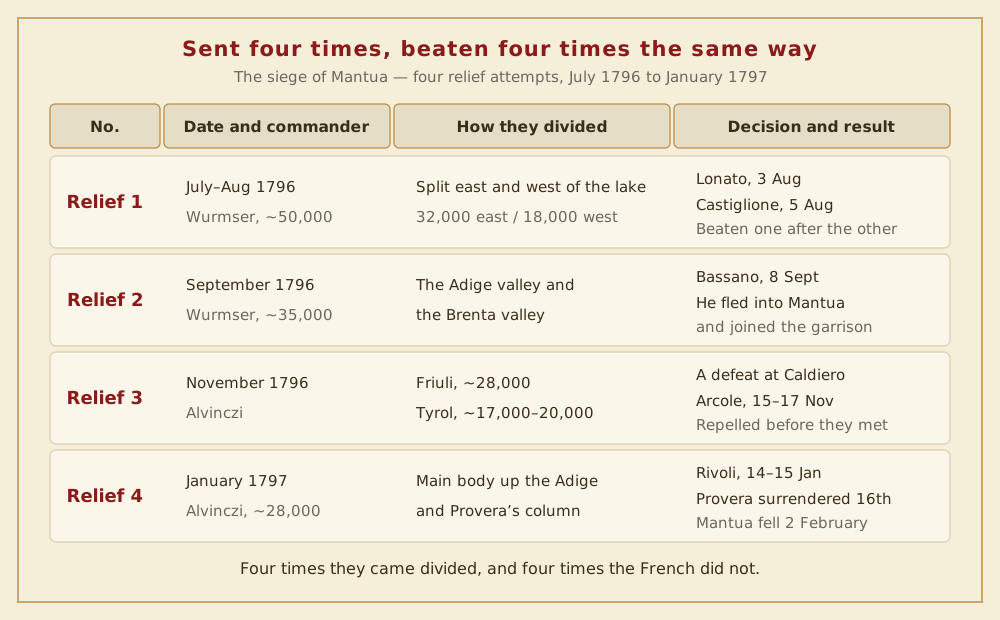
The blockade of Mantua began on 4 June 1796 and ran until the fortress surrendered on 2 February 1797[4]. That fortress gave the campaign its shape: Austria could not abandon it, so relief armies had to keep coming. A siege is a burden on the besieger and, at the same time, a magnet that draws the enemy to you.
All four of the armies it drew arrived in separate columns, marching down valleys divided by mountains or by the lake, unable to help each other until they met. Wurmser split his force east and west of Lake Garda in the first attempt and was beaten in turn at Lonato on 3 August and Castiglione on the 5th[6]. In September he divided again between the Adige and the Brenta and lost at Bassano on the 8th[5].
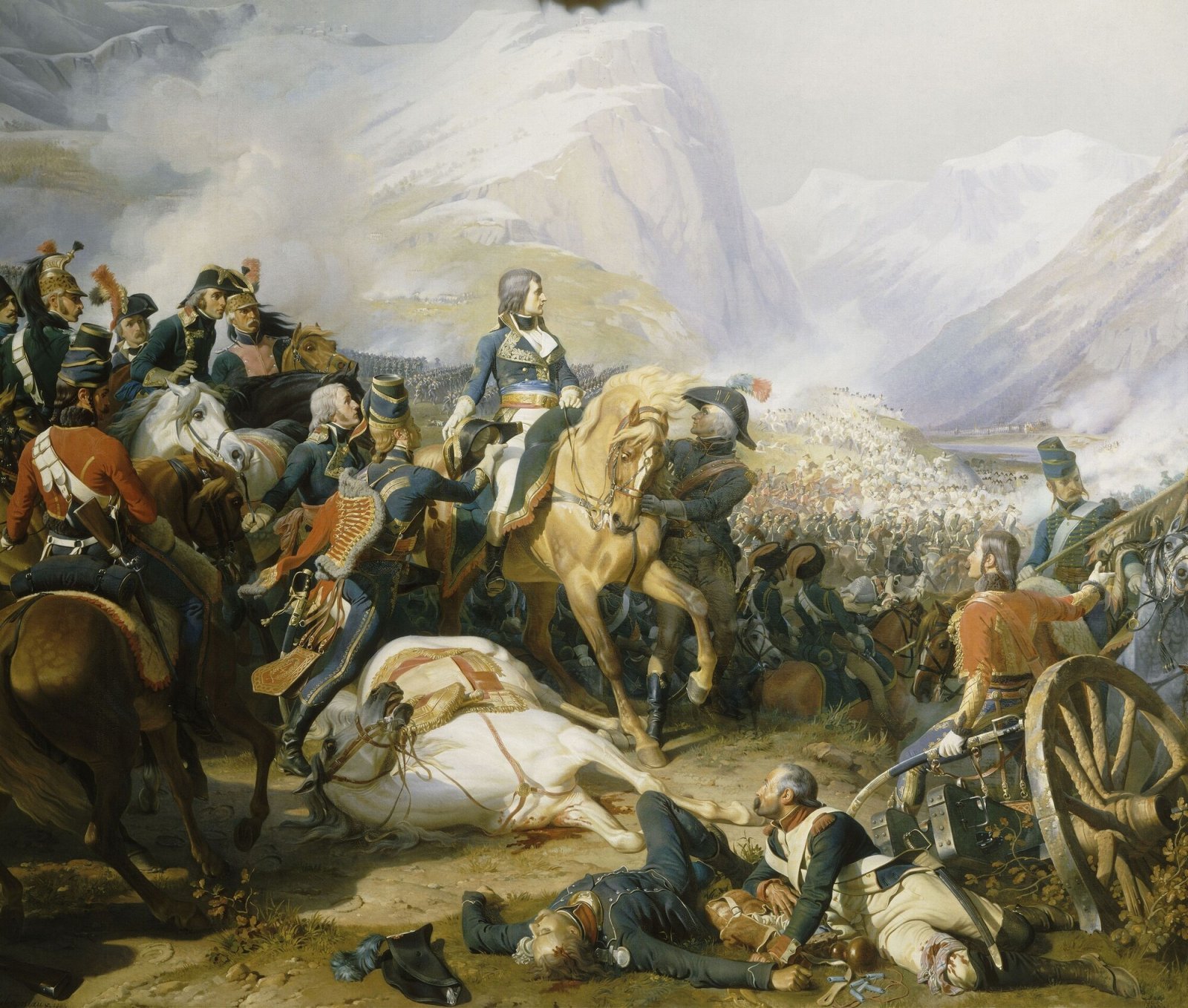
In November Alvinczi planned a convergence of about 28,000 from Friuli and 17,000–20,000 from the Tyrol; the two never kept step, and one was pushed back at Arcole before the other arrived[5]. January's attempt split again between the main body and Provera's column: the main body was destroyed at Rivoli and Provera surrendered on the 16th[4].
French side (ages in April 1796)
-
Commander
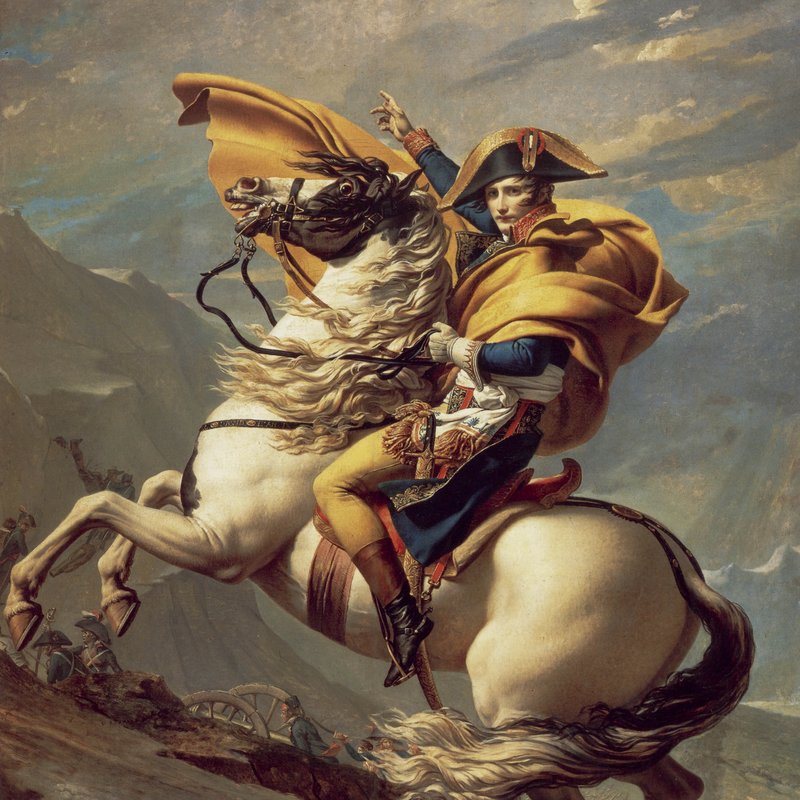 Napoleon (commanding the Army of Italy, 26)
-
Division
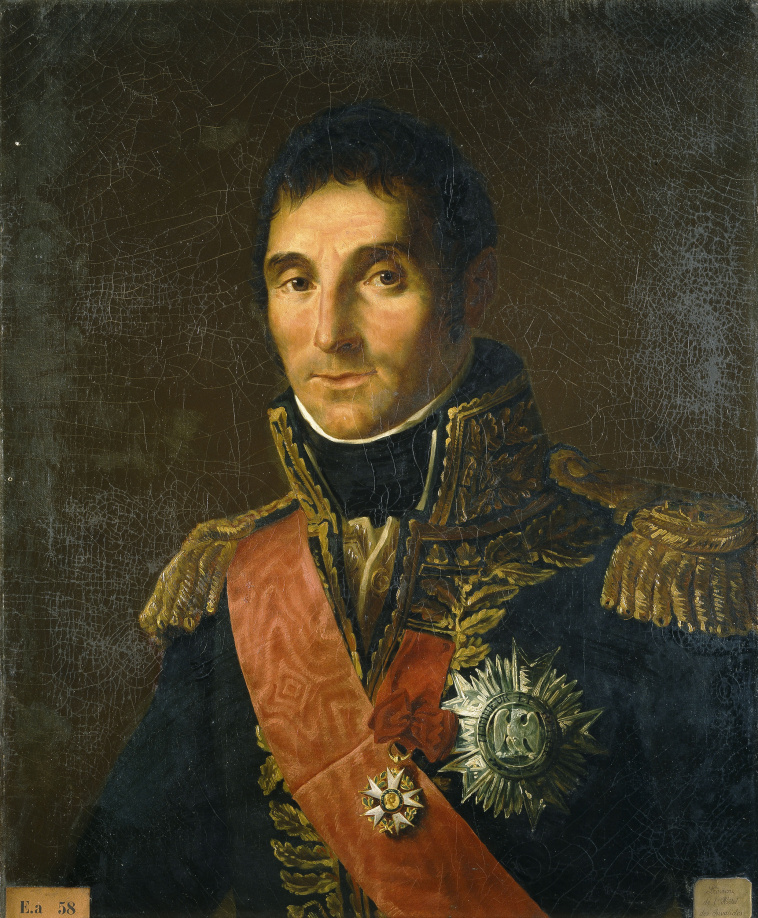 Masséna (vanguard and pursuit, 37)
-
Division
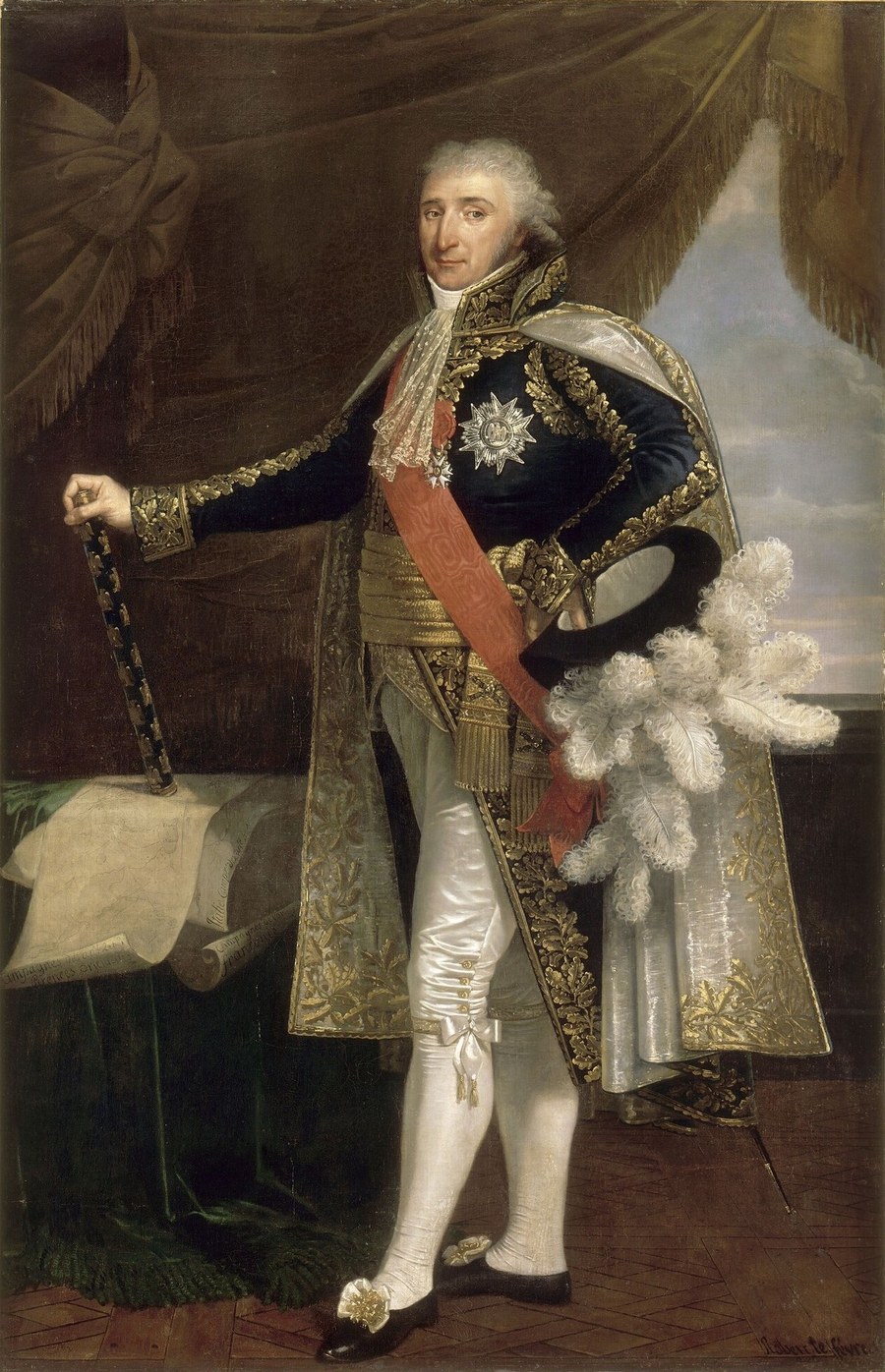 Augereau (the weight at Castiglione, 38)
-
Chief of staff
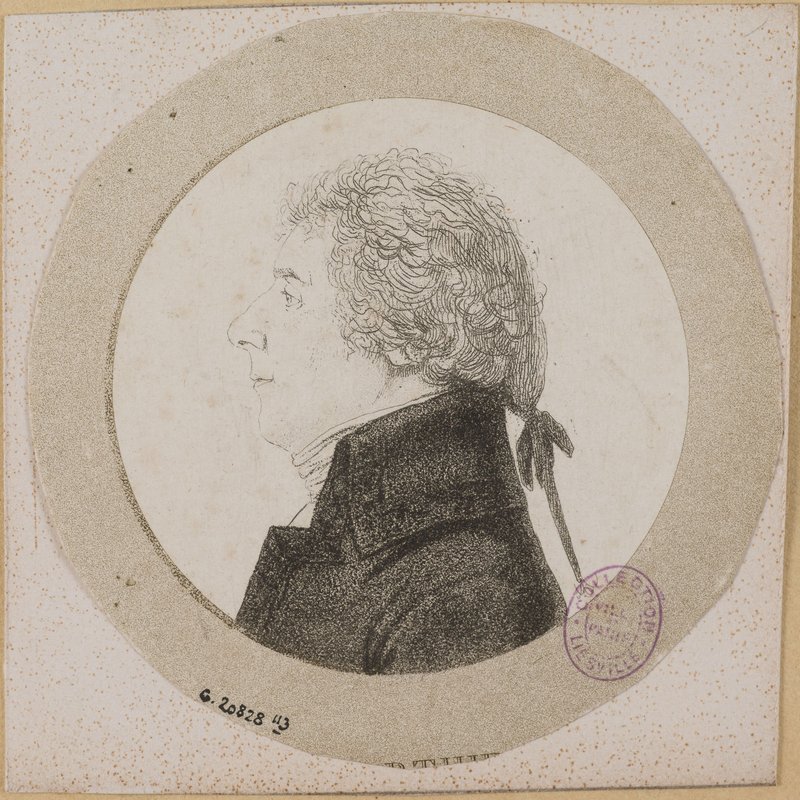 Berthier (the man who made orders work, 42)
Austrian side (ages at their own moment)
-
At the outset
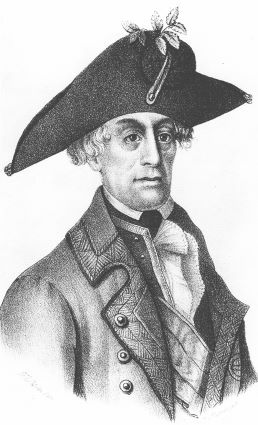 Beaulieu (commanding in Italy, 70)
-
Reliefs 1–2
 Wurmser (field marshal, 72; ended inside the fortress)
-
Reliefs 3–4
Alvinczi (field marshal, 61)
The man who came to relieve the fortress and became another mouth in it
Beaten at Bassano in the second attempt and cut off, Wurmser fled into Mantua. The general who had come to relieve the place joined its garrison, and the fortress went from about 14,000 men to roughly 30,000[4]. What had increased was not fighting power but the number of mouths eating the stores. On the day of surrender only about 16,000 were fit to march, and the garrison had lost 16,333 men to combat and disease over the siege[4]. What was sent to save the fortress shortened its life.
4. The circuit that turned victory into capital
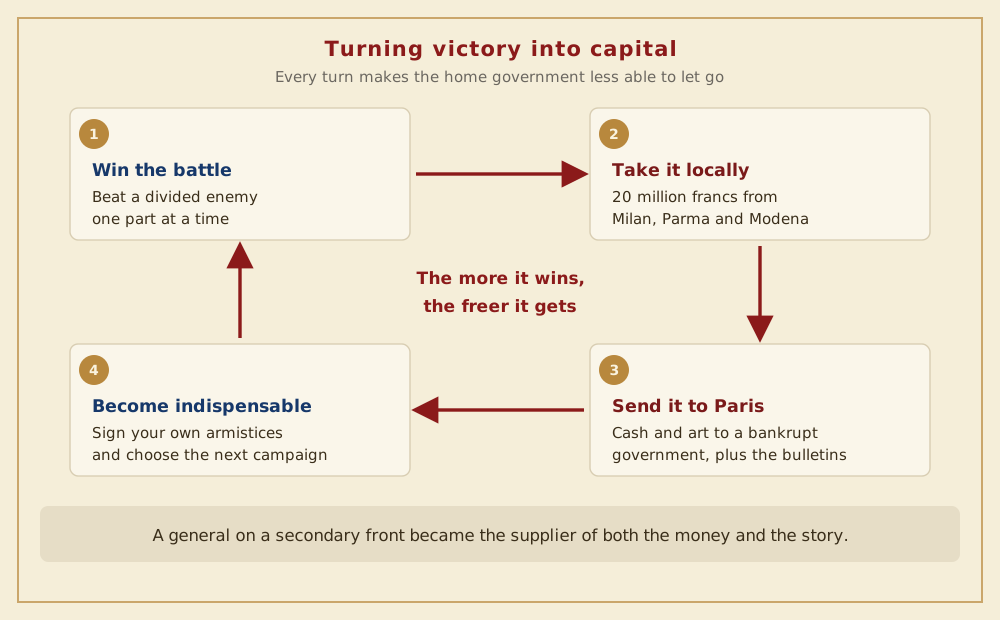
Win, and you can take from the country you hold. Milan and the duchies of Parma and Modena yielded 20 million francs, and for the first time since 1793 the Army of Italy was paid in hard cash[2]. Some 200 paintings and 100 sculptures went to Paris in the same period[2]. A bankrupt government was now being supplied by its own front.
Money was not the only thing travelling. The nickname the army coined after Lodi — le petit caporal — fixed the image of a commander who shared the soldiers' risk. At Arcole in November 1796 the story of a flag carried onto the bridge entered circulation, and Gros's painting made it the prototype of the heroic image. What was done on the battlefield and what was said about it pointed the same way.

Nor was the telling left to chance. The Courrier de l'Armée d'Italie, founded on 20 July 1797, was one of two newspapers the commander ran and sent home; extracts were reprinted in the Paris press, successes emphasised and failures unmentioned[7]. The flow of money and the flow of story reached the capital along the same channel.
5. Four things that decided the campaign
The enemy arrived divided, every time
All four relief attempts came in separate columns cut off from each other by mountains or the lake[4]. The one arrangement that guarantees each part can be beaten alone was offered up by the other side, four times.
The French did not divide
The siege was raised and the siege train abandoned rather than split the field army[6]. Choosing concentration over equipment is what kept producing local superiority.
The army could feed itself
Requisition cut the chain to depots and magazines. An army that is not waiting for its own supply is fast, and speed here meant arriving before the enemy columns could join.
6. If the conditions had been different
What follows is a thought experiment based on the sources. The outcomes cannot be demonstrated; the point is to make the dependencies visible.
| Condition changed | Immediate effect | Effect on the campaign |
|---|---|---|
| A: the siege is not raised for the first relief | The siege train survives; the field army is split in two | Local superiority becomes impossible. Most likely the fortress is kept and the field is lost |
| B: the relief armies arrive as one body | The enemy is also the stronger side at contact | The arithmetic of interior lines collapses. But Austrian practice favoured converging columns and chose them four times running |
| C: no requisition; wait for supply from France | Marching speed falls; the men stay unpaid in paper | Before any battlefield effect, there is no cash to send to Paris. The circuit never turns |
Only C changes the outcome without changing a single battle. The decisive part of this campaign sat outside the tactics.
7. Consequence: a general takes over the diplomacy
The preliminaries at Leoben on 18 April 1797 and the Treaty of Campo Formio on 17 October ended the war[1]. What matters is less the terms than who negotiated them. From the armistice at Cherasco in April to the final treaty, the man settling and signing was the commander in the field. The disposal of the Venetian Republic, more than a thousand years old, was decided inside that judgement.
The Directory could only ratify. And what put it in the position of having to ratify was not the victories themselves but the circuit that kept converting them into cash and public opinion. The relationship established here removes the government itself two years later.
The same method becomes far more explicit in the Marengo campaign of 1800, where a battle nearly lost was rewritten by the bulletins into a victory that had gone to plan. At Austerlitz in 1805, the battlefield half of the method is completed as well.
8. What it suggests today
(1) A position that is given nothing can become the position that supplies. A department that receives no budget and no people does not change its order in the queue by arguing better. What this campaign shows is a different route: become the supplier of what the centre needs — cash, results, a story it can tell — and requests start being treated as requests. The order matters. Discretion is not obtained by asking; it arrives as a by-product of dependence.
(2) If the competition arrives divided, you only have to stay whole. In a market where a rival is pushing several products at once, the moment you try to answer all of them you are divided too. What the four relief attempts demonstrate is a plain fact: a force that has split cannot help itself until it reunites. You can be smaller overall and still be the bigger side at the one place you choose to meet.
9. Closing
The First Italian Campaign is usually told as the campaign in which an unknown general became famous. Structurally, what happened was not the acquisition of fame but a reversal of dependence. A government with nothing to give and an army with nothing to its name: nineteen months later the government could not afford to let the front go.
This was not the campaign that invented a way of winning, but the campaign that invented a use for winning. The battlefield arithmetic — beat a divided enemy one part at a time — is only the engine that drives the circuit. Examined on its own, it cannot explain why these eighteen months put one man at the centre of a state.
Next: the Marengo campaign, where the circuit connects directly to power.
Sources
- David G. Chandler, The Campaigns of Napoleon, Macmillan, 1966.
- Andrew Roberts, Napoleon: A Life, Allen Lane / Penguin, 2014.
- Encyclopædia Britannica, Battle of Lodi.
- Wikipedia contributors, Siege of Mantua (1796–1797).
- J. Rickard, Napoleon's Campaign in Italy, 1796-97, History of War, 2009.
- Harrison W. Mark, Battle of Castiglione, World History Encyclopedia, 2023.
- Wayne Hanley, The Genesis of Napoleonic Propaganda, 1796-1799, Columbia University Press / Gutenberg-e, 2005.
- J. Rickard, Armistice of Cherasco, 28 April 1796, History of War, 2009.