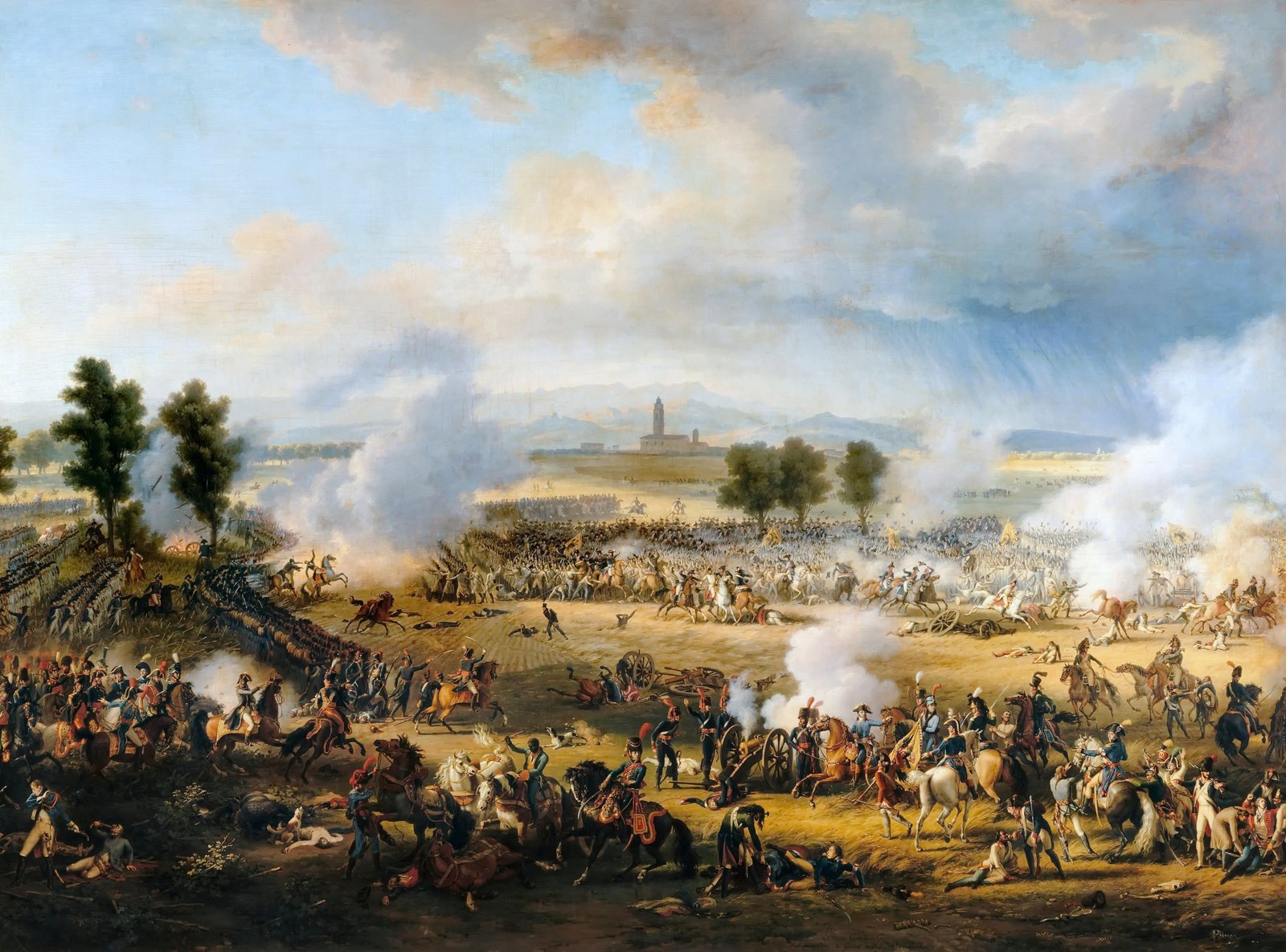
On the afternoon of 14 June 1800, First Consul Napoleon was on the brink of defeat. The Austrians had pushed his line back several kilometres, and Melas, certain of victory, left the field and reportedly dispatched word of his triumph to Vienna. Then, toward evening, Desaix—who had marched away from the battle—turned back on his own initiative, Kellermann's cavalry struck the enemy flank, and the situation reversed overnight. Victory was won—but only by the thinnest of margins. The story that "Napoleon engineered a flawless victory from the very start," however, was not made on the battlefield: it was manufactured in an official report rewritten three times after the fact. Marengo shows, more clearly than any other battle, that the victory and the story of the victory were built separately.
1. Key Facts
- Date
- 14 June 1800morning to evening
- Location
- Marengonorthern Italy, near Alessandria
- Belligerents
- France vs AustriaWar of the Second Coalition
- Result
- French come-from-behind victory→ Convention of Alessandria
Forces Committed (total)
Aus. about 1.1×
Forces on Field at the Crisis (morning–afternoon)
Aus. about 2× (local superiority)
Artillery
Aus. about 4–6×
Casualties (killed, wounded, captured)
Aus. higher (prisoners included)
| Role | France | Austria |
|---|---|---|
| Supreme command | 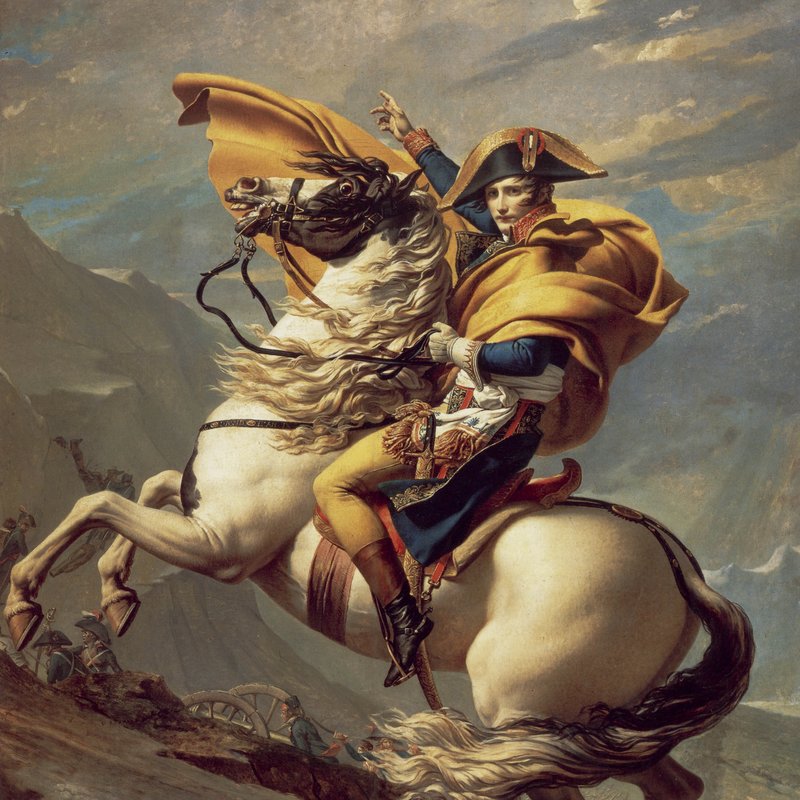 NapoleonFirst Consul, 30 NapoleonFirst Consul, 30 |
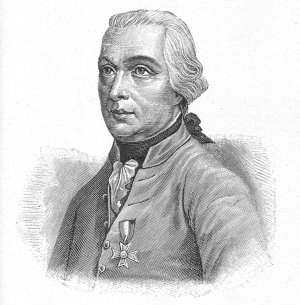 MelasAustrian commander-in-chief, 71 MelasAustrian commander-in-chief, 71 |
For the corps- and division-level chain of command, see §3 The Two Armies. The nominal commander-in-chief was the chief of staff, Berthier (the constitution forbade the First Consul from taking the field in person), but in practice Napoleon directed the battle.
2. Strategic Background: The "Necessary Victory" of a Seven-Month Consul
The key to understanding Marengo lies not on the battlefield but in the political clock in Paris. Napoleon had only just seized the office of First Consul in the coup of Brumaire in November 1799; at the time of the battle his regime was a mere seven months old. With rivals such as Joubert, Moreau and Bernadotte in the wings, he desperately needed a decisive military victory to underwrite the legitimacy of the new order[3].
The strategic situation, meanwhile, was unfavourable. In April 1800 the Austrians under Melas had been squeezing the French in Italy, driving Masséna into Genoa and besieging him there. Crucially, Genoa fell on 4 June—ten days before Marengo. Napoleon's expedition had therefore ceased to be a "relief of Masséna" and had become an operation to reconquer a northern Italy already lost.
A heroic depiction of the crossing of the Alps just before Marengo. In reality Napoleon rode a mule, but in the painting it has been replaced by a rearing charger—itself an instance of "designing the story."
Napoleon secretly assembled a reserve army (about 30,000) and, in mid-to-late May, crossed the Great Saint Bernard Pass (2,469 m) to descend into the Italian plain[5]. On 2 June he occupied Milan, swinging around into Melas's rear. Up to this point it was a brilliant piece of strategic maneuver. The trouble lay in what came next: in reading "how the enemy would move," Napoleon erred fatally.
3. The Two Armies and the Seeds of Dispersal
3-1. Chain of Command
French Army (Reserve Army)
-
Effective commander
Napoleon (First Consul, 30)
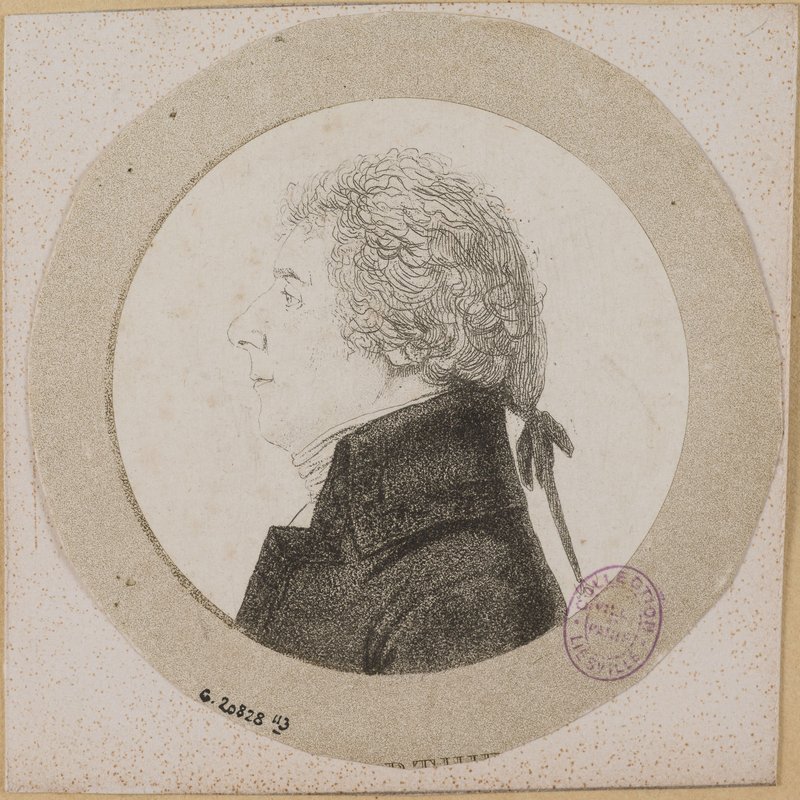 Louis-Alexandre Berthier (nominal commander-in-chief, 46)
-
Main morning defense
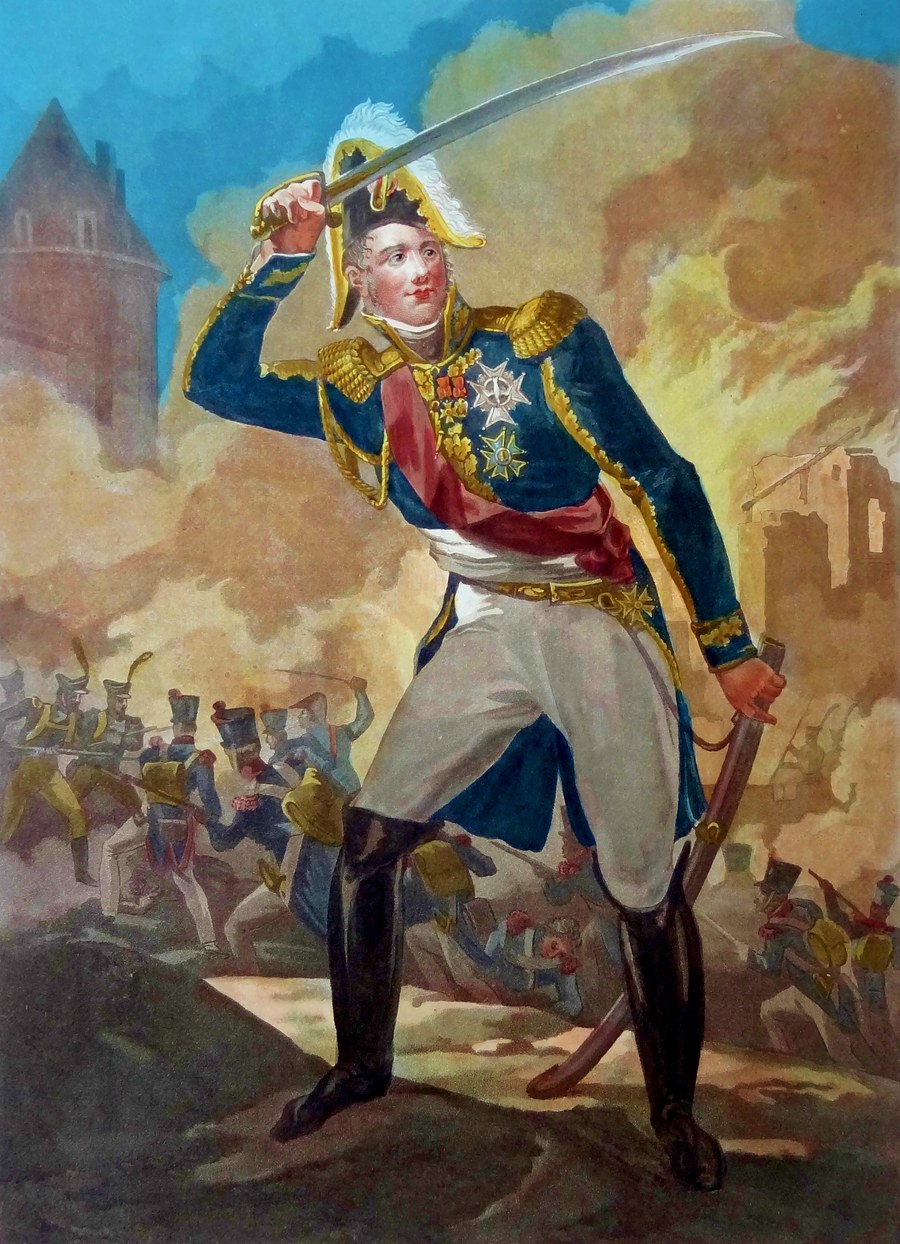 Claude Victor-Perrin (corps commander, 35)
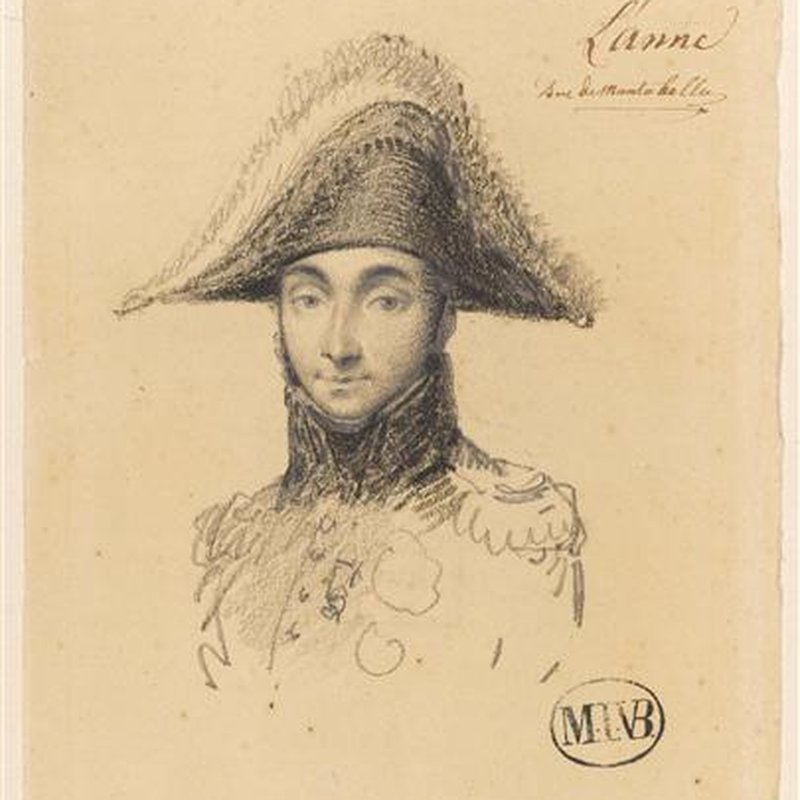 Jean Lannes (vanguard, 31)
-
Architects of the reversal
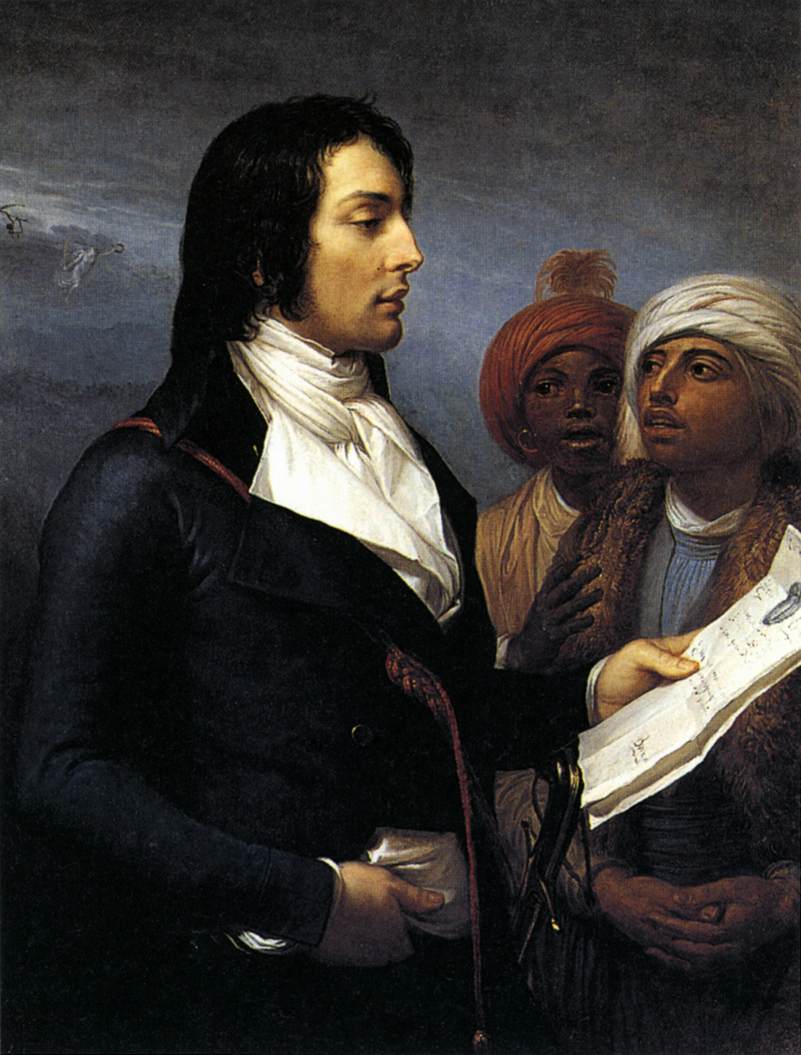 Louis Desaix (division commander, 31 / killed)
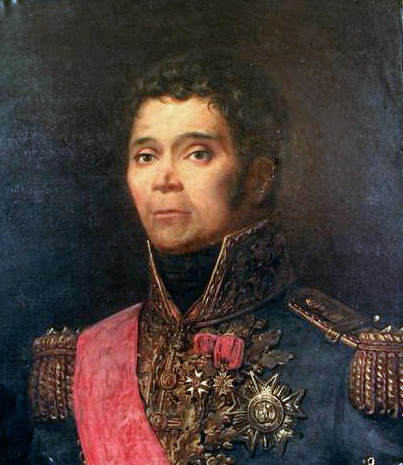 François-Étienne Kellermann (heavy cavalry, 29)
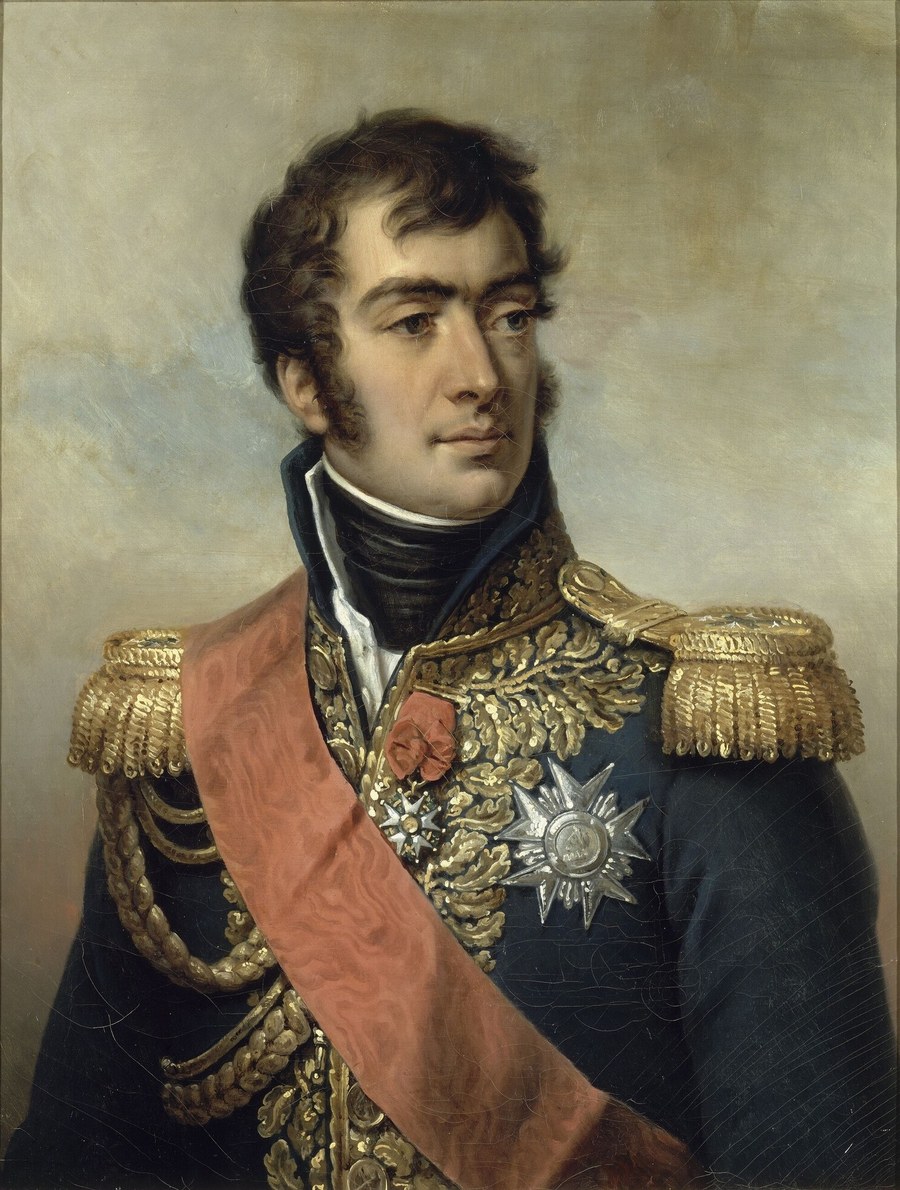 Auguste de Marmont (artillery, 25)
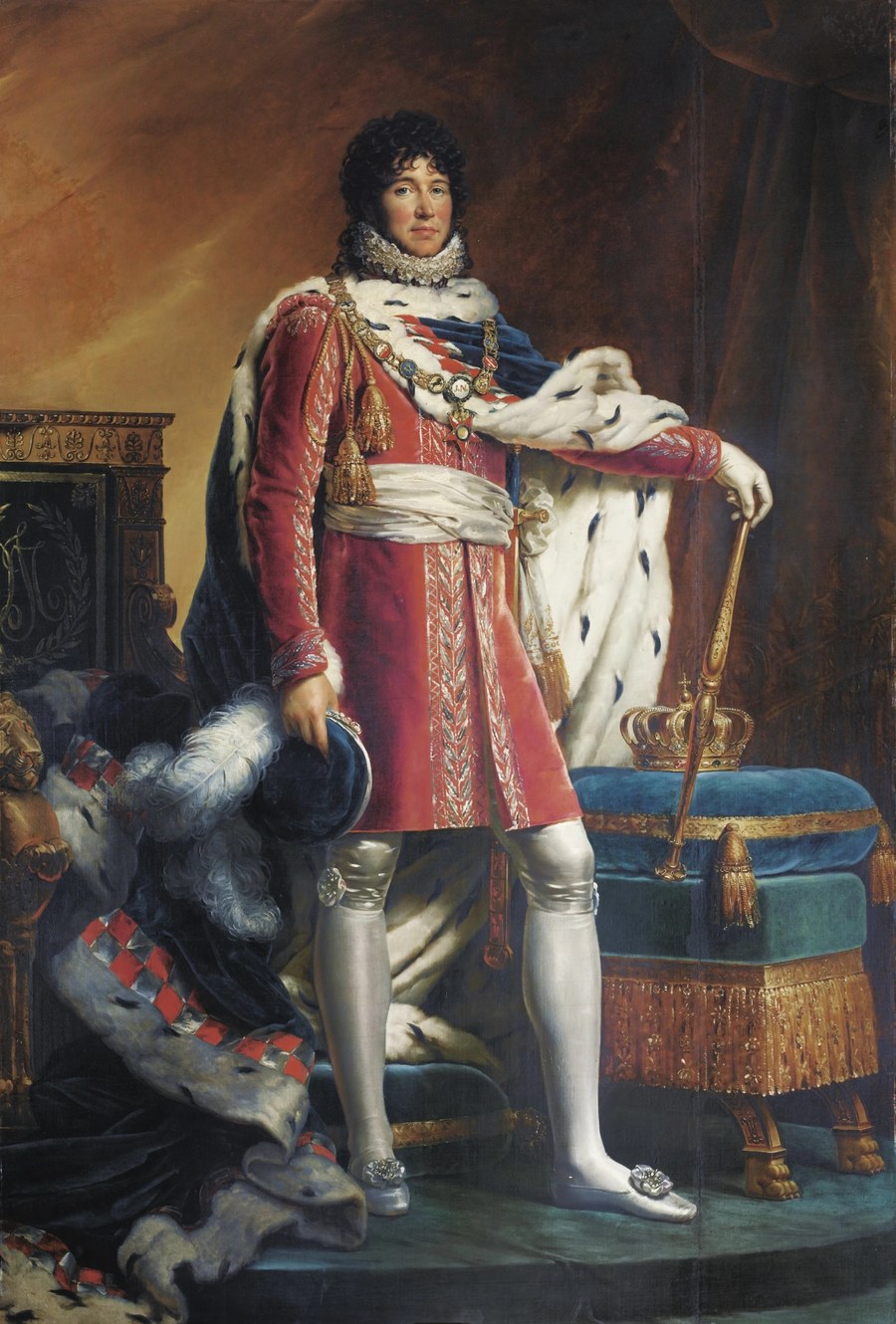 Joachim Murat (cavalry, 33)
Austrian Army
-
Commander-in-chief
Michael von Melas (commander-in-chief, 71)
-
Took command in the afternoon
 Anton von Zach (chief of staff / captured)
-
Right-wing column
Peter Karl Ott (toward Castel Ceriolo)
3-2. Dispersal as the Seed of Crisis
Napoleon read the situation as "Melas will avoid a decisive battle and slip away." Acting on that belief, and meaning to cut off the enemy's line of retreat, he detached Desaix's division to the south and spread his other formations widely[5]. As a result, when Melas crossed the river and launched his main attack on the morning of 14 June, the French could not concentrate enough strength on the field. Napoleon himself and the Consular Guard were several kilometres to the rear at Torre Garofoli.
This dispersal brought on the morning collapse. The crisis at Marengo had been prepared by Napoleon's own misjudgement before the fighting even began.
4. The Course of the Battle (Four Stages from Collapse to Reversal)
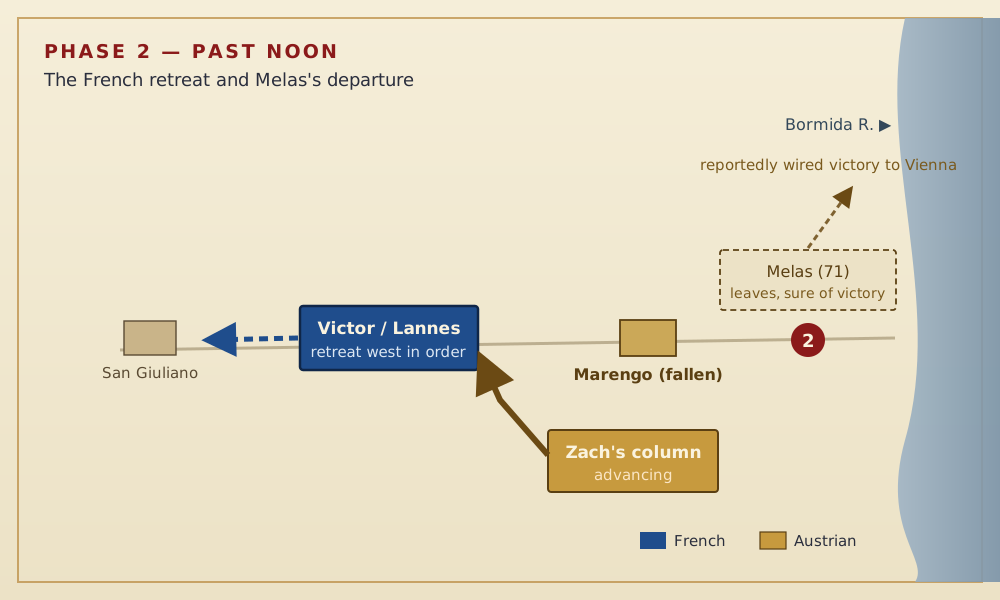
The phase maps below are based on cross-checking the sources (Chandler, the World History Encyclopedia, Wikipedia). Times vary among sources and are approximate. French = blue, Austrian = ochre.
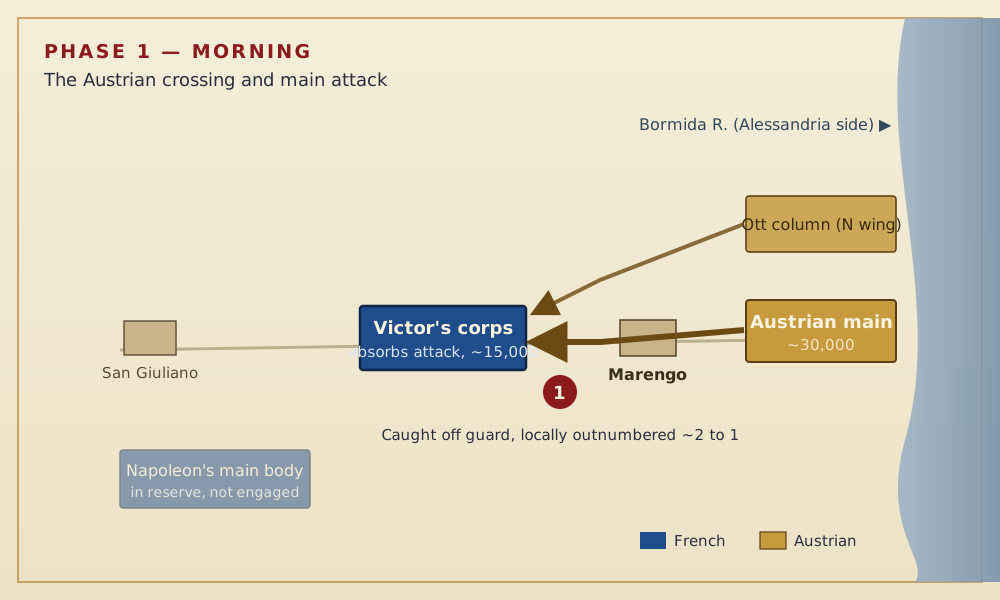
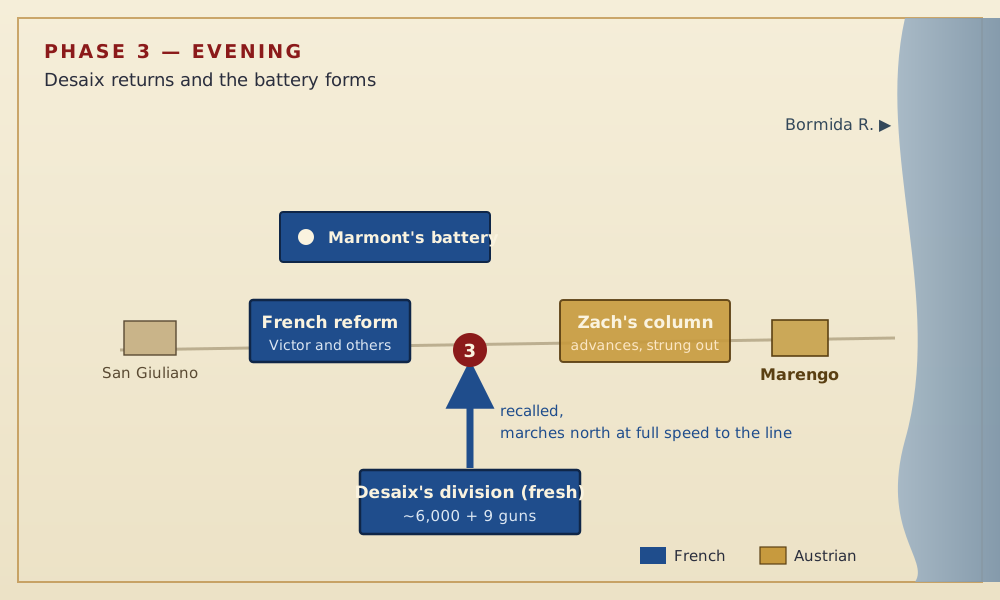
In the morning the Austrians crossed the Bormida and attacked en masse. The dispersed French were caught off guard, and Victor absorbed the main attack with about 15,000 men.
Past noon, the village of Marengo fell. The French fell back several kilometres. Melas (71), certain of victory, handed command to Zach and left the field.
Toward evening, Desaix—recalled to the field—returned with about 6,000 men and 9 guns. Marmont massed a battery, creating the springboard for the counterattack.
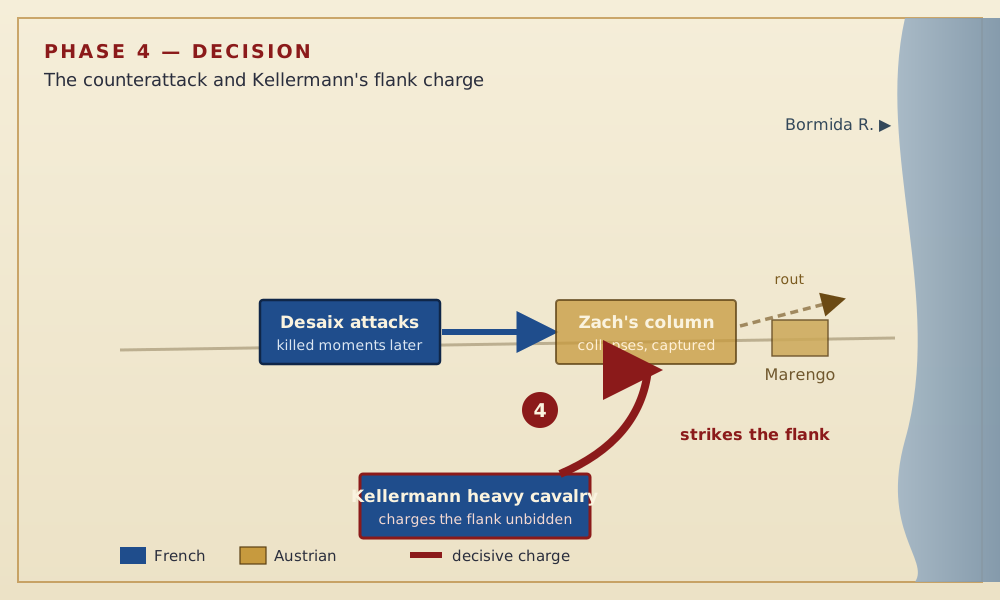
Desaix counterattacked frontally (and was killed moments later). At the same time, Kellermann's heavy cavalry charged the flank of Zach's column on his own initiative. The Austrians collapsed and Zach was taken prisoner.
Through the morning, the French were pressed by the Austrians' artillery (about 92–100 guns) and weight of numbers, and their line gave ground steadily. Past noon the village of Marengo fell, and the French retreated several kilometres across the plain. Around two or three in the afternoon, Melas, certain of victory, left the field and entrusted the pursuit to his chief of staff, Zach[5]. That conviction of having "won" lulled the Austrians into complacency.
5. Why It Came to the Brink of Defeat: The Misjudgement of Dispersal
The crisis at Marengo arose not because the Austrians were strong, but because Napoleon misread the enemy and dispersed his own army. Having sent Desaix south on the premise that "Melas will run," he found himself, on the morning of the decisive battle, locally outnumbered roughly two to one on the field.
This is the inverse of the picture at Austerlitz, where the allied army lost by clinging to "the premise of its plan." At Marengo it was Napoleon himself who deployed on a mistaken premise and was driven to within a step of defeat. The difference was that he had subordinates who could rescue him after the premise collapsed—and the pen, afterward, to erase that fact.
6. The Structure of the Reversal: Three Strokes of Luck and Initiative
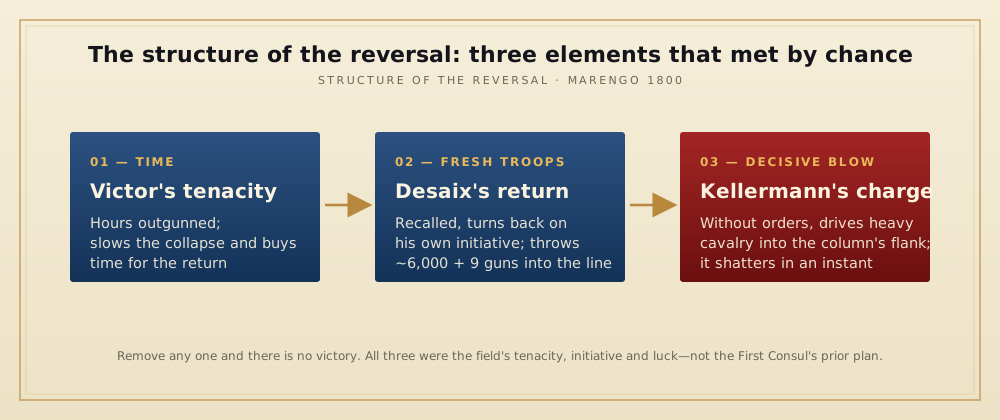
Around five in the afternoon the situation reversed dramatically. This was not Napoleon's plan but the result of three elements coming together by chance.
Victor's Tenacity (buying time)
Victor and Lannes, outgunned from the morning on, gave ground but slowed the collapse for several hours. This "selling time while losing" delay created the margin Desaix needed to return. Had the line broken outright, his return would never have arrived in time.
Desaix's Return (a reversal of initiative)
Detached to the south, Desaix received Napoleon's recall and turned back at full speed on his own judgement. About 6,000 fresh troops and 9 guns were thrown into the crumbling line. Had he been a little farther off, or a little later, the outcome would have been reversed[1].
Kellermann's Charge on His Own Initiative (the decisive blow)
As Desaix counterattacked frontally and Marmont fired at close range, Kellermann—without waiting for orders—drove his heavy cavalry into the flank of Zach's column. The column, advancing with its formation already strung out, disintegrated in an instant, and Zach and several thousand men were taken prisoner. What decided the battle was not the design of the First Consul, but the snap judgement of a single cavalry officer.
7. The Official Report, Rewritten Three Times
Here lies the heart of Marengo. From the moment victory was won, Napoleon began to remake the "official history" of the battle.
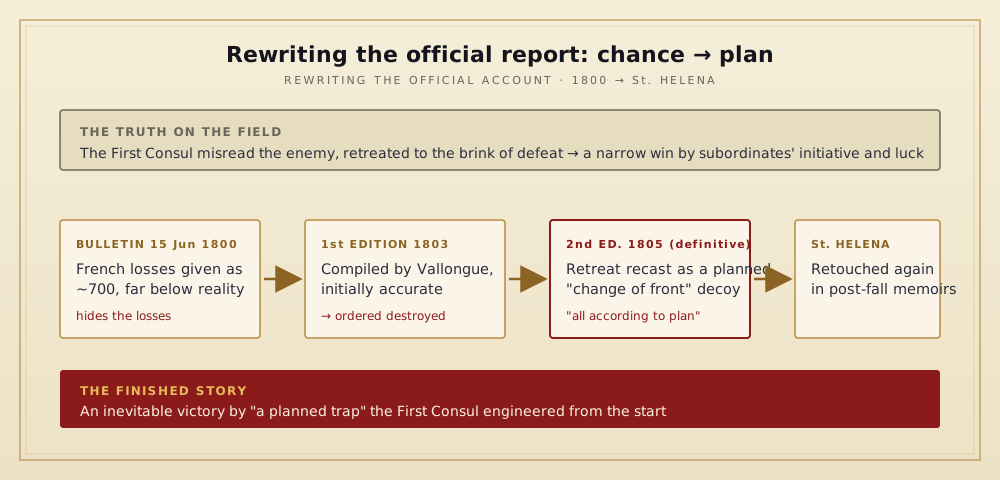
The problem was that the truth was politically dangerous. What actually happened was that "the First Consul misread the enemy, was driven to the brink of defeat, and was saved by the initiative of his subordinates and by luck." For a consul seven months into power, who needed a decisive victory to demonstrate his legitimacy, that account was unusable as it stood. So the report was rewritten by stages into "a planned victory engineered from the start"[4].
| Version | Date | Content and direction of revision |
|---|---|---|
| Bulletin | 15 June 1800 | The next-day army bulletin. French losses announced as about 700 (propaganda—a fraction of the real figure) |
| 1st edition | 1803 | Compiled by Colonel Vallongue of the War Ministry. Cross-checking the various records, it was initially quite accurate. But Napoleon ordered it destroyed |
| 2nd edition | 1805 | The definitive version, revised so that "everything had gone according to plan." The retreat redefined as a deliberate "change of front" |
| Re-revision | St Helena | In his post-fall memoirs, Napoleon once again retouched the account |
The Account of the Battle of Marengo issued under Berthier's name (the definitive version settled around 1805, after Austerlitz) likewise recasts the forced retreat of the morning as "a planned withdrawal to draw the enemy in while waiting for Desaix"[5]. Ironically, because a single copy of the 1803 version was later found under a desk, historians have been able to reconstruct a course of events closer to the truth[4].
This is a more naked form of the idea that first emerged at Lodi—of running the battlefield victory and the design of the story at the same time. At Lodi the staging embellished the facts. At Marengo the staging remade them. And at Austerlitz it was refined into nothing less than an ideological apparatus of empire.
8. The Death of Desaix and the Reassigned Credit
There was a further motive for the rewriting: the man who saved the victory was not the First Consul himself.
Desaix was hit at the head of the counterattack and was killed almost instantly (at 31). His dramatic dying words—"My only regret is not having done enough to be remembered by posterity"—are a later invention; in reality he is said to have had no time even to speak[3]. The dead do not speak. And so his deeds could be reshaped to suit those who did.
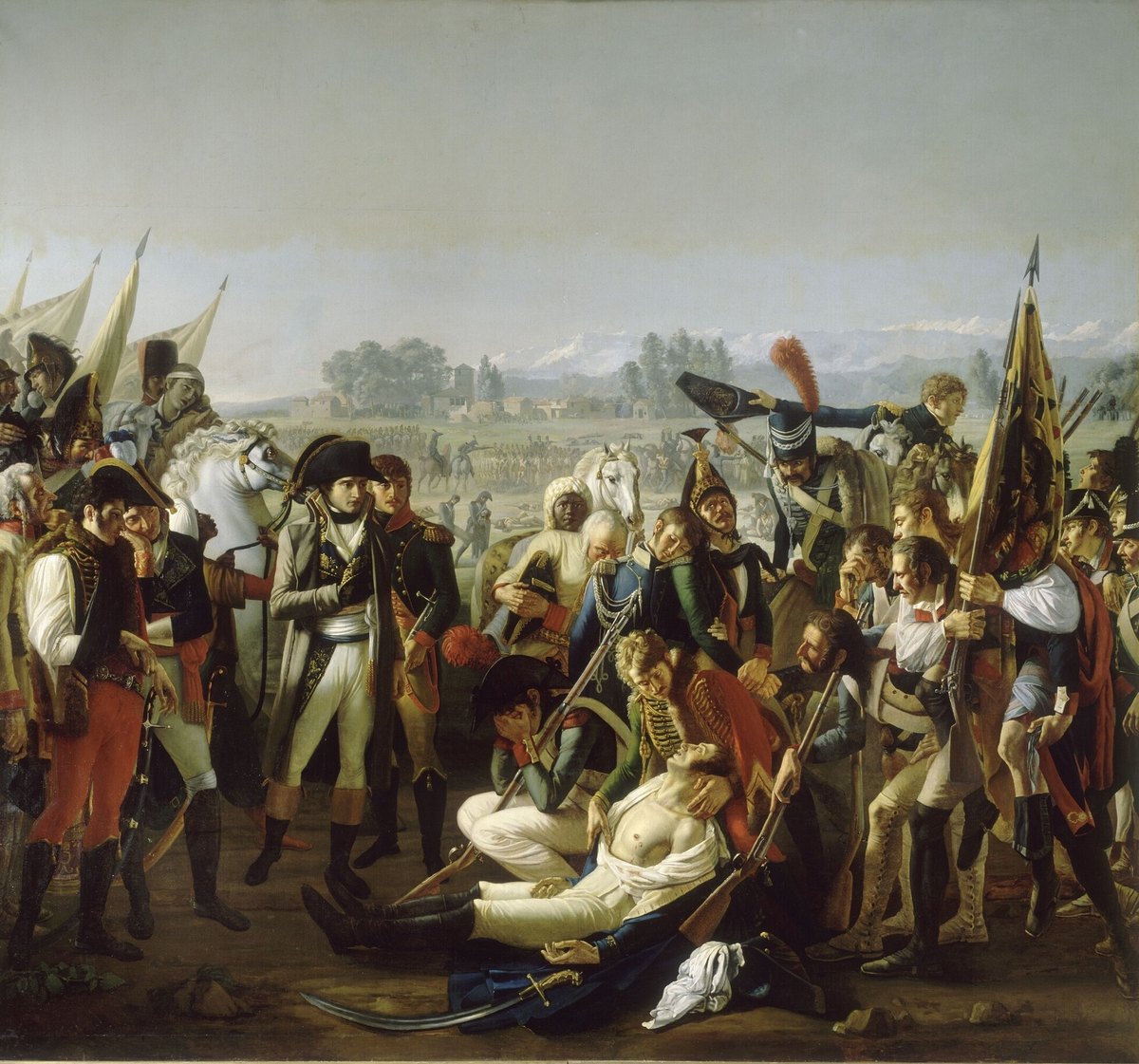
A hero falling at the moment of victory. Desaix's death was convenient for the myth—he could no longer lay claim to the credit.
The living claimants were more troublesome. Against Kellermann, who had struck the decisive blow, the bulletin of 15 June praised instead the charge of the Guard cavalry under Bessières, a man close to Napoleon. To Kellermann, Napoleon offered only a cold "that was a fairly good charge" (une assez bonne charge)[4]. In the report Kellermann's charge was written down as belle ("fine"), and Bessières's as glorieuse ("glorious").
Kellermann never forgot the slight as long as he lived. He is reported to have remarked later: "Can you believe it—Bonaparte did not even make me a division commander, and yet it was I who set the crown on his head." To place "the First Consul's plan" at the center of the story of victory, the fact that a subordinate's initiative had decided it simply had to be cut.
9. Counterfactual Simulation
What follows is a thought experiment based on the sources; its conclusions cannot be empirically verified. It is offered to make visible the dependencies among the elements.
| Branch | Tactical outcome | Long-term impact |
|---|---|---|
| A: Desaix does not arrive in time (detached too far away) | The French are simply defeated. Melas's victory is confirmed and the Austrians hold northern Italy. | First Consul Napoleon suffers a military defeat seven months into office. The voice of his rivals (Moreau and others) grows louder, and the legitimacy of the Consulate is deeply wounded. The road to empire is closed off, or takes a very different shape. |
| B: Kellermann holds back from his unauthorised charge | Desaix's frontal counterattack alone lacks decisive force; the battle ends in a draw or a narrow win. The Austrian main body retires in good order. | No one-sided concessions such as the Convention of Alessandria can be wrung out, and the reconquest of northern Italy ends incomplete. The political capital of "the victory of Marengo" is halved, and the raw material for the myth grows scarce. |
| C: No rewriting—the truth is published as it was | The tactical result is the same (victory). | The truth remains: "the First Consul misread the enemy and was saved by his subordinates." The victory is real, but it does not prove the personal genius of Napoleon. Marengo is remembered not as "the origin of the myth" but as "a precarious narrow win," and the technique of self-mythologising he later perfected might never have been established. |
What the three branches show is that the "masterpiece" quality of Marengo could not have come from the facts of the battlefield alone. What saved the victory was the initiative of subordinates and luck (A and B); what turned it into "the plan of a genius" was the pen wielded afterward (C).
10. Lessons for Today
What Marengo poses to the present is the insight that "the story of a result is designed separately from the result itself."
- Designing the after-the-fact narrative: the temptation to reconstruct a success won by chance or luck as "the strategy all along" works universally, on organizations and individuals alike. Press releases, founding legends and memoirs often perform the Marengo maneuver, rewriting "a victory that was never planned" into "a planned victory."
- Reassigning credit to survivors and the dead: the story of a success is edited to suit those who hold the power to tell it. Just as Kellermann's charge was demoted to belle, it is not rare for the real architect to be diluted out of the record.
- The cost of "not showing the crisis": the bulletin that falsified French losses as 700 protected the regime in the short term, but the more the truth (several thousand killed and wounded) later came to light, the more starkly the gap between myth and reality stood out. A conveniently rewritten story grows the more fragile the more it is examined.
When a start-up's "pivot" is later recounted as "a planned strategic shift," when a corporate scandal is announced as "an anticipated, managed event"—there the same pen is at work as in the second and third editions of Marengo. When you doubt a result, it helps to ask: in whose telling, when, and in which edition was this story told?
Closing: The Battlefield Where a Myth Was Born
Marengo is at once a battle Napoleon (barely) won on the field and a battle whose victory he remade afterward into "proof of genius." The thin ice of near-defeat was saved by the initiative of subordinates and the death of one general—and then the First Consul's pen refashioned it all into the story of "a planned trap."
Emerging at Lodi, run nakedly at Marengo, and perfected at Austerlitz—the methodology of designing "the victory on the field" and "the victory of the story" as two distinct layers showed its most human face here, on the thin ice of 14 June 1800. At least part of what we remember as "Napoleon's genius" was made not on the battlefield but at a writing desk.
FAQ
Militarily it was a come-from-behind victory that swept Austria out of northern Italy, but its real importance is political and mythological. Only seven months after the coup of Brumaire, First Consul Napoleon needed a decisive victory to underwrite the legitimacy of his regime. Marengo gave it to him — though in reality it was a hairsbreadth escape that he later rewrote into a trap planned from the start. It is the origin point at which the battlefield victory and the storytelling of victory were run as one.
Yes. Having misjudged that Melas would avoid a decisive battle, Napoleon had dispersed Desaix's division and others, and when Melas attacked on the morning of 14 June the French were driven back several kilometres into the afternoon. Melas, certain of victory, left the field that afternoon and reportedly sent word of his triumph to Vienna. What saved the French was Desaix's counterattack on his recalled return toward evening and Kellermann's improvised cavalry charge timed to it. The outcome was decided not by Napoleon's prior plan but by his subordinates' work and by luck.
The famous remark — 「This battle is lost, but it is only two o'clock; there is still time to win another」 — is widely repeated, but Desaix actually reached the field in the evening (most sources say around 5 p.m.), so the time does not fit. It derives from Napoleon's own later recollections, not a verbatim record, and this article treats it as a reported line. Desaix's dying words, too, are a later invention; he is said to have been killed almost instantly when hit.
What decided the final outcome was Kellermann's heavy cavalry charging the flank of Zach's column on his own initiative, yet the bulletin of 15 June praised instead the Guard cavalry charge under Bessières, a man close to Napoleon. Napoleon was cold toward Kellermann, offering only that it had been a fairly good charge. This is read as a subordinate's unauthorised feat being inconvenient for the story that victory came by the First Consul's plan. Kellermann complained of the slight for the rest of his life.
It is said to have been rewritten three times: the bulletin of 1800; the 1803 version (compiled by Colonel Vallongue of the War Ministry, initially accurate, but which Napoleon ordered destroyed); and the definitive 1805 version — and it was retouched once more in the St Helena memoirs. The direction of revision was consistent: to remake an improvised, hairsbreadth escape into a victory engineered from the start. Because a single copy of the 1803 version survived, later historians have been able to reconstruct a course of events closer to the truth.
No. Marengo pushed Austria out of northern Italy (the Convention of Alessandria) and consolidated Napoleon's political position, but the war itself went on. What ended the War of the Second Coalition was General Moreau's victory at Hohenlinden that December and the Treaty of Lunéville in 1801. Marengo's decisiveness was political and symbolic rather than military.
Both are heavily colored by later legend. Napoleon's favorite horse 「Marengo」 is said to have been named after the battle, but no horse of that name appears in the imperial stable records. 「Chicken Marengo」 — the tale that a cook improvised it on the battlefield — is rejected by food historians (tomatoes were hard to obtain in that region at the time, and the earliest recipes contain none). Both are stories the memory of victory built after the fact, further evidence that Marengo was the battle that breeds myths.
Claims and Sources
- David G. Chandler(1966). The Campaigns of Napoleon, Macmillan.
- Encyclopædia Britannica. Battle of Marengo, Encyclopædia Britannica. [link]
- Harrison W. Mark(2024). Battle of Marengo, World History Encyclopedia. [link]
- The Napoleon Series. The Consular Guard at Marengo / Rewriting the Official Report, The Napoleon Series. [link]
- Wikipedia contributors. Battle of Marengo, Wikipedia. [link]