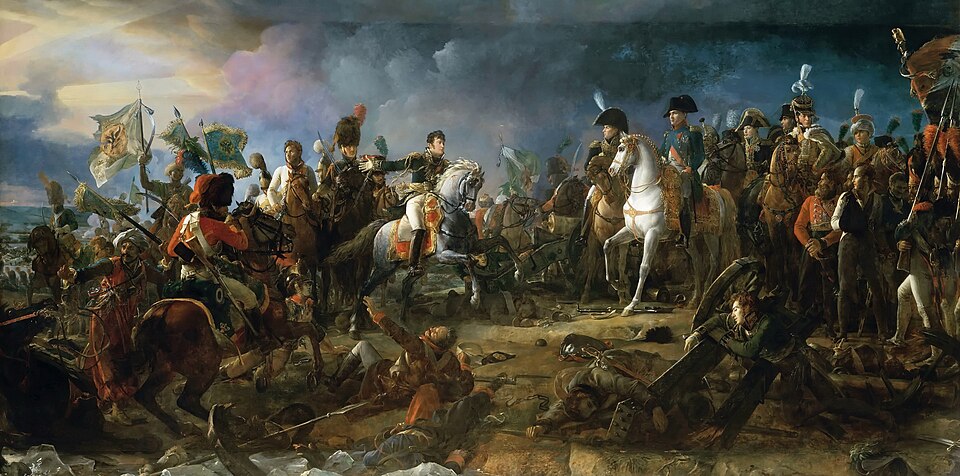
On 20 October 1805 an Austrian army surrendered at Ulm without a major battle. Six weeks later the allied army was destroyed at Austerlitz. What this war shows — the map of the continent rewritten in under three months — is not that there are two ways of winning. Both were the same design, and both worked by using the enemy's correct decision.
1. What was actually at stake
Britain needed allies on the continent. Austria and Russia answered, and the Third Coalition was formed: British sea power joined to continental armies, closing on France from both sides.
The French aim was plain — destroy one of them before the Austrian and Russian armies could join. Once joined, they could simply outnumber. What was really at stake was therefore not tactical skill but time.
And time was asymmetric. The allies grew stronger by waiting; France grew weaker. For the Austrians, "wait for the reinforcements" was an entirely correct decision — and it was that correctness which was the first thing in this war to be used against them[1].
2. Making them move, in two stages
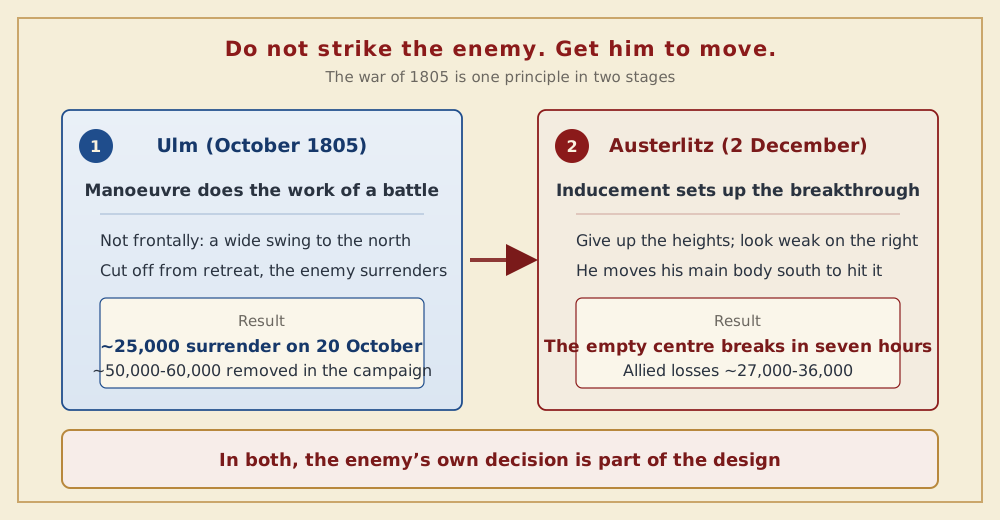
Stage one: neutralise without fighting
The French did not advance frontally. They swung wide to the north and came out behind the enemy. Cut off from retreat, the Austrian army surrendered without a major action: about 25,000 on 20 October, with some 50,000 to 60,000 taken out of the war across the campaign[1].
These figures need care. The surrender in the town of Ulm (~25,000) and the total neutralised across the campaign (~50,000–60,000) are different numbers. Merged, they make the operation look either larger or smaller than it was.
Stage two: induce, then destroy
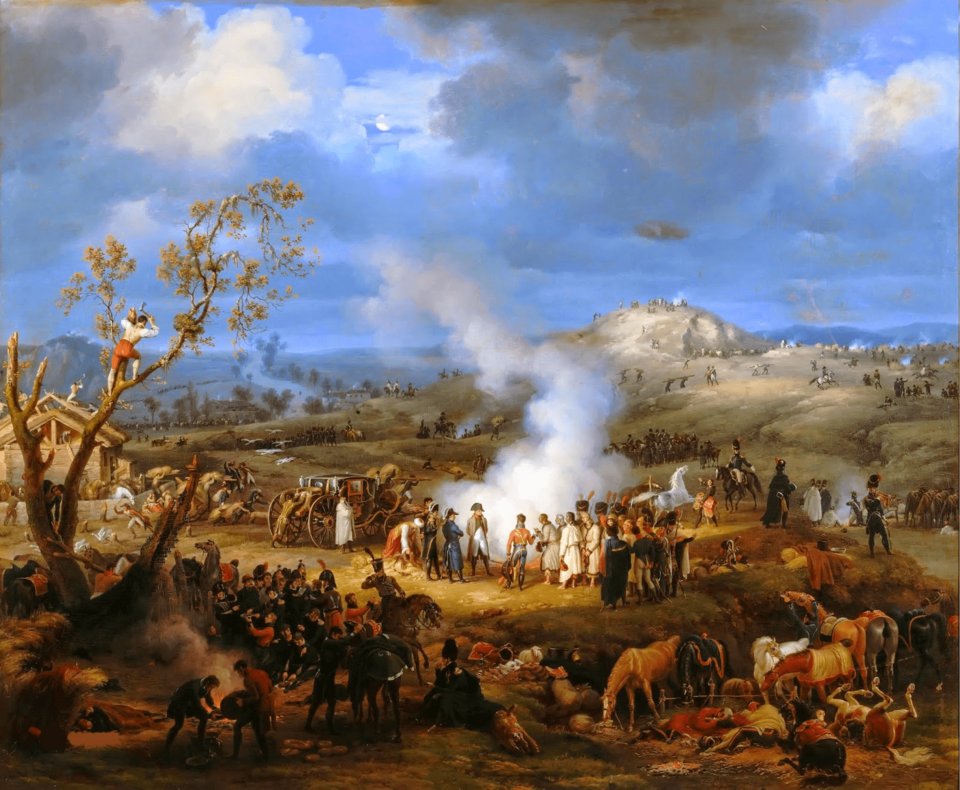
Austerlitz, on 2 December, used a finer version of the same design. The French gave up the Pratzen heights in the centre and made the right wing look deliberately weak. To strike that weakness and cut the line of retreat, the allies moved their main body south — and the centre emptied[3].
What makes this battle a masterpiece is not the elegance of the breakthrough. It is the design that made abandoning the centre the rational choice for the allies.
Two decision-making centres
French side
-
One decider
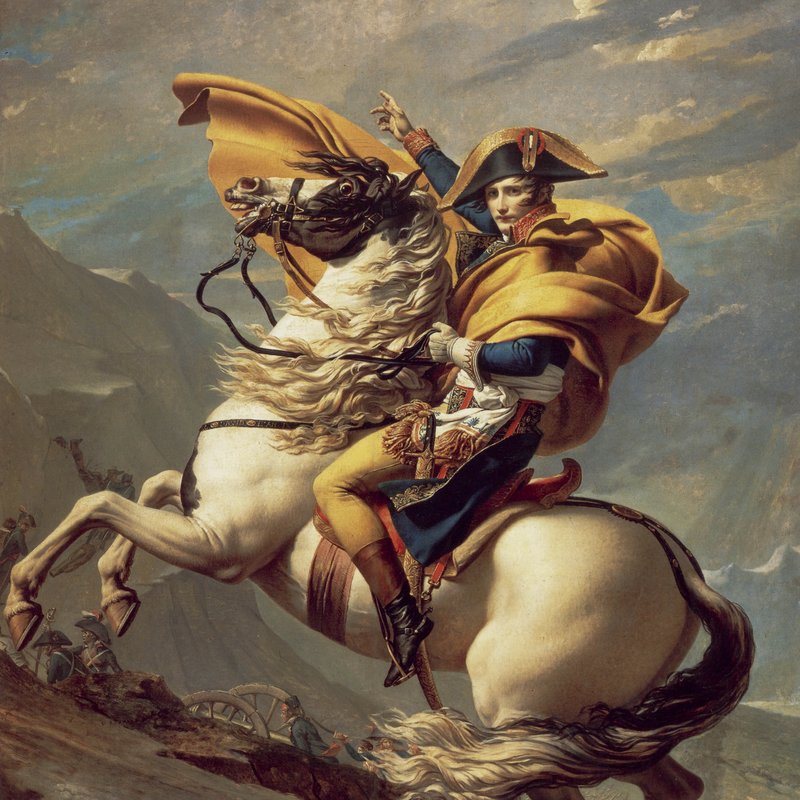 Napoleon (Emperor, 36)
Allied side
-
Tsar
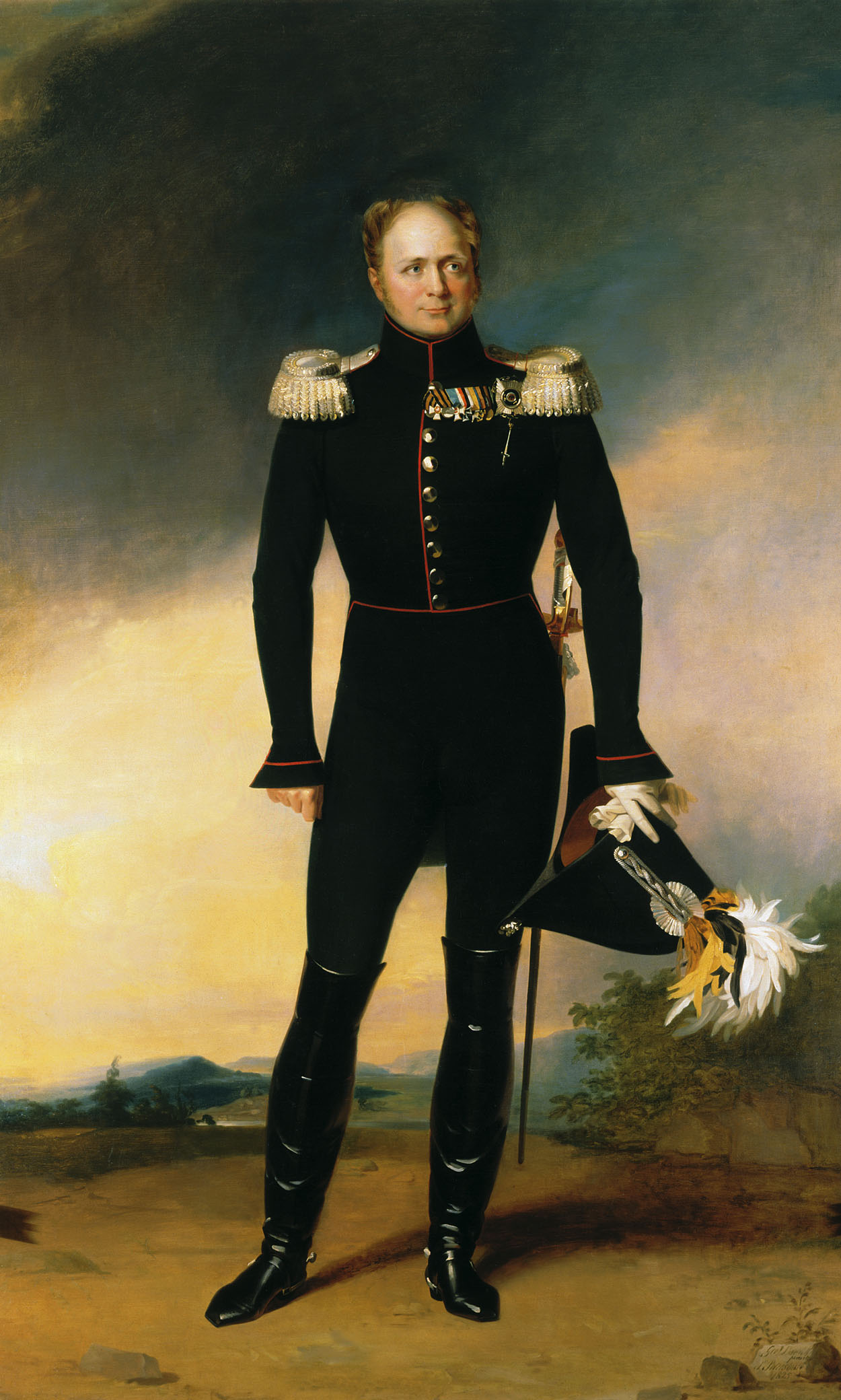 Alexander I (present in person, 27)
-
Emperor
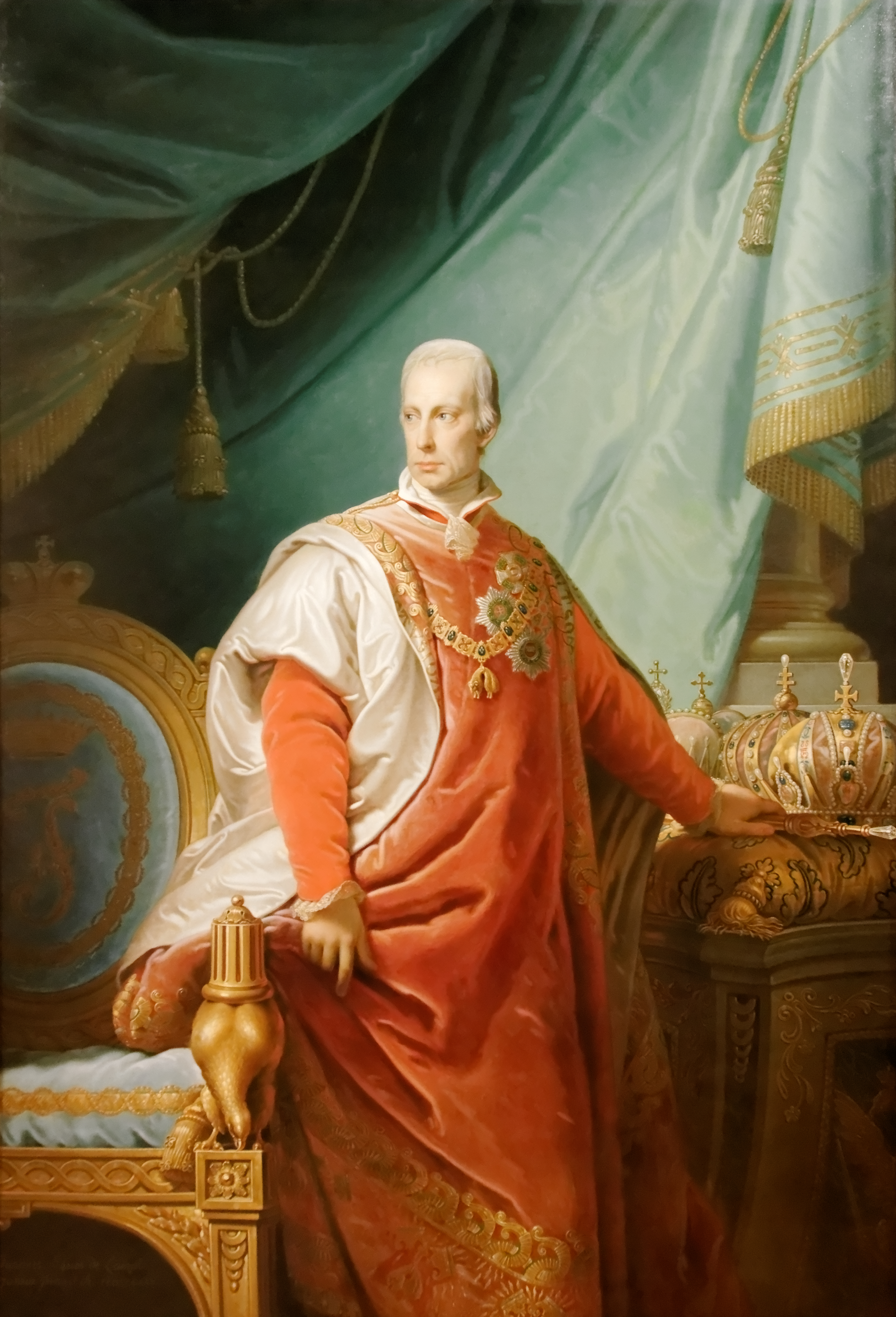 Francis II (Holy Roman Emperor)
-
Russian command
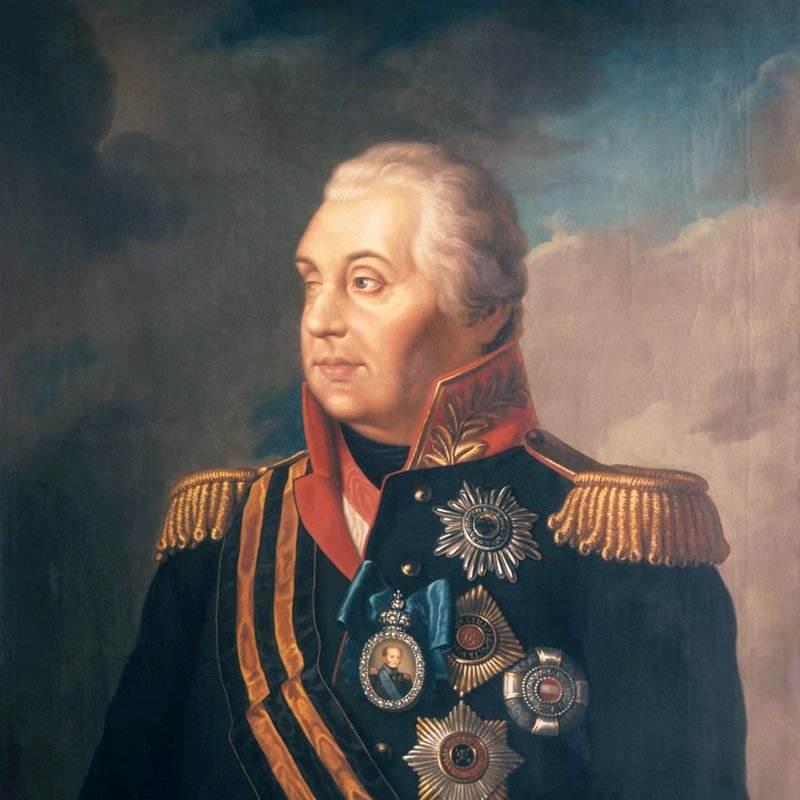 Kutuzov (reluctant to give battle)
In speed of decision the two sides were not on the same footing. On the French side one man decided. On the allied side two emperors sat alongside a commander-in-chief who did not want the battle at all[4]. Whether inducement works depends partly on how many layers the other side's decision has to pass through — a committee is likelier to drift towards the bait than to stop someone taking it.
3. The enemy was not wrong
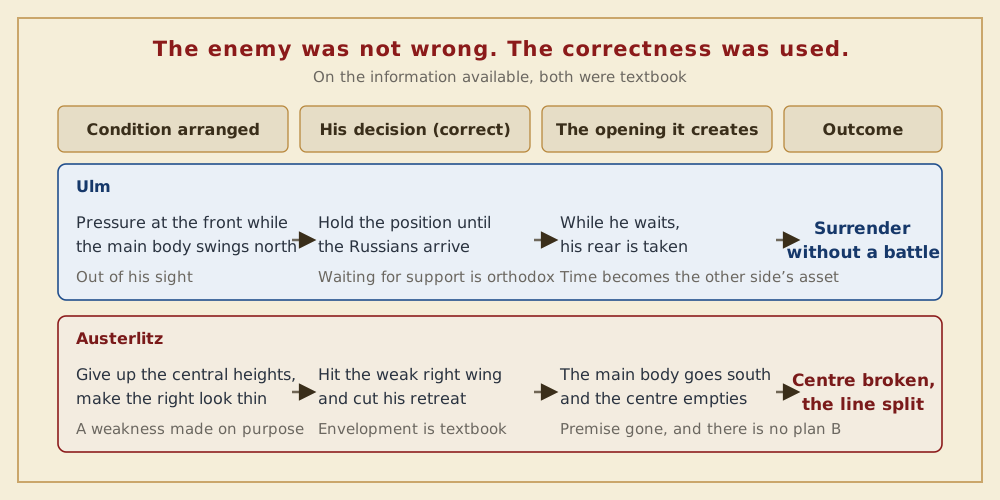
Written as a heroic tale, this is where you say the enemy generals were incompetent. The sources do not. That the Austrians waited for reinforcements, and that the allies moved to strike a thin wing, were both correct on the information they had at the time[4].
The difference was not in the quality of the decisions but in who had built the premises they were made on. The French had arranged matters so that the option they wanted chosen looked the most attractive. The other side chose freely, chose correctly, and moved as designed.
When the premise fails, there is nothing to fall back on
The allied envelopment was put together by textbook procedure. The problem was that the whole plan stood on a single premise: that they would keep holding the centre. When that premise failed there was no alternative to substitute. Structural defeat has this shape — not a failure of execution, but the brittleness of a plan with only one line in it.
4. What each kind of victory cost
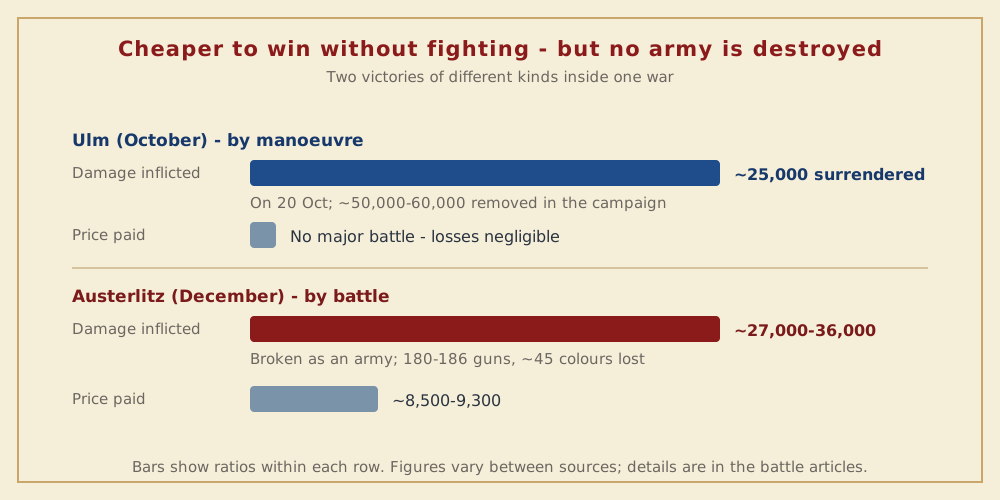
Austerlitz: strength
Allies about 1.2×
Austerlitz: losses
FR about one third
Ulm cost France almost nothing because there was no battle to pay for. Austerlitz destroyed an army but cost 8,500 to 9,300 men. The cheaper victory does not reach as far. Neutralising an enemy is not the same as removing him from the war, and the difference shows up in what has to be done next.
5. Four conditions inducement needs
To reproduce how this war was won you need conditions, not a procedure. There are four.
Give the enemy a correct option
A weakness is not hidden but shown — and he will not move unless attacking it is rational for him. Inducement is not deception; it is laying exactly one road that runs along the enemy's own reasoning.
Use the asymmetry of time
One side grew stronger by waiting and the other weaker[1]. The enemy's correct decision to wait is itself the act of handing over time. Ulm stands on this single point.
Decide in advance what to give up
Abandoning the central heights was an investment, not a loss. Without deciding beforehand what may be surrendered temporarily, no inducement can be laid. A side that cannot give anything up is permanently reactive.
Be close enough to reach the gap
The window between the enemy moving and the centre emptying is short, and troops must already be placed to reach it[3]. Inducement only exists paired with mobility.
Remove any one of the four and the method stops reproducing. What happened at Eylau in 1807 was precisely the loss of condition 04: snow and mud made it impossible to have troops in a position that could arrive in time.
6. If the allies had not moved
What follows is a thought experiment based on the sources. The outcomes cannot be demonstrated; the point is to make the dependencies visible.
| Condition changed | Immediate effect | Effect on the war |
|---|---|---|
| A: the allies hold the heights and do not move | The centre never empties; the breakthrough has no premise | The battle is indecisive and becomes a waiting game. Time favours the allies, so this is the worst case for France |
| B: the Austrians retreat from Ulm instead | The envelopment closes on nothing; no bloodless neutralisation | A junction with the Russians becomes possible, and Austerlitz might be fought at far worse odds |
| C: the inducement works but the assault arrives late | The centre empties and cannot be struck | The allies notice the gap and return. Inducement and mobility cannot be separated |
What A shows is that this design depends on the enemy being active. Against an enemy who does not move, inducement does nothing. Seven years later, in Russia, that is exactly the kind of opponent France would meet.
7. Consequence: an 800-year-old body politic disappears
The Austrians surrender at Ulm: ~25,000 (with ~50,000–60,000 neutralised across the campaign)
The French enter Vienna. The Russians avoid battle and withdraw north
Austerlitz. The allied army is destroyed in seven hours
Treaty of Pressburg. Austria makes peace
The Confederation of the Rhine is formed and German states leave the Empire
Francis II abdicates. The Holy Roman Empire ceases to exist[2]
Austria made peace at Pressburg on 26 December. On 6 August the following year Francis II abdicated and the Holy Roman Empire ended[2]. A body politic that traces to the coronation of 962 finished as the consequence of one war.
The Empire's end was not caused directly by Austerlitz, however. It had already been hollowed out in July 1806 when the German states formed the Confederation of the Rhine and went over to France. A battle is the trigger, not the whole cause — a distinction that matters again when reading how fast Prussia collapses in the next war.
8. What it suggests today
(1) Build the other party's rationality into the plan and the cost of persuasion disappears. Inducement is not about making someone decide wrongly. It is about arranging the situation so that what they choose in their own interest is what you had assumed. There is nothing to argue and nothing to conceal. The more correctly they reason, the more exactly they move as designed.
(2) A single-line plan is a total loss when one premise fails. The allied envelopment was procedurally sound. But when "we keep the centre" stopped being true, there was nothing to put in its place. Writing the premises down and assessing separately which of them could break is not advice confined to 1805. The quality of a plan is only measured on the day a premise fails.
9. Closing
What France gained in this war was not two kinds of victory but two outputs of one principle. Treat the enemy's decision as part of your design: at Ulm that appeared as "neutralise without fighting", at Austerlitz as "make him fight and destroy him".
The principle carried a premise that was invisible at the time. The enemy has to be willing to act. Against an opponent who will not move, who keeps withdrawing, who declines battle, none of it works. That opponent is seven years away.
Before this: the War of the Second Coalition. After it: Jena–Auerstedt and the campaign of 1806.
Sources
- Wikipedia contributors, Ulm campaign.
- Encyclopædia Britannica, Holy Roman Empire.
- Encyclopædia Britannica, Battle of Austerlitz.
- Harrison W. Mark, Battle of Austerlitz, World History Encyclopedia, 2023.
- David G. Chandler, The Campaigns of Napoleon, Macmillan, 1966.