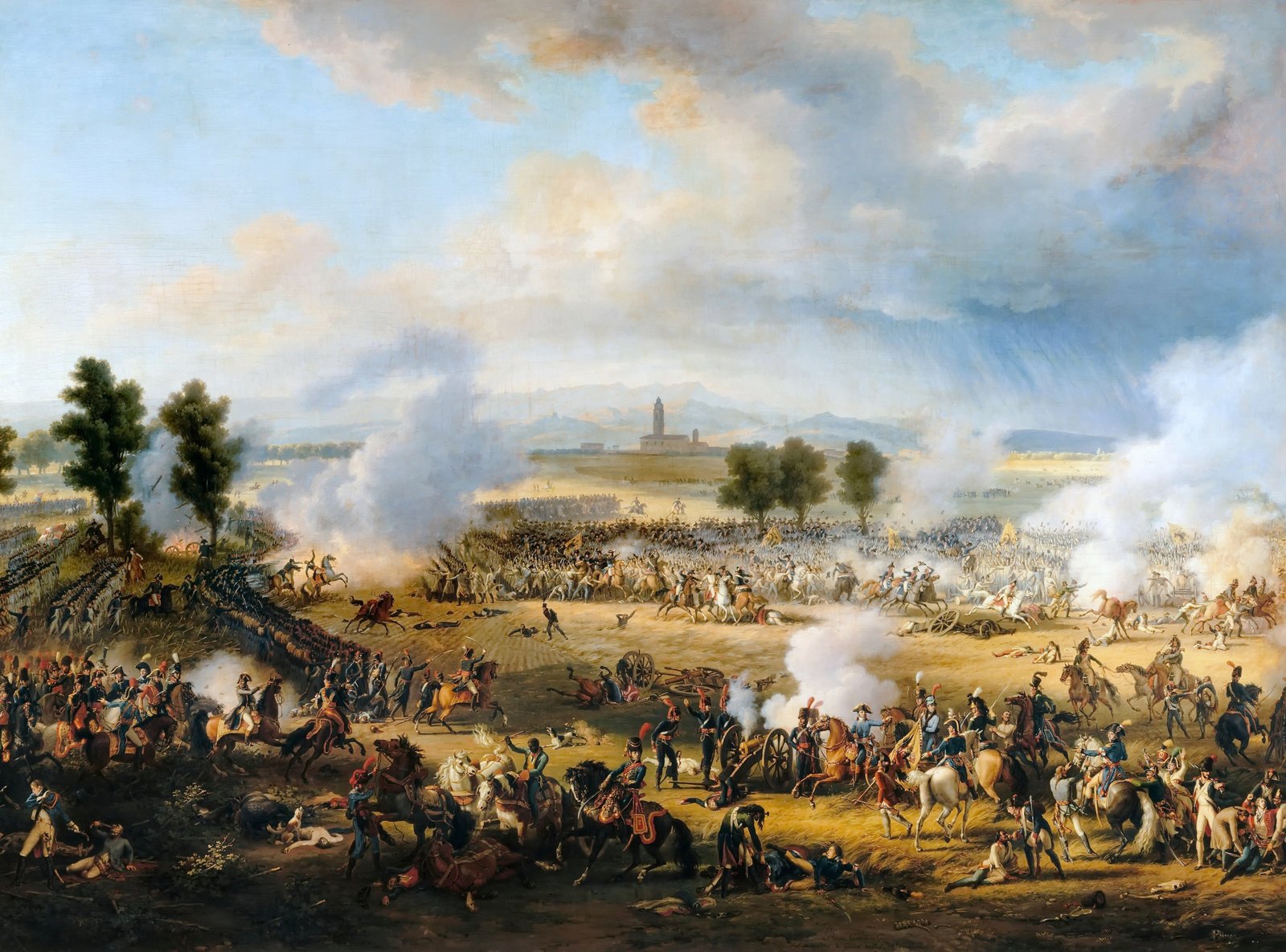
On 3 December 1800 the Austrian army broke in the woods at Hohenlinden. An armistice followed 22 days later, peace 68 days later. That is the day that ended the War of the Second Coalition. What is remembered, though, is a different victory, scraped together in northern Italy six months earlier. The size of a result and the size of its memory do not match. What decides the difference is who holds the record.
1. What was actually at stake
Through 1799, while everything won in the First Italian Campaign was being lost, the man who had won it was in Egypt. Suvorov's allied armies took Magnano, Cassano, the Trebbia and Novi in succession and wiped out very nearly all the gains of 1796–97[5]. The French were pushed back on Genoa and the coastal mountains.
For the man who became First Consul in the coup of Brumaire in November 1799, the campaign of 1800 was not about territory. A position taken by coup can only be underwritten by victory — and not by someone else's victory. That single requirement bends the whole war out of shape.
Two things were being played for. Forcing Austria to peace, and whose achievement that peace would be recorded as. The first was accomplished. The second was decided somewhere other than the battlefield.
2. Two years, and the gains were undone
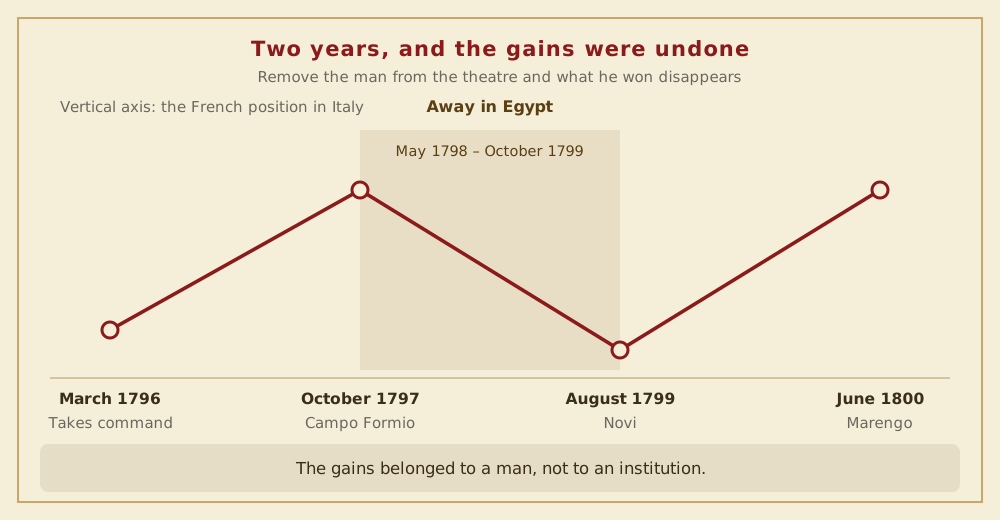
The Treaty of Campo Formio in October 1797 made northern Italy a French sphere. A single year undid it. What is worth noticing is not how fast it collapsed but that it collapsed at all.
Had the gains been institutional, they could have been held without the man who made them. They were not. They belonged to a person, not to a system — a fragility the later Empire never shook off.
And that same fragility forces the next decision. A regime resting on one man's prestige has to keep adding new victories to his name. That the campaign of 1800 opened with something as risky as crossing the Alps is a consequence: a safe way of winning would not have been enough.
3. Marengo: a victory picked up off the floor
Judged as command, what happened at Marengo on 14 June 1800 was a chain of errors. The position of the enemy's main body was misread, the army was dispersed, and it was driven back frontally. Melas left the field convinced he had won and is said to have sent word of the victory to Vienna.
Total engaged
AT about 1.1×
On the field during the crisis (morning to afternoon)
AT about 2×
What saved the line was Desaix marching back on his own initiative at the sound of the guns, and Kellermann's cavalry striking the flank behind him[3]. The victory of that day came from subordinates' judgement, not the commander's plan. Desaix was killed in the counter-attack.
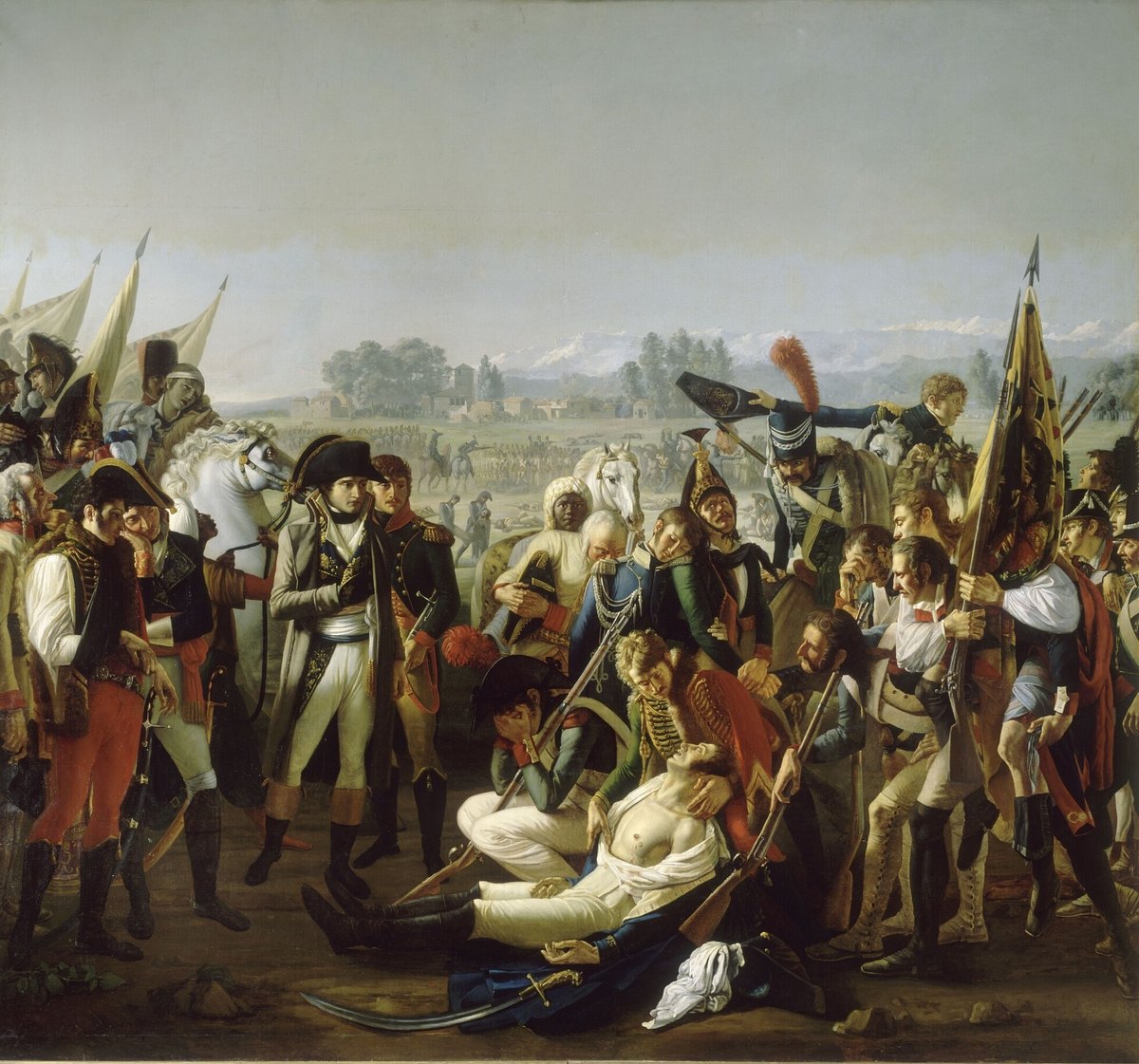
The Convention of Alessandria the next day obliged the Austrians to evacuate northern Italy. A large result. But the war was not over: Vienna would not make peace, and the fighting ran on for another six months.
4. Hohenlinden: the battle that ended the war
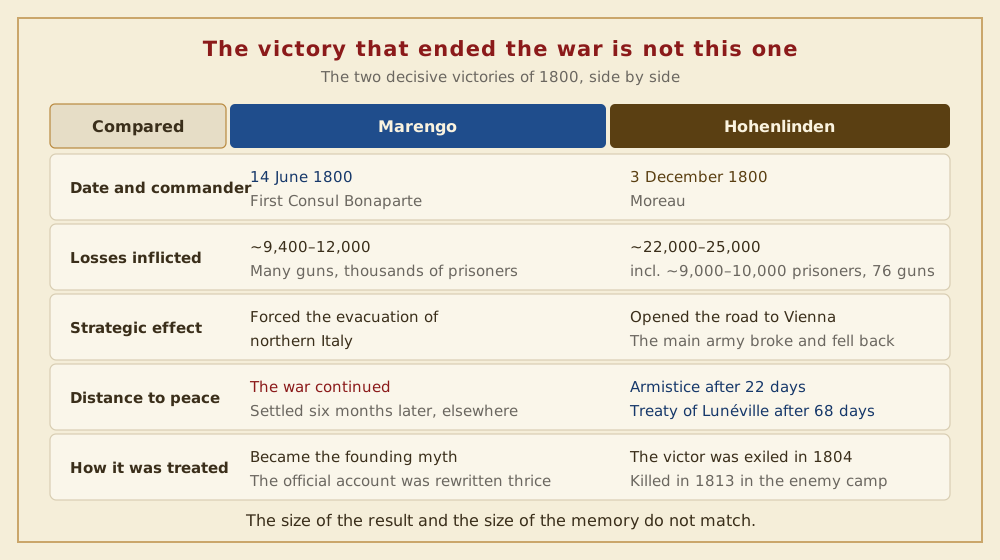
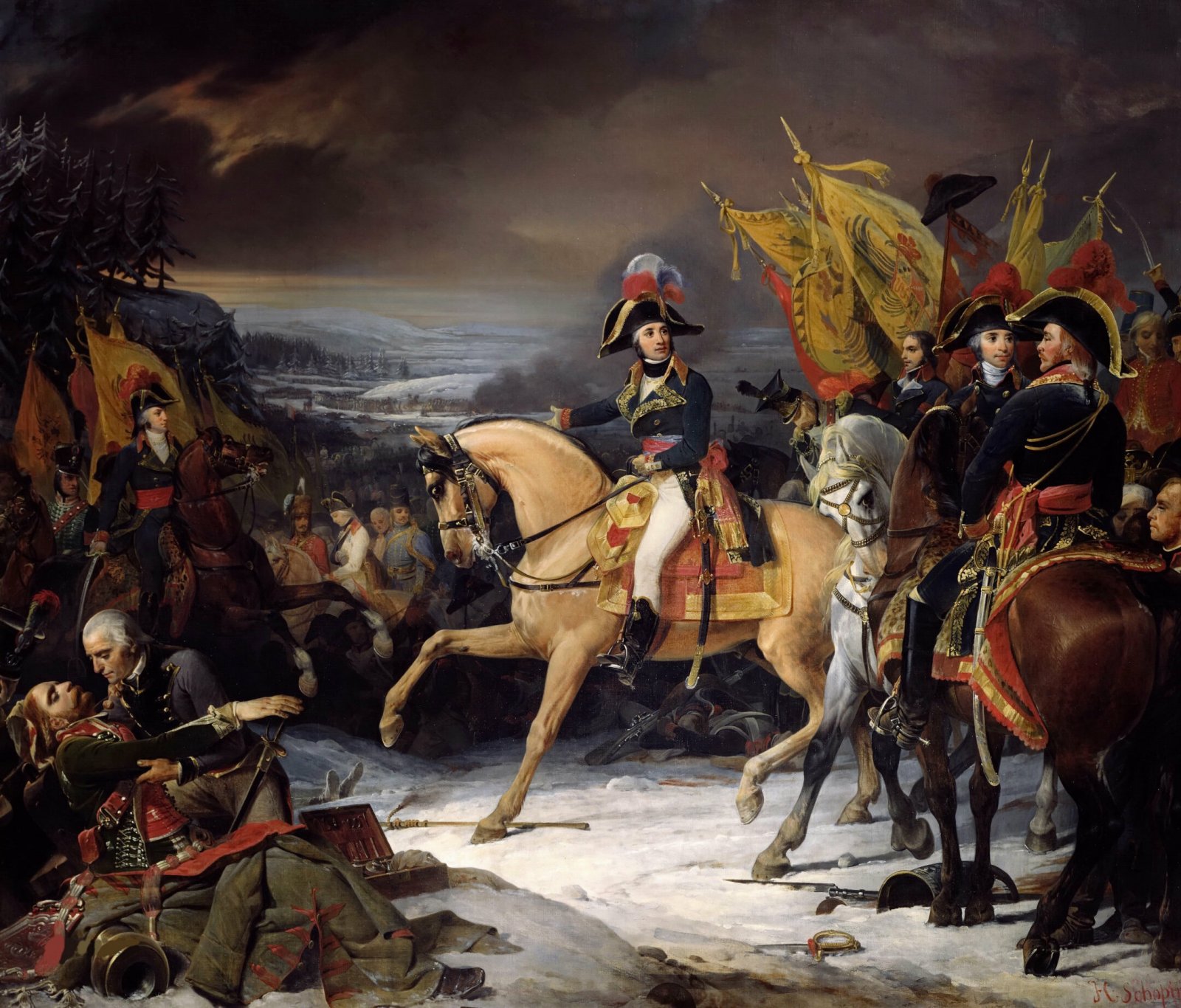
On 3 December, in snow and forest at Hohenlinden, Moreau's Army of the Rhine had about 53,600 men against roughly 60,261 Austrians and Bavarians. He was outnumbered[1]. The result was nevertheless one-sided: French dead and wounded of about 2,500–3,000, against allied dead and wounded of some 13,550–15,500 plus 8,950–10,000 taken prisoner and 76 guns lost[1].
Counting prisoners, that is a loss ratio of roughly eight to one (the French figure covers dead and wounded only) — steeper than the roughly three and a half to one of Austerlitz. The road to Vienna opened, an armistice was signed at Steyr on 25 December, and the Treaty of Lunéville followed on 9 February 1801[2].
Marengo, 14 June 1800
-
Commander
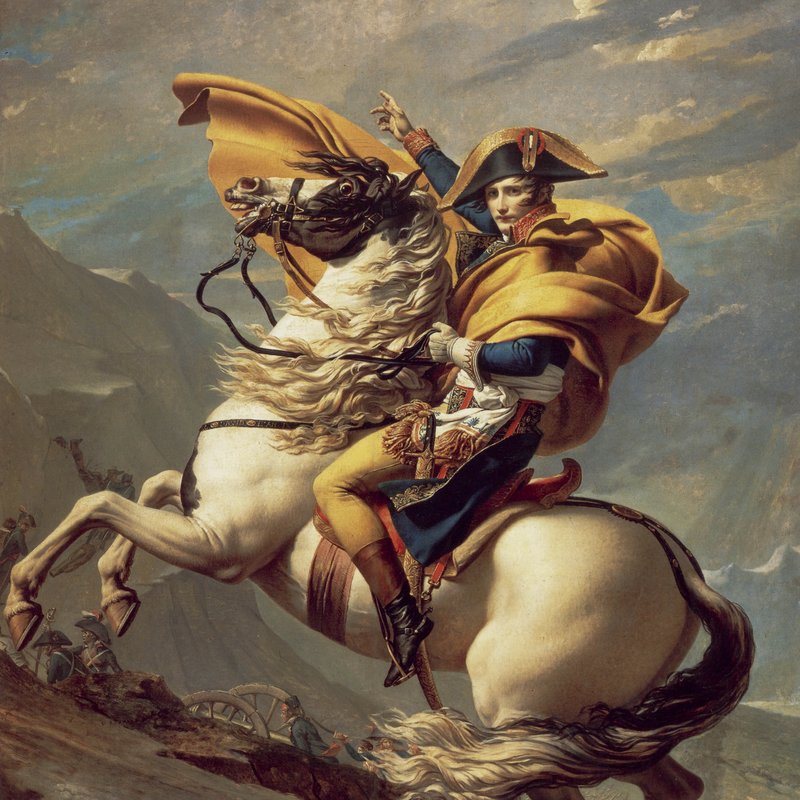 Napoleon (First Consul, 30)
-
Division
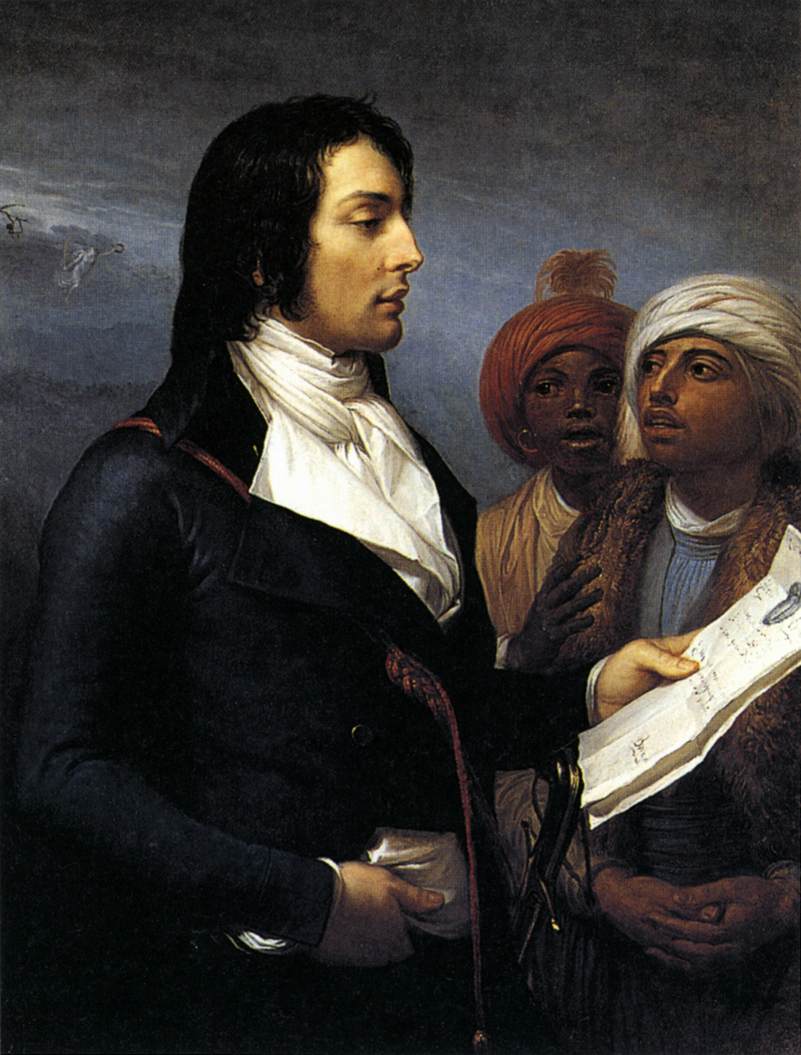 Desaix (turned back unbidden, 31; killed)
-
Heavy cavalry
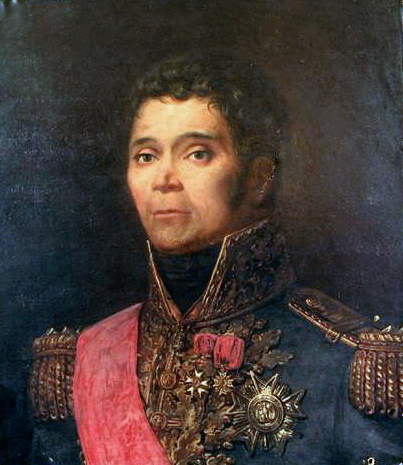 Kellermann (the flank charge, 29)
-
Austrian command
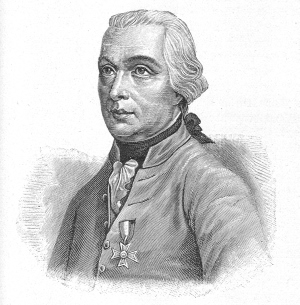 Melas (left the field believing he had won, 71)
Hohenlinden, 3 December 1800
-
French command
 Moreau (Army of the Rhine, 37)
-
Division
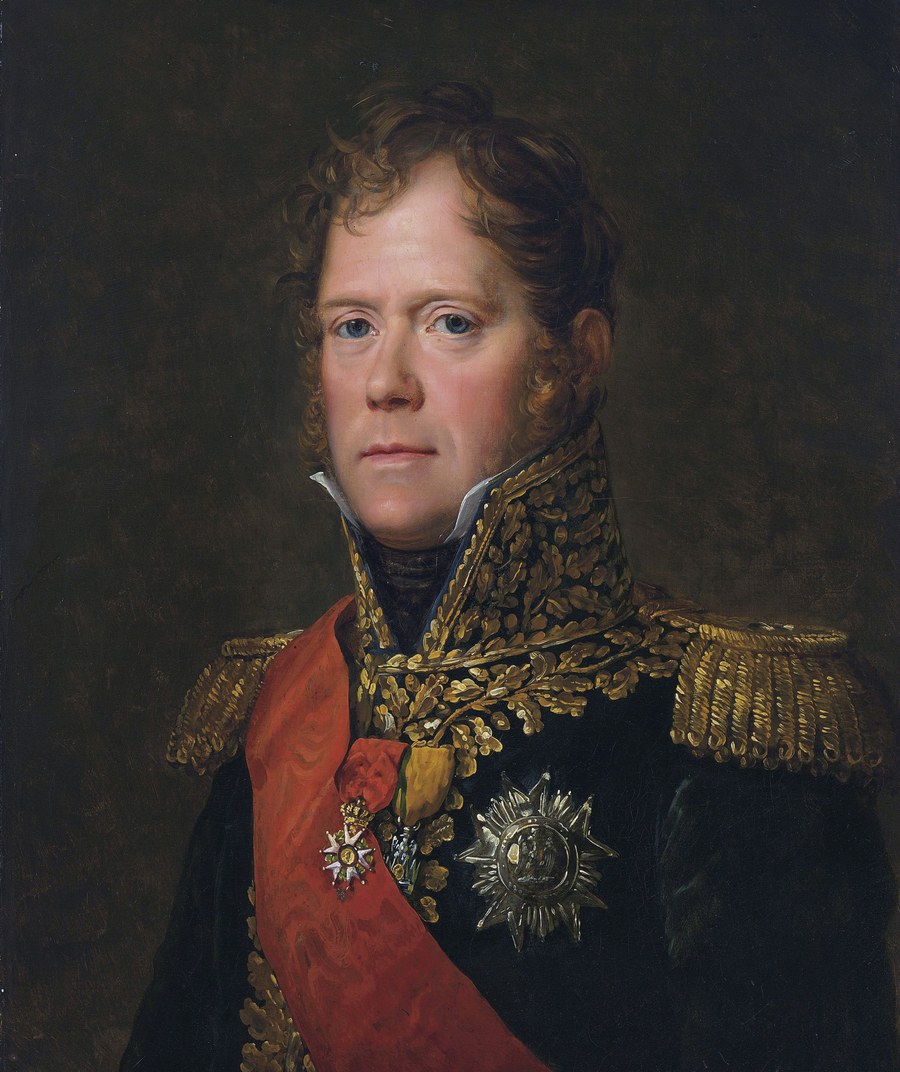 Ney (holding the centre, 31)
-
Division
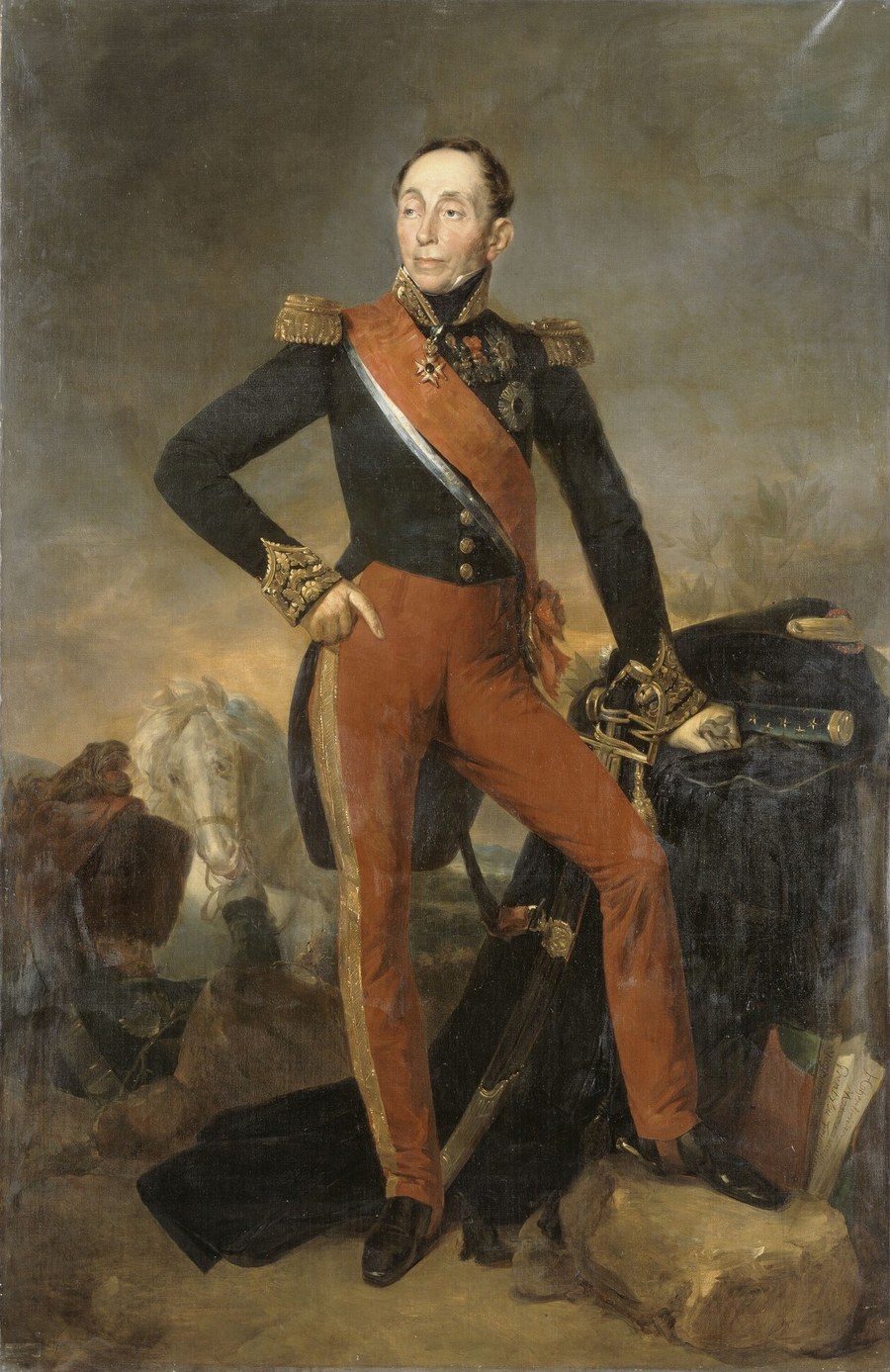 Grouchy (left wing, 34)
-
Austrian command
Archduke John (three months in post, 18)
An eighteen-year-old commanding an army
The Austrian army was led by Archduke John, appointed in September 1800 at the age of eighteen. He is reported to have been reluctant to take the post[4]. Moving several columns through forest is difficult for an experienced commander. Blaming the defeat on one young man's inexperience is crude; the decision to put him there is fair game. Whoever the commander, Austria in this war kept leaving the quality of command to chance.
5. How the credit was allocated
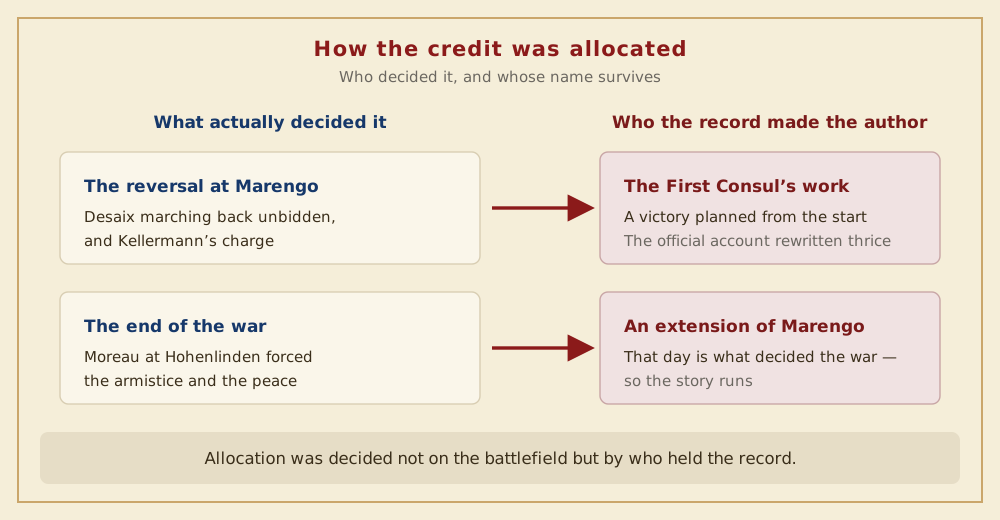
The official report of Marengo was not settled on the first attempt. A version was produced in 1803, revised in 1805, and edited again in later years. With every version the element of accident shrank and the degree of planning grew[6]. The rewriting itself is covered in the Marengo article; what matters here is that the rewriting did not stop at one day's fighting.
Hohenlinden ended the war. What circulated as "the victory of 1800" was Marengo. Power underwritten by another man's victory is not underwritten at all. For a regime tied to one person, the allocation of credit was not decoration but structural necessity.
The allocation reached the people as well. Moreau was implicated in the Cadoudal affair of 1804, tried, convicted, then pardoned and exiled to the United States. In 1813 he was hit by a cannonball at Dresden — in the allied camp[7]. The general who ended the war died thirteen years later on the other side.
6. Four things that decided the war
The gains were tied to a person
Eighteen months of absence undid nearly everything won in 1796–97[5]. A result that has not been institutionalised leaves with the man.
A safe victory would not do
When the only basis of power is victory, a reliable but dull operation is unusable. The size of the gamble was set by political need, not by the military situation — which is why Marengo became so dangerous.
Subordinates decided it
Without Desaix turning back and Kellermann charging, 14 June is a defeat[3]. An army that lets the man on the spot decide can absorb its commander's mistakes — a virtue that is invisible in the record.
7. If the conditions had been different
What follows is a thought experiment based on the sources. The outcomes cannot be demonstrated; the point is to make the dependencies visible.
| Condition changed | Immediate effect | Effect on the war |
|---|---|---|
| A: Desaix does not march to the guns | 14 June ends as a defeat | A Consul seven months past his coup loses the basis of his position. The regime probably breaks before the war is decided |
| B: Desaix survives | A claimant to the credit remains | Less room to rewrite. But as Moreau shows, a rival general was dealt with by other means |
| C: Hohenlinden is a draw | The road to Vienna stays shut | Lunéville is delayed — which only makes it clearer that Marengo alone could not compel a peace |
Only A shakes the regime itself. Power in 1800 rested on a single afternoon.
8. What it suggests today
(1) If a result is not moved from people into a system, it reverts the moment the person leaves. That is what 1799 was. When an able individual moves on and the accounts and the process fall apart with them, that is not evidence of how good they were — it is evidence of a design failure. The more personal the success, the more it needs handing to a mechanism rather than to a successor.
(2) Credit is distributed by need, not by contribution. The person who did the decisive work fades from the record and a more convenient figure becomes the protagonist. This is less a matter of malice than of who is holding the pen. Which is why deciding the format of the record in advance — writing down who did what before the outcome is known — is cheaper than trying to restore fairness afterwards.
9. Closing
The War of the Second Coalition is usually told as the recovery of lost ground. Structurally it demonstrates something else. A regime built on one person must not only keep winning, it must keep collecting the victories under his own name.
The third of December, in the forest, produced a treaty. The fourteenth of June, in northern Italy, produced a myth. What the regime needed was not the treaty.
Before this: the First Italian Campaign. After it, at Austerlitz, comes a victory that needs no rewriting at all.
Sources
- Wikipedia contributors, Battle of Hohenlinden.
- Encyclopædia Britannica, Battle of Hohenlinden.
- Encyclopædia Britannica, Battle of Marengo.
- Wikipedia contributors, Archduke John of Austria.
- Wikipedia contributors, Suvorov's Italian campaign.
- The Napoleon Series, Marengo 1800: A Lost Account.
- Fondation Napoléon, Moreau, Jean-Victor.
- David G. Chandler, The Campaigns of Napoleon, Macmillan, 1966.