Russia · Field Commander
Mikhail Kutuzov
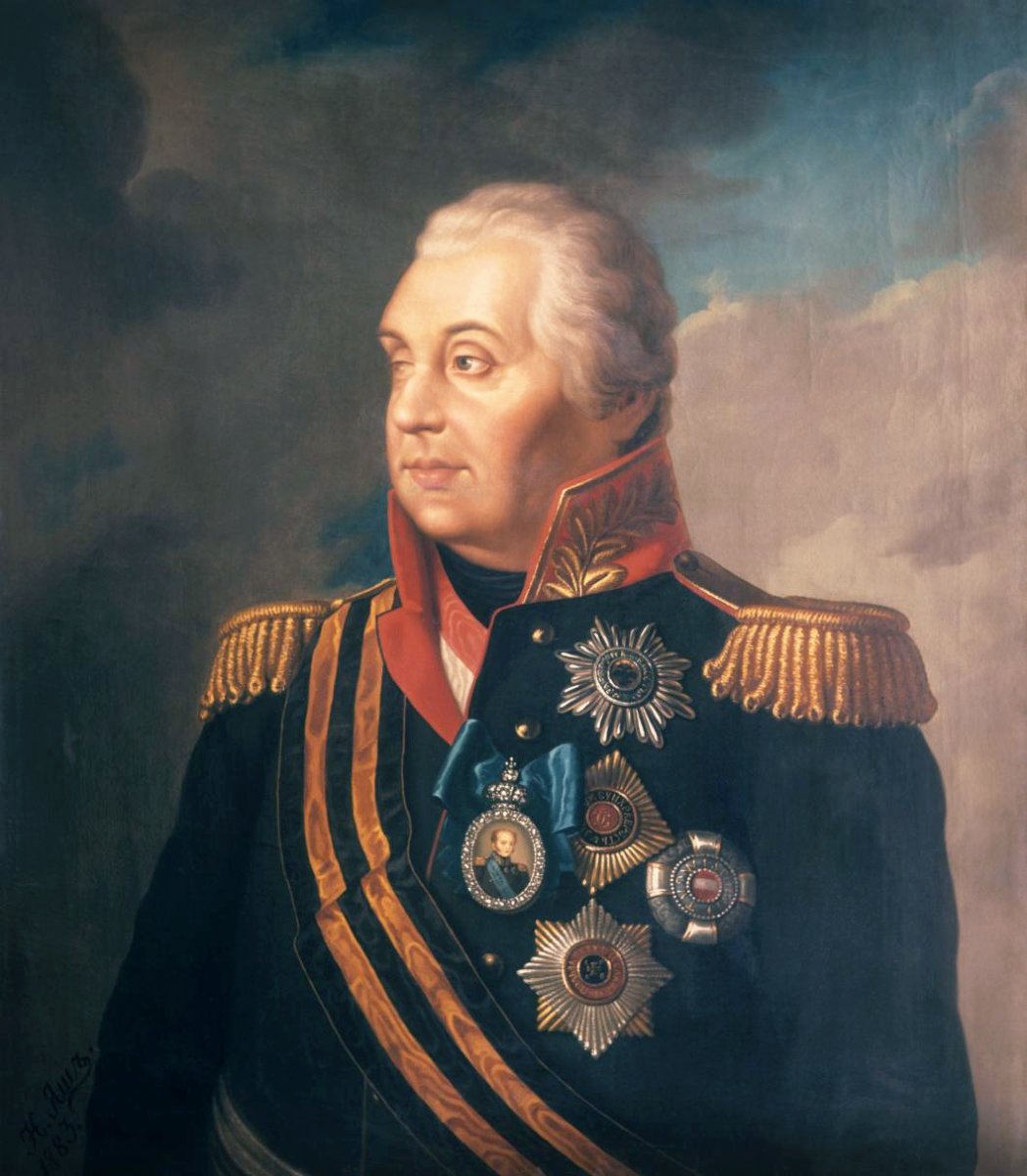
Commander-in-chief of the Russian army in 1812. He is rarely described as a master of battle, and indeed he gave up the field at Borodino. He won the war all the same. He is the commander who carried out most clearly the way of fighting available to a side whose condition for victory is not the destruction of the enemy army.
1805: the battle he argued against
Kutuzov was the nominal commander of the allied army beaten at Austerlitz. He had argued against fighting it. In the autumn of 1805 he withdrew several hundred kilometres from Braunau to Olmutz, avoiding a decisive action and giving priority to joining the reinforcements[1].
The order to attack on 2 December came from Alexander I, and the case for caution was overruled[1]. That single day is a specimen of the kind of fighting he most wanted to avoid. Read from here, his judgement seven years later is consistent.
What he actually did: keep the army in existence
In August 1812 he replaced Barclay de Tolly, who had kept withdrawing. Opinion demanded a decisive battle, and the appointment was made in expectation of a general who would fight. What he actually continued was the policy his predecessor had begun: ground may be given up, the army may not.
At Borodino on 7 September he took the attack head-on, and after losses exceeding 70,000 on the two sides together he withdrew with his army intact. At the council of war at Fili on 13 September he decided to abandon Moscow. The decision to give up a capital cannot be taken unless the condition for victory has been set at the survival of the army.
The decisive moment: winning by not fighting
For five weeks after the entry into Moscow, the French waited for an answer about terms. None came. As set out under the Russian campaign, this war had asymmetric victory conditions. Winning on the field settles nothing if the other side does not accept that it has lost.
Kutuzov moved south to recover his supply lines and numbers, followed the retreating French, and went on refusing a decisive action. To strike hard would wear down his own army and damage the very condition he was playing for. Maintaining the decision not to fight even when he could have won was his central craft in this campaign.
Moving to the flank
After giving up Moscow, Kutuzov moved his army southwest towards Tarutino. This was not a move to escape. It was a position that put the road to the southern grain districts and arsenals on his own side of the map while sitting beside the French line of retreat.
As a result the French leaving Moscow could not take the richer southern route and had to go back along the road burnt on the way in. Reducing the enemy's options without fighting a battle - that single move is one of the reasons the retreat became a destruction.
Limits, or how it ended
The caution was criticised at the time. The argument that a more energetic pursuit could have destroyed more of the French army dates from then. That opinions divide is itself characteristic of this way of fighting: with no spectacular finish, the results are hard to see.
In 1813, advancing into Germany, he fell ill and died on 28 April[2]. The Trachenberg Plan of the War of the Sixth Coalition - never fight the army he leads in person - was written down three months after his death. The idea that avoiding a decisive battle can be the winning line had already been proved in 1812.
Sources
- Encyclopaedia Britannica, Mikhail Illarionovich, Prince Kutuzov.
- J. Rickard, Prince Mikhail Ilarionovich Kutuzov, 1745-1813, History of War.
- Adam Zamoyski, 1812: Napoleon's Fatal March on Moscow, HarperCollins, 2004.
Aparece en las batallas
-
1805-12-02
La batalla de Austerlitz (1805) — la obra maestra de Napoleón: vencer al enemigo diseñando la situaciónRol: Nominal commander-in-chief (stripped of real authority)
-
1812-09-07
Batalla de Borodinó (1812) — por qué el día más sangriento no decidió nadaRol: Russian commander-in-chief