France · Emperor and Supreme Commander
Napoleon Bonaparte
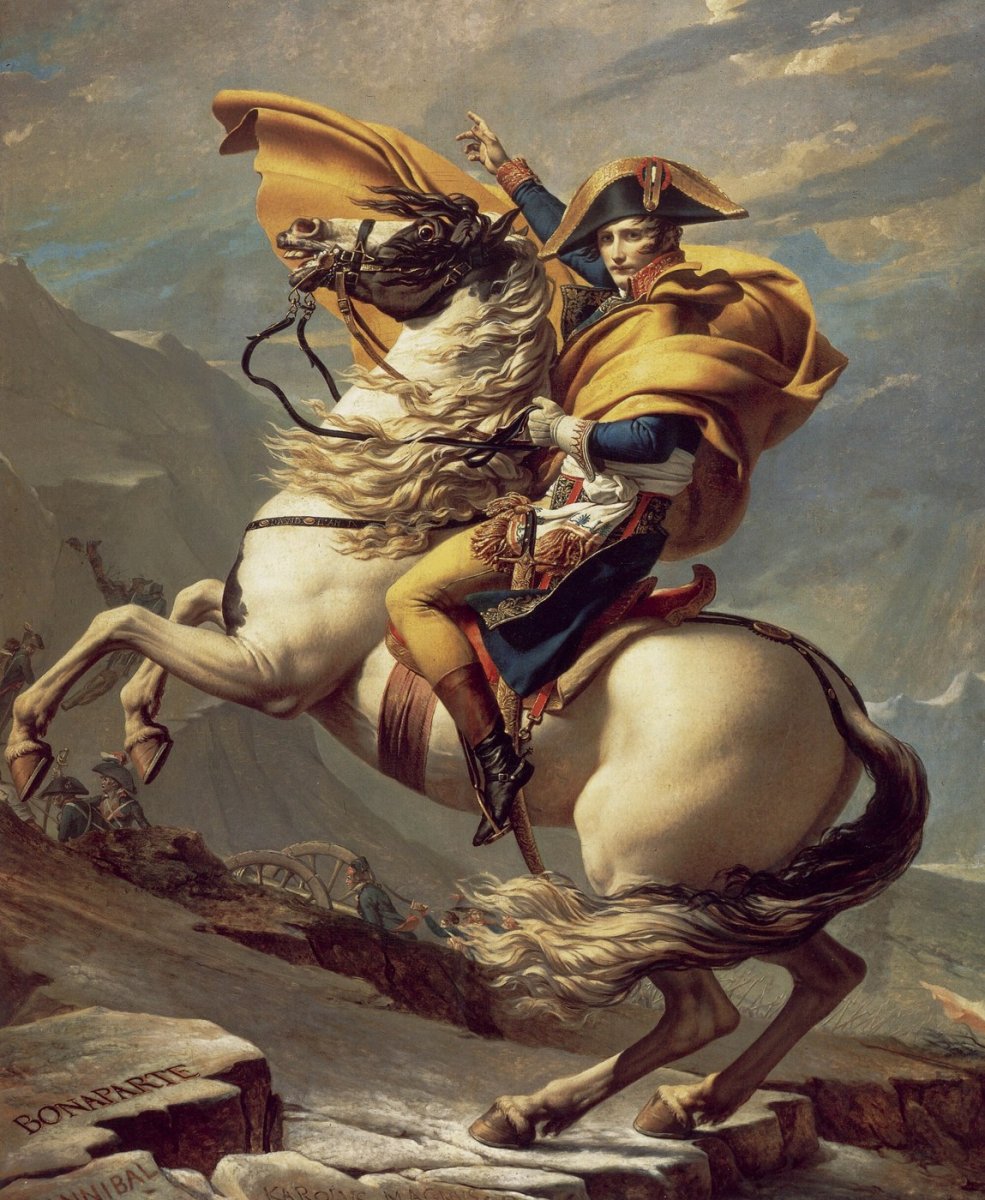
The man at the centre of every war this site covers. He is set out here not as a biography but as one method, and the period over which it stayed valid. The way he fought was not a flash of genius but a handful of elements plus the conditions under which they worked. The process by which those conditions were lost, one at a time, is the history of twenty years of war.
1. The rise: 1769 to 1796
Born into the minor Corsican nobility, he passed through a military school on the mainland to the academy in Paris. He graduated in September 1785 and was commissioned into the La Fere regiment as a second lieutenant of artillery at sixteen[1]. Without a revolution it is the career of a provincial gunner.
The turn came at the siege of Toulon in 1793. Take the heights above the harbour and the British and Spanish fleets must leave - he planned and carried out the artillery dispositions that made that one point, and was promoted general of brigade at twenty-four[1]. On 5 October 1795, 13 Vendemiaire, he put down the royalist rising in Paris and secured his standing with the government as a soldier who could be used.
Then in March 1796, at twenty-six, he took over the Army of Italy: short of equipment and of pay, the least regarded army in France at the time. From there he fought the first Italian campaign through nineteen months and brought Austria to terms.
2. Four elements of the method
Interior lines and the central position
Get inside enemies approaching separately and beat them in turn, making a majority only at the moment of contact. Established in northern Italy in 1796; the same design was still in use in 1815.
The corps system
Formations able to fight alone for several days. March dispersed, gather for the decisive battle. A structure in which one man need not see everything - provided there are commanders who can work it.
Speed
Living off the country cuts dependence on magazines and buys marching speed. On the eve of Austerlitz, Davout's corps covered about 110 km in 48 hours.
Designing the story
Bulletins and newspapers composed events for the audience at home. The official report of Marengo grew more deliberate with each edition. The route by which a result became political capital.
All four are set out at length in Napoleonic tactics.
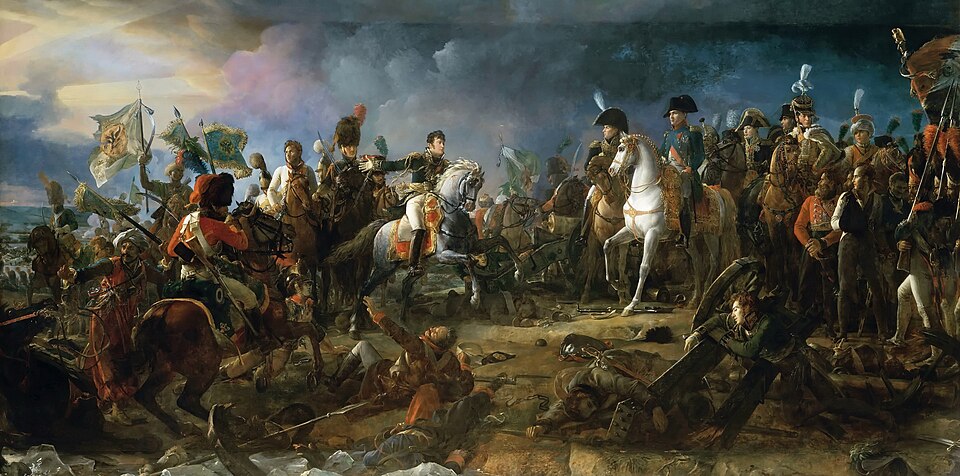
3. Outside the battlefield
He is discussed as a soldier, but the work of governing was part of the method too. The civil code promulgated in March 1804 set down equality before the law, property and freedom of contract, and influenced the civil law of states across nineteenth-century Europe[2]. Administrative divisions, taxation and schooling were reorganised in the same years.
The two sides are not unrelated. Being able to install institutions in conquered territory produced the men and the money for the next war. At the same time, the more institutions were installed, the more local resistance grew. In the Peninsula and in Russia alike, what resistance formed around was the fact of being occupied.
4. Myth and record
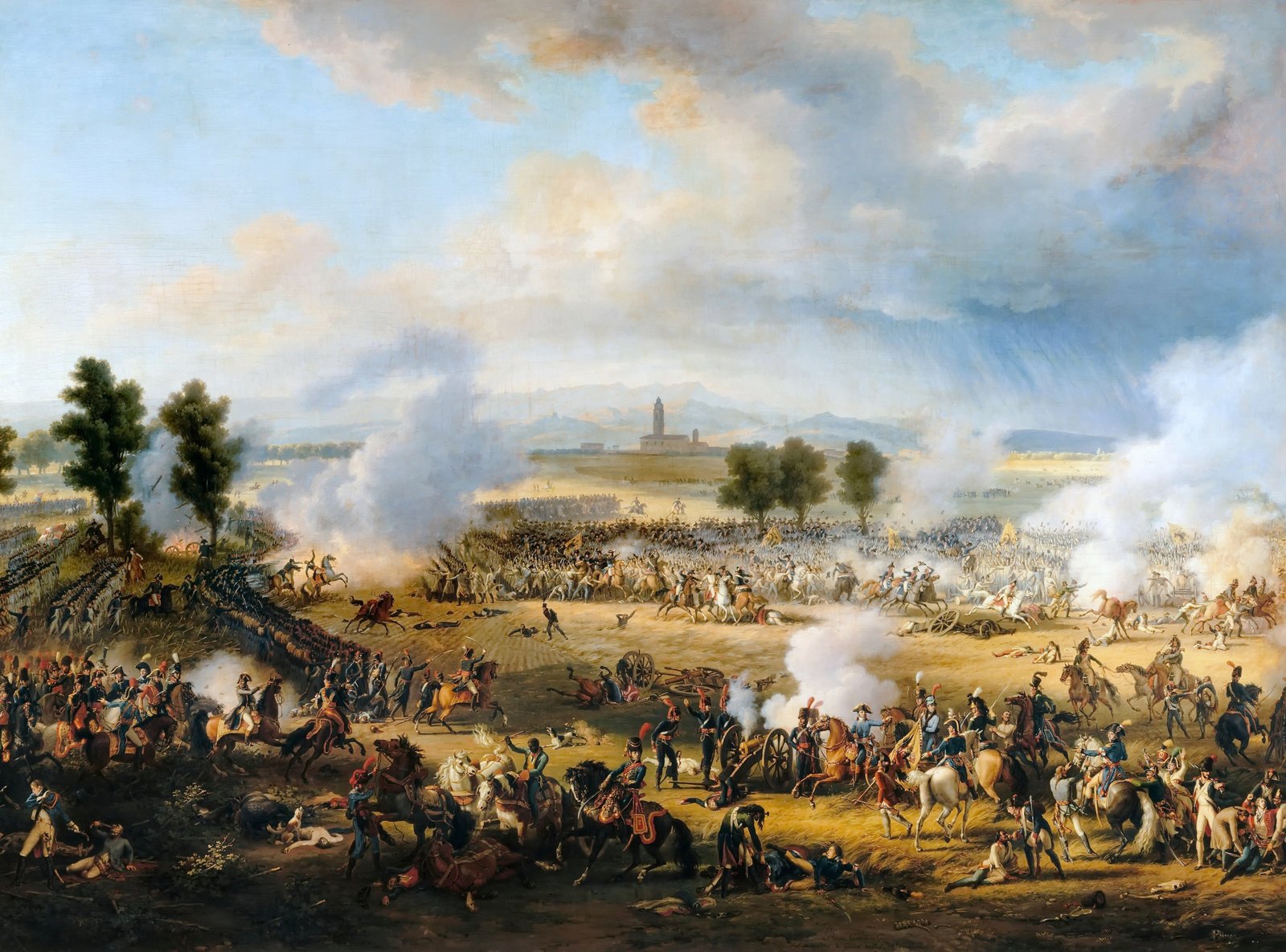
Marengo, on 14 June 1800, was a precarious victory recovered from the edge of defeat. What saved the line was the counter-attack of Desaix, who turned back on his own initiative on hearing the guns, and the cavalry charge of Kellermann that followed. But with each edition of the official report the element of chance shrank and the account moved towards a victory planned from the start[4].
Calling that rewriting a lie is easy; structurally it is more tangled. A position taken by coup can be underwritten only by victory, and someone else's victory will not serve. Designing the story was also work that the form of the power demanded. This is treated at length under the War of the Second Coalition.
5. Four premises the method needed
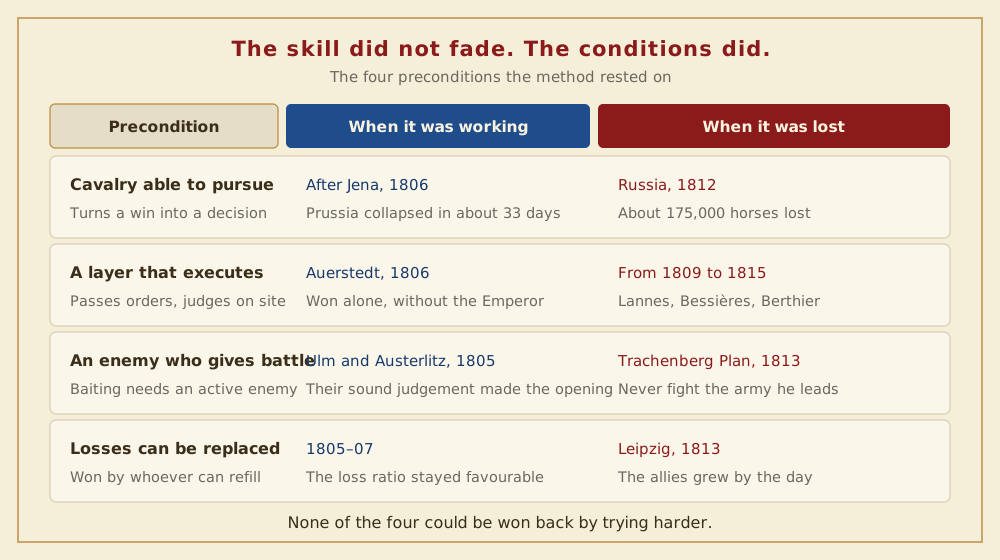
The premises matter more than the elements. The method worked only while the following four held.
First, being able to pursue. What turns a win into a decision is the legs of the cavalry. After about 175,000 horses were lost in the Russian campaign, victories stopped breaking enemy armies[3].
Second, having a layer of men who execute: the people who turn an intention into orders and judge for themselves in the field. Lannes was killed in 1809 and Bessieres in 1813, and Berthier died on 1 June 1815. By the Hundred Days, that layer was all but empty.
Third, the enemy coming out to fight. Inducement and concentration both assume an enemy who acts. The Trachenberg Plan of July 1813 removed that premise with one line: never fight the army he commands in person[5].
Fourth, being able to replace losses. At Leipzig the allies grew day by day while French reinforcements barely came. An even battle of attrition is won by whoever can replace.
6. What the record of the battles shows
| Year | Battle | Result | What the day shows |
|---|---|---|---|
| 1796 | Lodi | Victory | The germ of designing action and story together |
| 1800 | Marengo | Narrow win | An accidental victory rewritten as a plan |
| 1805 | Austerlitz | Decisive win | The best case of all four elements at once |
| 1806 | Jena-Auerstedt | Decisive win | The corps system held even when he read the field wrong |
| 1807 | Eylau | Drawn | The first day the method produced no decision |
| 1807 | Friedland | Decisive win | The turn towards firepower as the main act |
| 1809 | Wagram | Victory | From an art of manoeuvre to a contest of mass |
| 1812 | Borodino | Held the field | Winning without the other side losing |
| 1813 | Leipzig | Defeat | The day numbers beat method |
| 1815 | Waterloo | Defeat | The design held; the execution did not |
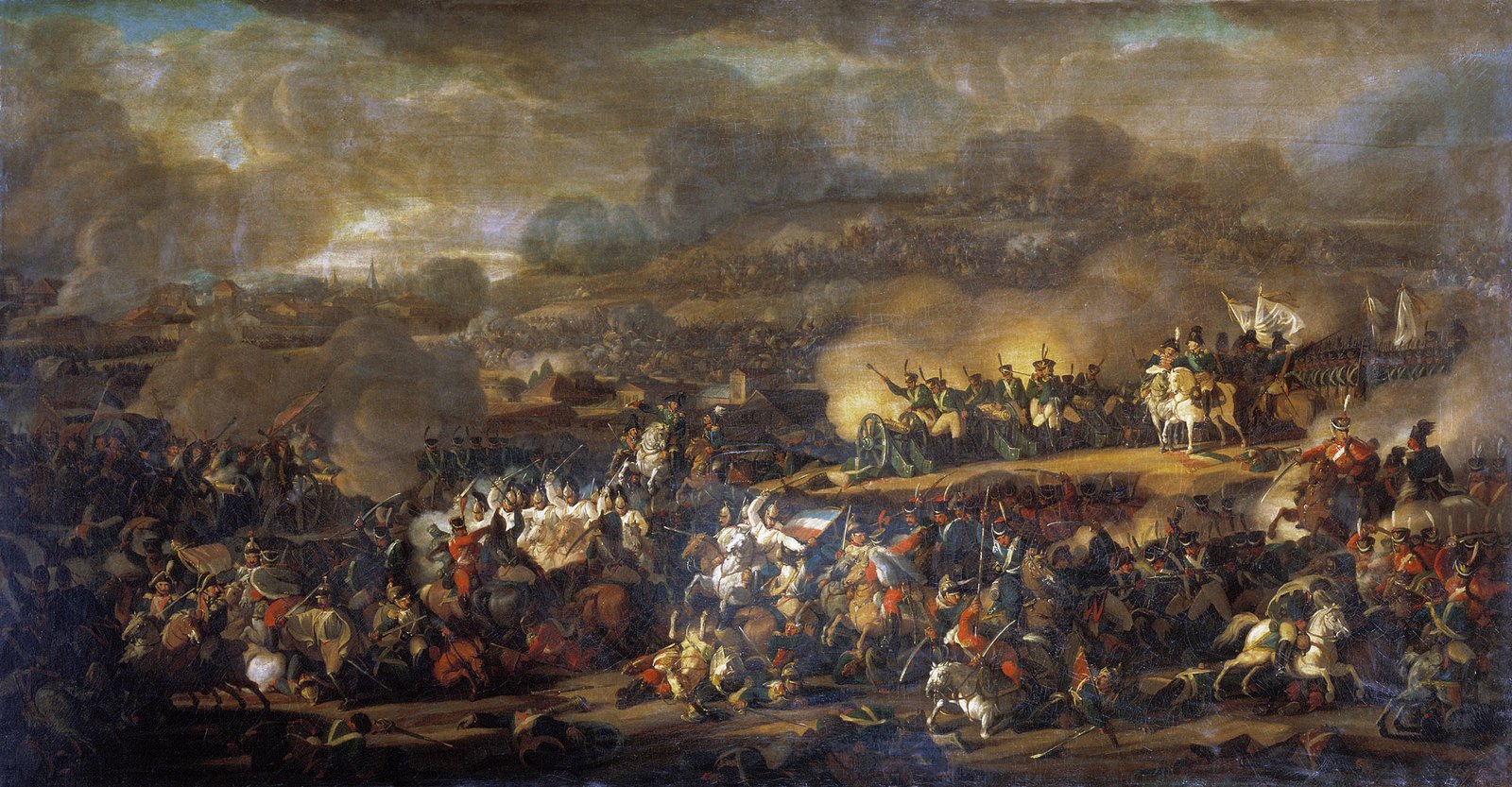
Laid out in order, the character of the winning changes before the losing begins. At Eylau in 1807 decisions stopped being produced; at Wagram in 1809 the loss ratio became even; at Borodino in 1812 holding the field settled nothing. The defeats come after that.
7. How it ended
Paris fell on 31 March 1814; he abdicated on 6 April and was sent to Elba. He left the island in March 1815 and was restored, and after Waterloo on 18 June he abdicated again on the 22nd[2]. Exiled to St Helena in the south Atlantic, he died there on 5 May 1821, aged 51.
The memoirs dictated over six years on the island were themselves a last piece of story design. The famous remark that he understood his own destiny at Lodi lacks contemporary evidence. The work on the battlefield had ended; the work on the record had not.
8. How to read him
What makes this man hard to assess is that the designer of the method and the maker of its limits are the same person. He designed the redundancy of the corps system and never delegated the judgement itself. He handed out crowns as rewards, and those crowns created interests that competed with loyalty. He supported power with a story, and that power could then be maintained only by continuing to win.
This site reads him not as a story about a genius but as a reproducible structure and its conditions. Write the conditions down and you can ask whether the same method would work somewhere else. The eight wars from 1796 to 1815 can be arranged as the order in which those conditions were lost, one by one.
Sources
- Wikipedia contributors, Napoleon.
- Encyclopaedia Britannica, Napoleon I, Emperor of France.
- The Napoleon Series, Napoleon's Equine Strategy in 1813.
- The Napoleon Series, Marengo 1800: A Lost Account.
- J. Rickard, Trachenberg Plan, 12 July 1813, History of War.
- David G. Chandler, The Campaigns of Napoleon, Macmillan, 1966.
- Andrew Roberts, Napoleon: A Life, Allen Lane / Penguin, 2014.
Aparece en las batallas
-
1796-05-10
La batalla de Lodi (1796) — El asalto al puente y el nacimiento del «pequeño cabo»Rol: Commander-in-chief (directed the artillery dispositions himself)
-
1800-06-14
Batalla de Marengo (1800) — Cómo una casi derrota fue reescrita como trampa planeadaRol: First Consul; commander-in-chief in fact
-
1805-12-02
La batalla de Austerlitz (1805) — la obra maestra de Napoleón: vencer al enemigo diseñando la situaciónRol: Emperor and commander-in-chief
-
1806-10-14
La doble batalla de Jena-Auerstedt (1806) — La batalla decisiva fue aquella en la que Napoleón no estuvoRol: Emperor; commanded at Jena
-
1807-02-08
La batalla de Eylau (1807) — El día en que el método de Napoleón no logró producir una decisiónRol: Emperor and commander-in-chief
-
1807-06-14
Batalla de Friedland (1807) — Cuando las condiciones regresaron, el método de Napoleón volvió enteroRol: Emperor and commander-in-chief
-
1809-07-06
Batalla de Wagram (1809) — El día en que el método de Napoleón pasó del arte al desgasteRol: Emperor and commander-in-chief
-
1812-09-07
Batalla de Borodinó (1812) — por qué el día más sangriento no decidió nadaRol: Emperor and commander-in-chief (never committed the Guard)
-
1813-10-18
Batalla de Leipzig (1813) — la batalla de las Naciones, donde el maestro del centro fue envueltoRol: Emperor and commander-in-chief (held the central position and was surrounded)
-
1815-06-18
Batalla de Waterloo (1815) — El día en que un sistema de un solo hombre se vino abajo por falta de redundanciaRol: Emperor and commander-in-chief (designer of the central position)