Russia · Russian Left Wing
Pyotr Bagration
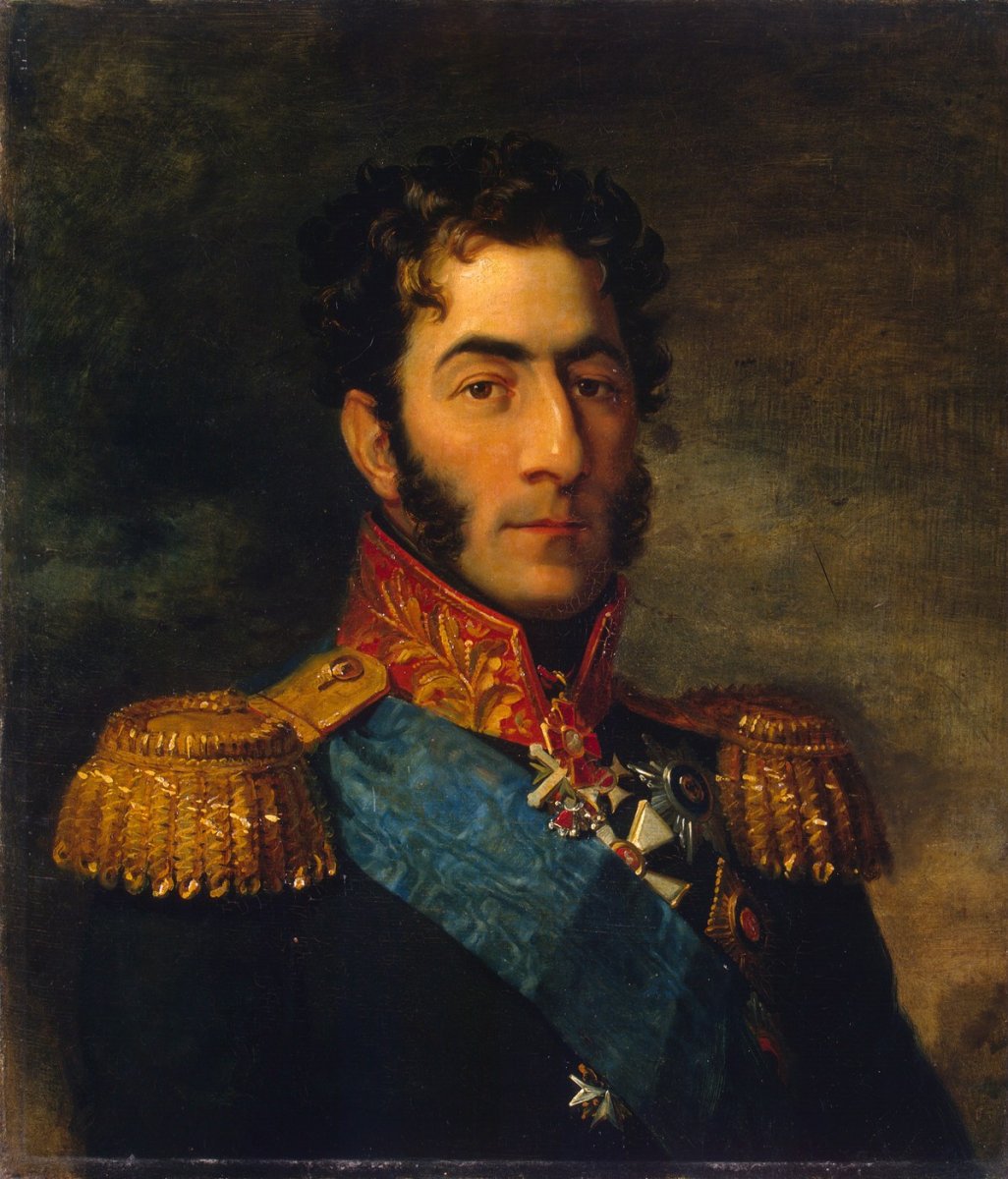
Known as the most aggressive general in the Russian army, he made his name in the least rewarded job of all, the rearguard. Twice he took on the task of keeping a withdrawing army alive, and twice he succeeded. That Russia could choose a war of not losing its army owes something to having a commander who made that choice possible.
What he actually did: withdraw with the army alive
Losing a battle and losing an army are different things. The first can be made good; the second cannot. What separates them is whether there is a force that keeps absorbing the pursuit for as long as the retreat lasts.
On 16 November 1805 at Schongrabern (Hollabrunn) Bagration led a rearguard of about 7,500 and held up Murat's pursuing cavalry. Murat, believing the Russian main body was in front of him, agreed to negotiate an armistice, and in that interval Kutuzov's army joined Buxhowden's reinforcements at Brunn[1]. A force placed there to be sacrificed saved the whole army.
The value of that work connects directly to the structure of the Russian campaign. For a side whose condition for victory is keeping its army, the rearguard is not an auxiliary role but the unit that executes the strategy itself.
Seven years of fighting the same enemy
In 1799 Bagration served in northern Italy under Suvorov - the counter-offensive of the War of the Second Coalition that all but cancelled what France had gained in 1796-97. Given both advance guard and rearguard, he was drilled in mountain manoeuvre.
He led the right wing at Austerlitz in 1805 and fought at Eylau in 1807. Few generals on the Russian side fought the same enemy for seven years. Knowing the opponent's hand is also what makes the weight of a decision to avoid battle intelligible.
The decisive moment: Borodino
In 1812 Bagration led the Second Western Army and withdrew several hundred kilometres before joining Barclay de Tolly's First Army. He objected strongly to the policy of withdrawal and relations between the two were tense - the most aggressive general in the army spent that year on the task that demanded the most patience.
At Borodino on 7 September he held the arrow-shaped earthworks, the fleches, on the southern wing. He absorbed repeated attacks by Davout and Ney for several hours until, at about eleven in the morning, a shell fragment shattered his left leg. Gangrene set in after the operation and he died on 24 September[2].
The left wing was shaken by the loss of its commander but did not collapse. It fell back to the line of the Semyonovka and reformed. That the Russian army did not lose that day rests on this kind of accumulated holding on.
Limits, or how it ended
Bagration's death was an expensive price for Russia. The army survived it all the same, and the war went on. Beaten while leading the right at Austerlitz, in action again at Eylau, and finally struck down at Borodino - for seven years he held the same role against the same enemy.
What he embodied was not the craft of winning but the craft of choosing how to lose. For a side that cannot win on the field, the road to winning the war exists only on top of that craft.
Sources
- J. Rickard, Combat of Hollabrunn, 15-16 November 1805, History of War.
- Encyclopaedia Britannica, Pyotr Ivanovich, Knyaz Bagration.
- The Napoleon Series, Russian Generals of the Napoleonic Wars: General Peter Bagration.
Apparaît dans les batailles
- 1805-12-02
-
1807-02-08
La bataille d'Eylau (1807) — Le jour où la méthode de Napoléon échoua à produire une décisionRôle : Russian formation command
-
1807-06-14
Bataille de Friedland (1807) — Quand les conditions reviennent, la méthode de Napoléon retrouve sa forme achevéeRôle : Left wing (south; destroyed in the bend of the river)
-
1812-09-07
Bataille de la Moskova (1812) — pourquoi le jour le plus sanglant ne décida de rienRôle : Second Army; left wing (severely wounded at the fleches, later died)