France · V Corps Commander
Jean Lannes
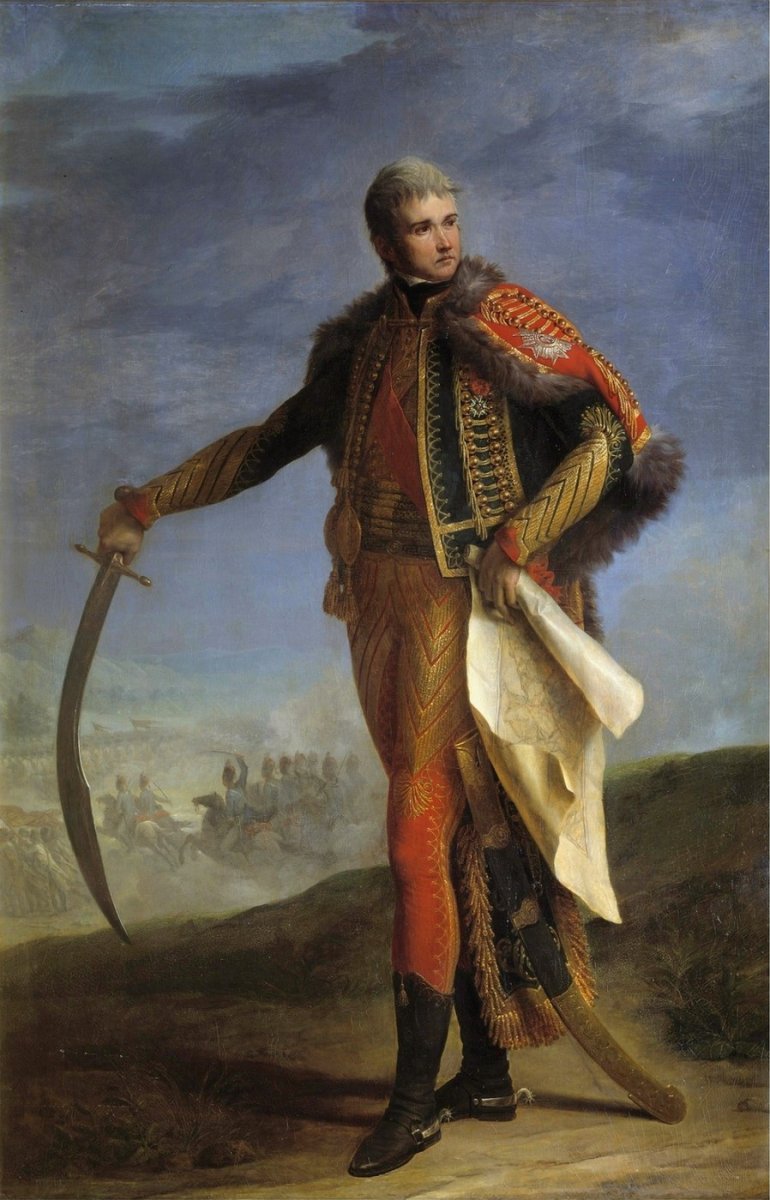
The marshal entrusted again and again with the advance guard and the breakthrough. He is easily written up as a man of courage alone, but what was actually valued in him was that he could judge for himself where to attack. Give him a task with the Emperor nowhere near and he would still hit the right place - and while that layer of men was thick, the method worked.
What he actually did: breakthrough with judgement
A breakthrough does not come off on courage. Get the point, the moment or the weight wrong and the troops dissolve in the fire in front of them. From the first Italian campaign onwards, Lannes was among those trusted with that judgement.
At Jena in 1806 he took the heights as advance guard and made the footing on which the rest could deploy. At Friedland in 1807 he held the Russians for several hours while outnumbered, buying the time for the Emperor's main body to arrive. Attacking and enduring to make time were used by the same man as the situation required.
This is the kind of commander the corps system assumed. Handing over the structure is not enough; only when there are people who can work the structure on their own judgement does a dispersed army move as one intention.
The battle that gave him a name, and the work that did not
At Montebello on 9 June 1800 Lannes held on while outnumbered and won, and the place-name later became his title[2]. It was five days before Marengo and served as the outpost action of that campaign.
His career also holds much that is not glamorous. From the end of 1808 into February 1809 he directed the siege of Saragossa, a fight taken house by house through the town[3]. An army that wins by movement still needs people where movement does not work - the fighting in the Peninsula in these years showed that first.
The decisive moment: May 1809
Aspern-Essling, on 21-22 May 1809, was the first pitched battle Napoleon lost. The pontoon bridges were destroyed during the crossing of the Danube and the troops who had got over were left isolated. On that field Lannes was mortally wounded in both legs by a cannon shot, and after amputation he died on 31 May[1]. He was the first marshal to be killed in action.
As noted under the War of the Fifth Coalition, Lannes was not at Wagram six weeks later. 1809 was the year the method turned towards attrition, and also the year the men who had carried it out began to be missing.
The hole never filled
No commander appeared afterwards to hold the same role at the same level. Bessieres was lost in 1813, Poniatowski the same year, and Davout was posted to Paris in 1815. By the Hundred Days, almost none of the men of 1805 were on the field.
The death of Lannes was the first line to disappear from that roster. Individual deaths may be chance; the failure to replace them is structural. Across twenty years this army never succeeded in reproducing its layer of executants.
Limits, or how it ended
The story that the Emperor wept over his body is widely repeated, though the strength of contemporary evidence for it varies. What is certain is that his death was not merely the loss of an able man but the loss of part of the method's premise.
Sources
- J. Rickard, Marshal Jean Lannes, 1769-1809, History of War.
- Napoleon & Empire, Jean Lannes, French Marshal.
- David G. Chandler, The Campaigns of Napoleon, Macmillan, 1966.
Apparaît dans les batailles
-
1796-05-10
La bataille de Lodi (1796) — L'assaut du pont et la naissance du « Petit Caporal »Rôle : Led the second wave
-
1800-06-14
Bataille de Marengo (1800) — Comment une quasi-défaite fut réécrite en piège planifiéRôle : Advance guard and centre
-
1805-12-02
La bataille d'Austerlitz (1805) — le chef-d'œuvre de Napoléon : faire vaincre l'ennemi par la conception de la situationRôle : V Corps (northern wing)
-
1806-10-14
La double bataille d'Iéna-Auerstedt (1806) — La bataille décisive fut celle où Napoléon n'était pasRôle : V Corps (led the way at Jena)
-
1807-06-14
Bataille de Friedland (1807) — Quand les conditions reviennent, la méthode de Napoléon retrouve sa forme achevéeRôle : Advance guard (half a day of holding action)